_2.png "Shadows ReadyTheme")
Solar Lighting for Dark Sky Communities: A Smarter Solution for Desert Parking Lots and Outdoor Spaces
Key Takeaways
- Dark-sky friendly lighting follows five principles published by DarkSky International and the Illuminating Engineering Society: light only what is needed, aim it down, keep it low, control it with timers or sensors, and keep it warm in color.
- For its DarkSky Approved seal, DarkSky caps color temperature at 3000K and lets a commercial fixture send no more than 0.5% of its light (50 lumens at most) above horizontal.
- Solar fixtures handle the "controlled" principle well: they switch on at dusk and many dim through the night or brighten only on motion.
- Color is where most solar parking lot lights fall short. Most ship at 4000K to 6500K; on our site the 20W pole light, the 15W bollard and two closeout heads can be ordered at 2700K or 3000K.
- "Dark sky compliant" means compliant with your local ordinance. Check the code, ask for the fixture's photometry file and confirm shielding before you buy.
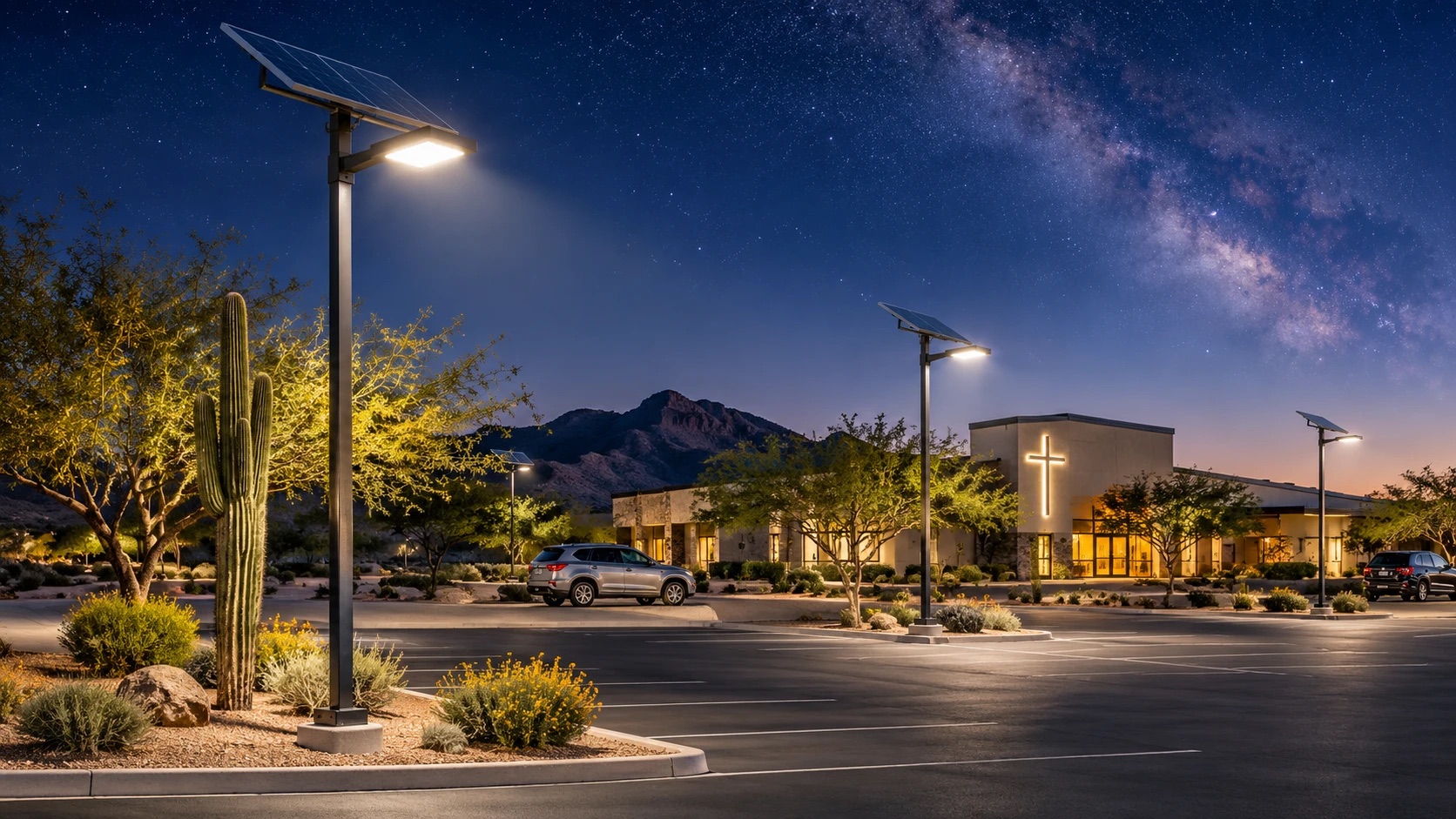
The short answer: solar lighting can work well in a dark sky community, as long as the fixture is aimed straight down, set to a warm color of 3000K or lower, and dimmed or motion-controlled late at night. Solar takes care of two problems at once. It needs no trench across the lot and no utility connection, and its built-in controls make it easy to run light only when people are there. What it does not do on its own is guarantee compliance. That depends on the fixture's color, optics and shielding, the mounting height and your local ordinance.
This guide is for churches, shopping centers, HOAs and business owners with lots in desert communities, where clear skies, stargazing and nocturnal wildlife are part of the local identity. It walks through what dark-sky lighting means, what the DarkSky Approved criteria actually say, and which of the solar lights we sell come closest.
What "dark sky lighting" means
DarkSky International (formerly the International Dark-Sky Association) and the Illuminating Engineering Society jointly publish the Five Principles for Responsible Outdoor Lighting. Their one-line summary: light where you need it, when you need it, in the amount needed, and no more. Responsible outdoor lighting is:
| Principle | What DarkSky says | What it means for a parking lot |
|---|---|---|
| Useful | Use light only if it is needed; every light should have a clear purpose | Light drive aisles, entrances, walkways and the doors people use, not the whole property edge to edge |
| Targeted | Use shielding and careful aiming so light points down and does not spill beyond where it is needed | Flat, downward-facing heads; no tilting fixtures up to throw light farther; keep light off neighbors and open desert |
| Low level | No brighter than necessary; watch reflective surfaces | Pick the lowest output that does the job; pale concrete reflects more light upward than dark asphalt |
| Controlled | Use timers or motion detectors so light is dimmed when possible and off when not needed | Dim after the last service or closing time, and brighten on motion |
| Warm-colored | Limit shorter-wavelength (blue-violet) light | Choose 3000K or lower; amber sources (around 1800K to 2200K) go further |
Source: DarkSky International and IES, Five Principles for Responsible Outdoor Lighting, updated September 2026.
DarkSky's reasoning is simple: when we over-light, aim light upward, skip timers and sensors, or use the wrong color, the night environment suffers. Its luminaire program page lists the costs as disrupted wildlife, effects on human health, wasted money and energy, and a lost view of the stars. In desert communities, where many residents moved for the night sky, those costs are easy to see.
What the DarkSky Approved seal requires
"Dark sky compliant" is used loosely online. The closest thing to a national benchmark is DarkSky's own certification, the DarkSky Approved Luminaires program. Its guidelines, version 3.1 from October 2025, set these limits for commercial luminaires, the category that covers parking lots, streets and public spaces:
| Criterion | Limit for commercial luminaires |
|---|---|
| Uplight (light above horizontal) | No more than 0.5% of the fixture's lumens, and never more than 50 lumens; fixtures of 1,000 lumens or less may emit 5 |
| Color temperature | Nominal 3000K or lower |
| Fixtures with selectable color | Not eligible if any option is above 3000K |
| Dimming | Must dim to 10% of full output or less |
| Shielding | Pole-mounted street, area and parking lot fixtures must offer a shield option on the data sheet |
Source: DarkSky Approved Luminaires Guidelines, v3.1. A separate Pedestrian Comfort category, for walkways and local streets, also caps output at 10,000 lumens and adds limits on high-angle light.
Two things follow for buyers. First, the seal is a product certification: the manufacturer applies, pays a fee and renews it every year, and DarkSky keeps a searchable list of approved fixtures. Second, a lot can meet a local dark-sky ordinance without sealed fixtures, because most ordinances set their own rules for shielding, color and lumens. When an ordinance or a planning reviewer asks for "DarkSky Approved" by name, you need a fixture on DarkSky's list.
Why solar fits dark sky communities
Desert communities that protect their skies tend to have two other things in common: lots of sun, and long distances between a parking lot and the nearest power. Solar answers both.
- No trenching. Each pole carries its own panel and battery, so there is no trench through landscaping or asphalt and no new utility service. That matters most in rocky desert ground and on sites where the building sits far from the lot.
- No draw from the grid for those fixtures. The lights run on what their own panels collected that day. The pole and parking lot lights in this guide list charging times of 5 to 7 hours of bright sunlight, which desert sites get most of the year.
- Controls are built in. Our solar fixtures switch on at dusk and off at dawn by themselves, and most dim through the night or brighten on motion. That covers DarkSky's "controlled" principle without a separate timer or sensor.
The trade-off is output. Solar heads put out less light than the largest wired fixtures, which in a dark sky community is often the point. For lot-by-lot sizing, see our solar parking lot lighting guide.
Color temperature: where most solar lights miss
Most solar parking lot lights, ours included, ship in cool white because cool white gives the most lumens per watt. That is the opposite of what DarkSky asks for. Here is the warmest setting each of our solar fixtures can be ordered in, against DarkSky's 3000K limit:
Why color matters: DarkSky's fifth principle asks owners to limit shorter-wavelength, blue-violet light to the least amount needed, and the lower the color temperature, the less of it a white LED gives off. DarkSky's own definitions put 2700K to 3000K at "warm white," like an incandescent bulb, and 1800K to 2200K at very warm or amber. Its wildlife-tuned category goes further and allows only light at 560 nanometers or longer, which is amber. If your code calls for amber, none of the solar heads above qualifies; tell us what the code requires and we will tell you what we can supply.
The solar lights we would start with

Four of our solar fixtures can be ordered at 3000K or warmer. All four are listed below with what their product pages state, checked November 9, 2026.
20W Solar LED Pole Light
The 20W pole light is the easiest dark-sky pick we carry: 2700K is a standard option on the order form. It puts out 3,000 lumens and has three night modes. Mode 1 runs at 30% all night and jumps to full brightness on motion, which is the most dark-sky friendly setting. It fits 2 3/8 to 3 inch poles and suits entrances, walkways, mail kiosks and smaller lots. $499.99 each, $449.99 at 10 or more, with a 1-year warranty. One caution for low-desert sites: its listed operating range tops out at 113°F, so ask us about heat before you order for a lot that bakes in summer.
15W Solar LED Bollard
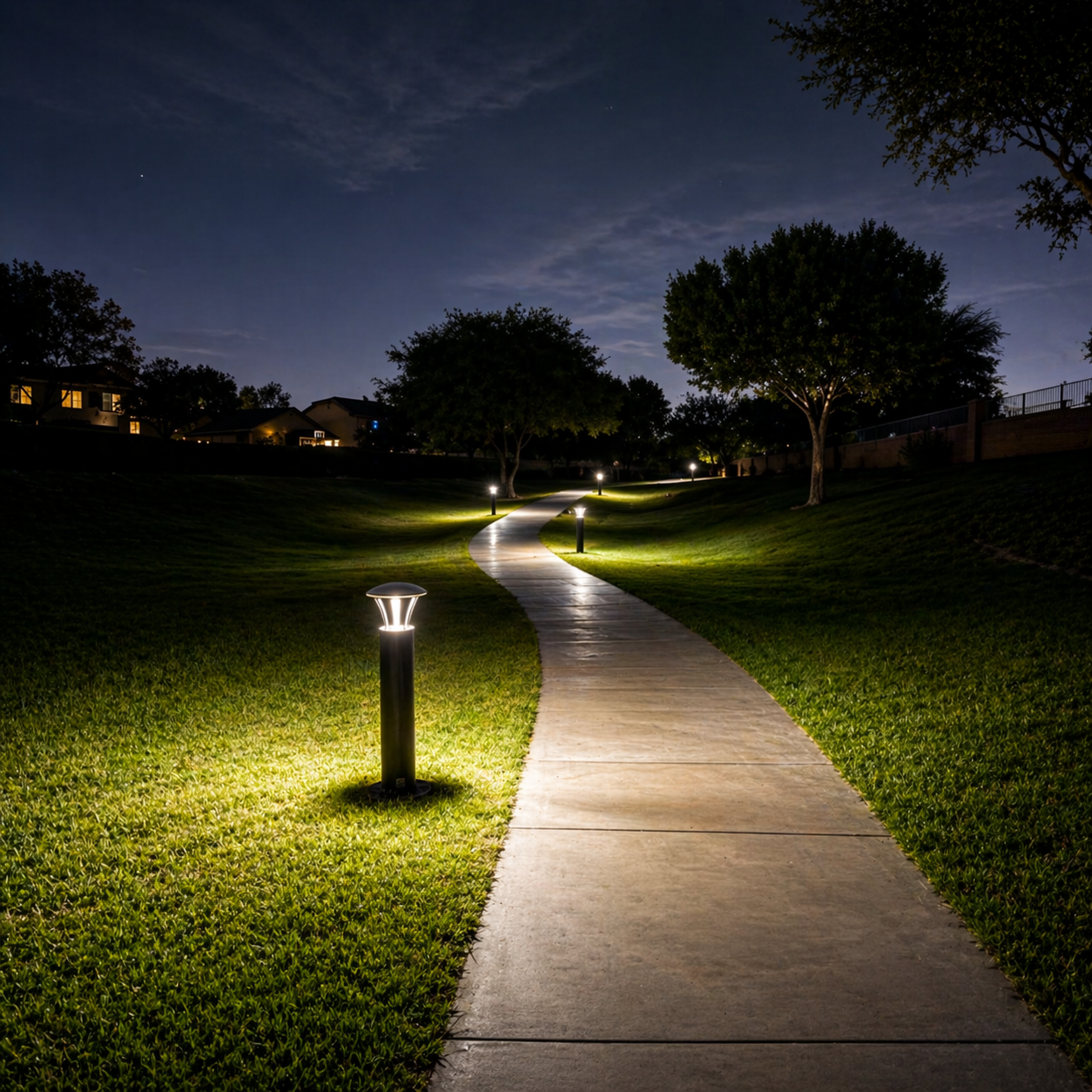
For paths between the lot and the building, the 15W bollard keeps light at knee height, where it lights the walk without reaching the sky or neighbors' windows. Color is selectable between 3000K and 5000K; set it to 3000K. Output is a modest 350 lumens with a 360° Type V spread, powered by a LiFePO4 battery. It stands 35.4 inches tall. $599.99 on sale (regularly $649.99), $584.99 at 10 or more, 2-year warranty.
30W and 120W solar parking lot heads (closeouts)
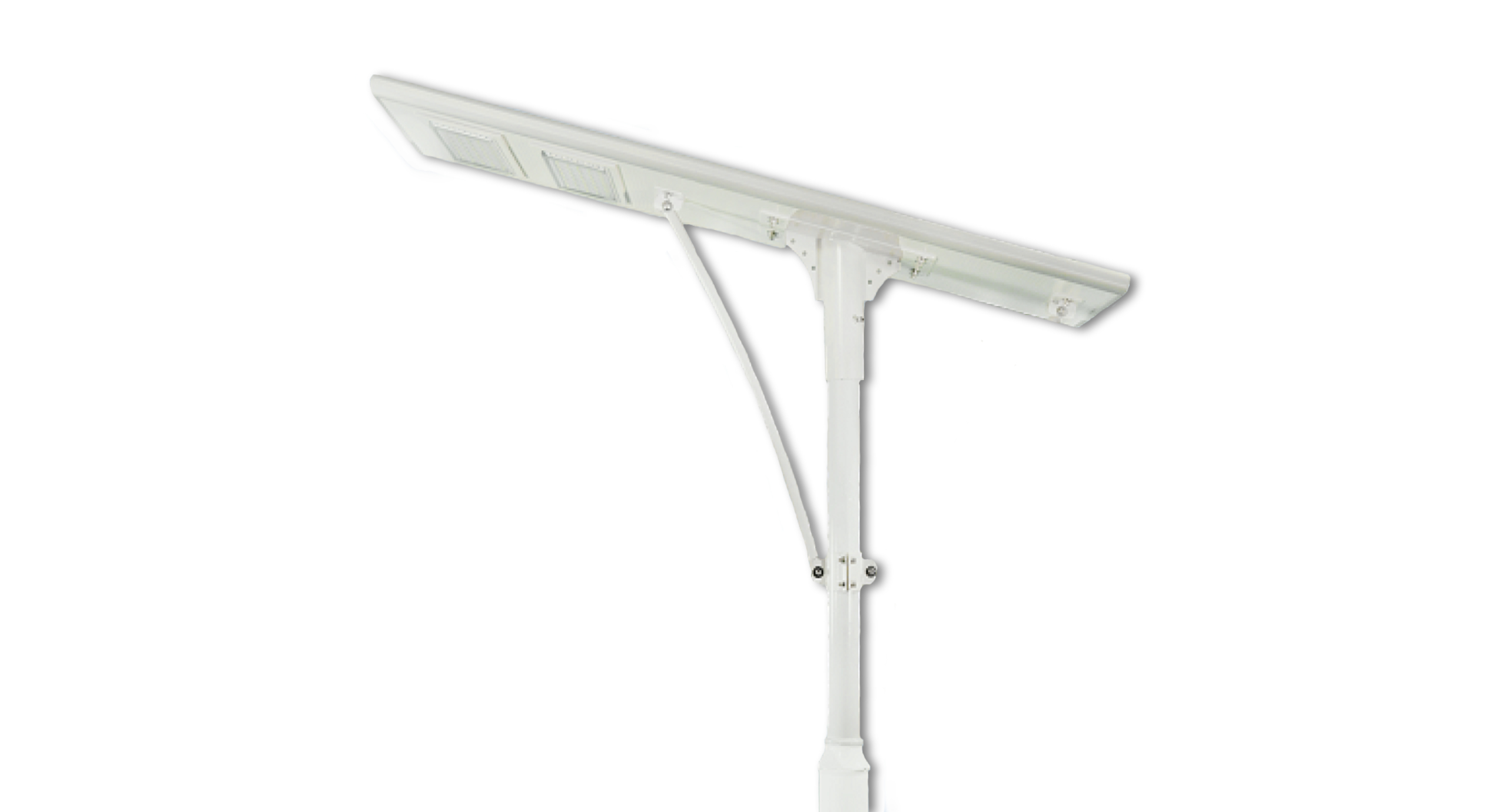
Two of our parking lot heads list 2700K among their color options (5000K is standard, so ask for 2700K when you order). Both are marked "Limited stock, Last Chance."
- The 30W solar parking lot light: 3,300 lumens, 15 to 20 ft mounting, IP65, Bluetooth app control (Android only), 3-year limited warranty, $449.99. Six were available on November 9.
- The 120W solar parking lot and street light: 18,000 lumens, 30 to 36 ft mounting, IP65, 3-year limited warranty, $779.99 (was $1,299.99). Its factory dimming profile steps down from 70% to 15% over the first six and a half hours of the night and is adjustable in its app. Twenty-five were available on November 9.
Both product pages include a photometry (IES) file, which is what a lighting designer or planning reviewer uses to check uplight, spill and light levels on your site plan.
| Fixture | Lumens | Color | Night controls | Price |
|---|---|---|---|---|
| 20W pole light | 3,000 | 2700K | 30% all night, full on motion | $499.99 |
| 15W bollard | 350 | 3000K | ASW 3.0 energy saving | $599.99 |
| 30W lot light (closeout) | 3,300 | 2700K | Phone app (Android) | $449.99 |
| 120W lot light (closeout) | 18,000 | 2700K | Steps down to 15%, set in app | $779.99 |
Specifications and prices from ledlighting-solutions.com product pages, November 9, 2026. Lumens are as listed on each page; warm color settings can produce somewhat less light than the standard setting. Poles and installation are not included.
Not on this list: our 100W and 12,000-lumen 120W heads (4000K) and our 80W and 100W motion-sensor heads (6500K). They are good lights for an ordinary commercial lot, and the motion models dim well, but their color is above the dark-sky limit. Browse the full solar parking lot and street light range and our area and walkway lights.
A dark-sky checklist for a desert lot
- Read your local code first. Many desert towns and counties have outdoor lighting ordinances that set shielding, color and total-lumen limits, and some apply only in certain zones. Borrego Springs in San Diego County, for example, has been a DarkSky-designated Dark Sky Community since 2009 and has its own lighting ordinance. Your planning department is the final word.
- Light only what people use. Mark the drive aisles, the entrance, the accessible stalls and the walk to the door. Leave landscaped edges and open desert dark.
- Choose 3000K or warmer. Order the warm option, and say so on the purchase order so the standard cool white does not ship by default.
- Mount flat and aim down. Keep the head level on the pole. Tilting a head up throws light farther, and that light ends up in the sky and in neighbors' yards.
- Ask about shielding. DarkSky expects pole-mounted parking lot fixtures to offer a shield. None of our solar product pages lists one today, so if your code requires house-side shields, ask us before ordering.
- Set the dimming. Use a motion mode or a stepped profile so the lot runs low after the last service, event or closing, and brightens only when someone arrives.
- Get the photometry checked. Send the IES file and your site plan to whoever reviews your lighting permit. They can confirm uplight, spill at the property line and light levels before anything goes in the ground.
For a church, the same steps fit the calendar: full light for evening services and events, then motion-only light the rest of the night. For an HOA, warm 20W pole lights at the entrance and bollards along the paths keep the neighborhood's look and its view of the stars. Our guide to solar lamp posts for HOAs covers spacing and budgets for those spaces.
Frequently asked questions
What does dark sky compliant lighting mean?
It means outdoor lighting that meets a dark-sky standard, usually a local outdoor lighting ordinance or DarkSky International's DarkSky Approved criteria. In practice that means fixtures aimed down with little or no light above horizontal, a warm color of 3000K or lower, no more light than the task needs, and timers, dimming or motion sensors so lights are low or off when nobody is there.
What is a certified dark sky place?
DarkSky International designates International Dark Sky Places, including Dark Sky Communities, Parks and Reserves, that protect their night skies through lighting policy and public education. Borrego Springs, California, surrounded by Anza-Borrego Desert State Park, was designated a Dark Sky Community in 2009.
What color temperature is dark sky friendly?
DarkSky's Approved Luminaires program caps color temperature at a nominal 3000K, and its guidelines describe 2700K to 3000K as warm white and 1800K to 2200K as very warm or amber. Some ordinances near observatories require amber. Check your local code for the exact limit.
Are solar parking lot lights dark sky compliant?
Some can be set up to follow dark-sky principles, but solar alone does not make a light compliant. The fixture still has to face down with minimal uplight, run at 3000K or warmer, offer shielding where the code requires it, and dim when the lot is empty. Most solar parking lot lights ship in cool white, so order a warm option.
What is the rule of thumb for outdoor lighting?
DarkSky and the Illuminating Engineering Society sum it up as light where you need it, when you need it, in the amount needed, and no more. Aim light down, use the lowest level that works, add timers or motion sensors, and choose warm colors.
What are the best solar dusk-to-dawn lights for a dark sky area?
Look for a fixture with a flat, downward-facing head, a 3000K or warmer option, and a dimming or motion mode. On our site, the 20W solar LED pole light comes in 2700K with a 30% all-night motion mode, and the 15W solar bollard can be set to 3000K for paths.
Do dark sky lights have to dim at night?
DarkSky's Approved Luminaires program requires fixtures to dim to 10% of full output or less, and its fourth principle asks that light be dimmed when possible and off when not needed. Some local ordinances also set hours for non-essential lighting, so check yours. Solar fixtures with motion modes or stepped dimming profiles make that easy.
Are your solar lights DarkSky Approved?
No. None of the solar lights on our site lists the DarkSky Approved seal today. Several can be ordered at 2700K or 3000K and dim through the night, which follows DarkSky's principles, but if your project specifies DarkSky Approved fixtures by name, use a fixture from DarkSky's approved list.
- DarkSky International and Illuminating Engineering Society, Five Principles for Responsible Outdoor Lighting (updated September 2026): https://darksky.org/resources/guides-and-how-tos/lighting-principles/
- DarkSky International, DarkSky Approved Luminaires program: https://darksky.org/what-we-do/darksky-approved/darksky-approved-luminaires-program/
- DarkSky International, DarkSky Approved Luminaires Guidelines, version 3.1 (October 2025), sections on commercial luminaires, CCT and dimming: https://darksky.org/what-we-do/darksky-approved/darksky-approved-luminaires-program/darksky-approved-luminaires-guidelines/
- DarkSky International, Borrego Springs, California, Dark Sky Community (designated 2009): https://darksky.org/places/borrego-springs-dark-sky-community/
- LED Lighting Solutions product specifications, prices and stock notes, November 9, 2026