My Cart: 0 item(s)
_2.png "Shadows ReadyTheme")
Solar Lamp Posts and Pole Lights for HOAs: Decorative Community Lighting Without Trenching
Key Takeaways
- A commercial solar pole light carries its own panel, battery and LED head on top of a standard pole. There is no trench, no wire, no meter and no monthly bill for that light.
- Trenching alone runs about $5 to $12 per linear foot, and $13 to $40 in hard ground, before wire, conduit, an electrician or a utility hookup. A 600 ft run is $3,000 to $7,200 just to dig.
- Big-box solar lamp posts are mostly accent lights. For an entrance, private road or mail kiosk, look for a rated output in the thousands of lumens, like our 20W solar pole light at 3,000 lumens.
- A common target for residential walkways is 0.4 foot-candles on average. As a planning estimate, one 3,000 lumen light covers about 3,750 square feet at that level.
- Choose warm white (2700K or 3000K) for homes and entrances and bright white (5000K) for parking and security areas.
Yes, an HOA can light its entrance, private roads, mail kiosks and common areas with solar lamp posts and never dig a trench. A commercial solar pole light is a self-contained fixture: a solar panel charges a battery during the day, and an LED head runs from that battery at night, switching on at dusk by itself. It mounts on a standard 3 inch round pole, so each light needs only a pole foundation, not a trench back to a power source. That takes the biggest costs out of community lighting: digging, conduit, wire, an electrician's time and a utility connection, plus the electricity bill for those lights afterward. This guide shows the board what trenching really costs, how much light each part of the community needs, which fixtures fit where, and the trade-offs to plan for.
Solar lamp post vs. commercial solar pole light
Search for "solar lamp post" and most results are lantern-style posts sold for a front yard, often with a planter base. They are pleasant accent lights for a garden bed. They are not built to light a community entrance or a private road. When you compare, look for three numbers on the product page:
- Rated lumens. This is how much light the head produces. Entrance and road fixtures should be rated in the thousands.
- Battery and panel size. Bigger panels and batteries carry the light through long winter nights and cloudy spells.
- Mounting height and pole size. Commercial heads mount on 10 to 12 foot poles and spread light over a much wider area than a 5 foot yard post.
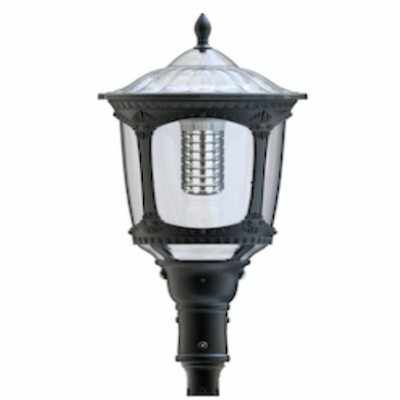
Our lead fixture for communities is the 20W solar powered LED pole light: 3,000 lumens, a 12.5 W monocrystalline panel, a choice of 2700K warm white or 5000K bright white, and a fit for 2 3/8 to 3 inch poles. It is $499.99 each, or $449.99 each for 10 or more, as of October 2026.
It has three night modes, set with a button on the fixture:
- 30 percent all night, rising to full brightness when motion is detected.
- 100 percent for the first 5 hours, then 25 percent (full brightness on motion).
- 70 percent all night.
The product page rates it for up to 4 to 7 nights on a full charge and 5 to 6 hours of bright sun to recharge.
What trenching costs, and what solar takes off the table
The expensive part of wired community lighting is rarely the fixture. It is getting power to it. HomeAdvisor's 2026 cost guide puts professional trenching at $5 to $12 per linear foot including equipment and labor, and $13 to $40 per foot for extra-large or difficult digs. Trenching through finished landscaping, under sidewalks or across a paved road costs more again, and the board still has to pay for conduit, wire, an electrician, permits and a utility connection on top.
Worked example: entrance, mail kiosk and four road lights
- Six lights spread along about 600 feet of entrance drive and private road.
- Wired: 600 ft of trench x $5 to $12 per foot = $3,000 to $7,200 for digging alone. In rocky or hard ground at $13 to $40 per foot, the same run is $7,800 to $24,000.
- Solar: six 20W solar pole lights at $499.99 each = $2,999.94 for the fixtures, with no trench. Each light still needs a pole and a foundation, which a wired light needs too.
Trenching rates from HomeAdvisor's trenching cost guide (updated June 2026). Wire, conduit, labor, permits and utility charges for the wired option are not included, so the true gap is wider. Poles are quoted on request.
The electricity saving is real but smaller, and boards should hear the honest number. A wired 25 W LED fixture running 12 hours a night uses about 110 kWh a year. At the U.S. average commercial rate of 14.19 cents per kWh, that is about $16 a year per light, or about $93 a year for six. The big saving with solar is up front: no trench through the landscaping, no new meter, and no electrician on site.
25 W x 12 hours x 365 nights = 109.5 kWh a year. Rate: U.S. Energy Information Administration, Electric Power Monthly, Table 5.6.A, commercial sector, June 2026. Your utility's rate will differ.
How much light does each part of the community need?
There is no single legal light level for a private HOA, so borrow from public standards. The City of San Diego's Street Design Manual, which follows the Illuminating Engineering Society's roadway lighting practice (RP-8), sets pedestrian-scale lighting at an average of at least 0.4 foot-candles on residential sidewalks, 0.6 in mixed-use areas and 0.9 in commercial areas.
A foot-candle is one lumen per square foot. Not every lumen from a pole light lands on the ground you care about, so a simple planning assumption is that about half does. That gives a quick estimate:
Area lit (sq ft) = rated lumens x 0.5 / target foot-candles
So a 3,000 lumen pole light covers about 3,000 x 0.5 / 0.4 = 3,750 square feet at a residential 0.4 foot-candles, or about 1,670 square feet at a brighter 0.9 foot-candles.
Which light goes where
| Area | Suggested fixture and mounting | Area lit at 0.4 fc |
|---|---|---|
| Entrance monument and gate | 20W solar pole light on a 10 to 12 ft pole; two heads on a dual-head arm for a grander look | 3,750 sq ft per head |
| Mail kiosk | 20W solar pole light on a 10 to 12 ft pole, in motion mode so it brightens when residents arrive | 3,750 sq ft |
| Private road corners and curves | 20W solar pole light on a 12 ft pole, or 18W solar walkway light at 12 to 18 ft | 3,125 to 3,750 sq ft |
| Parks, pool decks and common areas | 30W solar post top area light, 360 degree, at 9 to 12 ft on a 2 3/8 in pole | 3,750 sq ft |
| Walking paths | 15W solar walkway light at 6 to 12 ft, or 15W solar bollard for low, glare-free path light | 2,625 sq ft (walkway), 440 sq ft (bollard) |
| Clubhouse parking | Solar parking lot light, sized to the lot (see our parking lot guide) | Depends on lot size |
Planning estimates only: area = lumens x 0.5 / 0.4 foot-candles. Real coverage depends on mounting height, optics and surroundings. Specifications from our product pages, checked 14 October 2026.
Area math gives the minimum number of lights, not the spacing. On a private road, lights 150 feet apart give pools of light with darker gaps between them, which is how many communities light roads: at the entrance, intersections, curves and the mail kiosk. If the board wants continuous, even light along a road or path, place fixtures closer together and ask us for the fixture's photometric file before you finalize the plan.
For the clubhouse or amenity lot, our solar parking lot lighting guide sizes fixtures by lot size, and the parking lot signs guide covers the signs the lot needs.
Making it look like part of the neighborhood
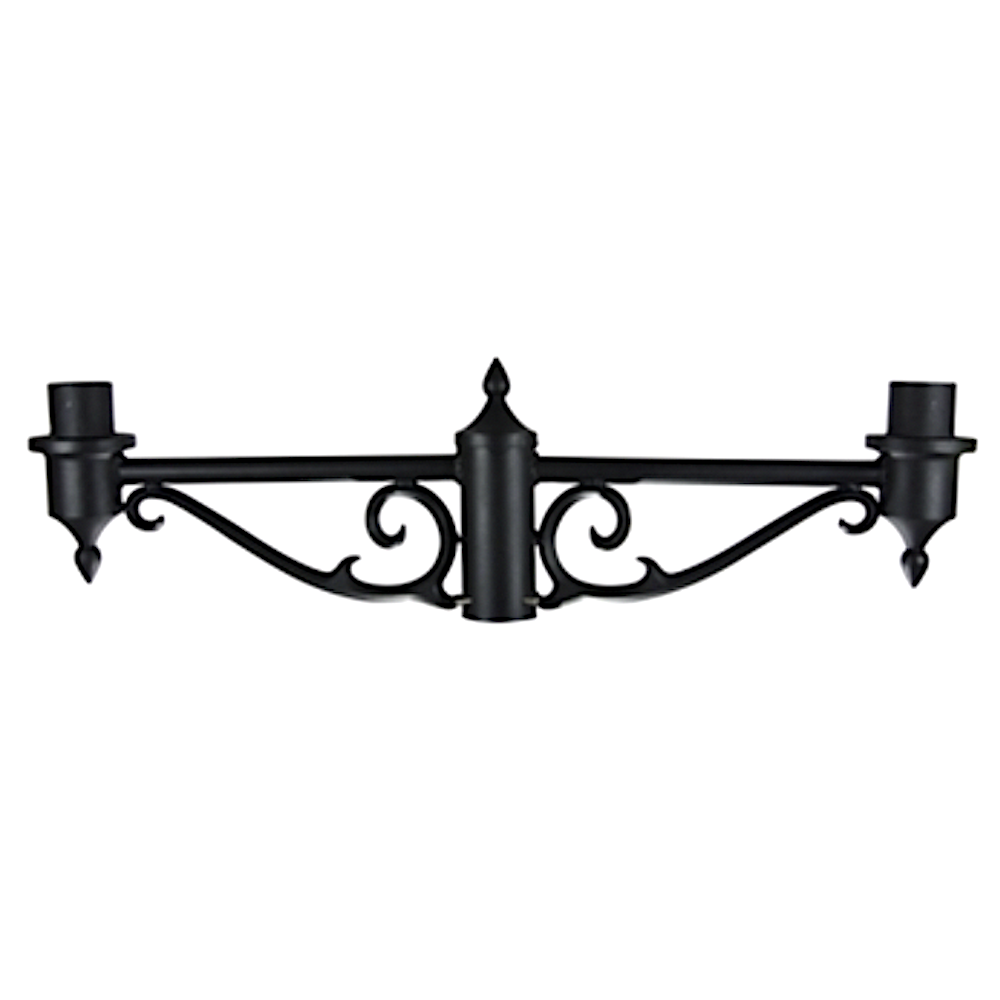
Board members usually care as much about how the lights look by day as how they work at night. Three pieces dress up a solar pole:
- Black round aluminum poles. Our 10 ft and 12 ft aluminum 3 inch round poles come in matte or glossy black (quoted on request).
- A decorative base cover. The base cover for 3 inch poles hides the anchor bolts with a two-piece black powder-coated shroud ($299.99).
- A dual-head arm. The decorative dual-head arm bracket ($699.99) carries two fixtures on one pole for a formal entrance. The second light head is sold separately.
Color temperature matters too. Warm white (2700K on the 20W pole light, 3000K on the bollard) reads as residential and inviting, the way most neighborhood porch lights look. Bright white (5000K) looks crisper and suits parking, gates and security areas. Many communities use warm white at the entrance and along homes, and bright white at the amenity lot.
The trade-offs to plan for
- Sun exposure. Each panel needs open sky. Mature trees, tall buildings and the north side of structures cut charging. Pick pole locations with the panel in mind.
- Winter nights. Long nights and short days drain batteries faster. The dimming and motion modes exist for this; a light that runs at 30 percent and jumps to full on motion goes much further than one at 100 percent all night.
- Batteries are a wear item. The 20W pole light's page lists battery life at 3 to 5 years and the warranty at 1 year; the 15W bollard carries 2 years and the 30W post top 3 years. Budget for battery replacement in the reserve study.
- Light output per pole. A solar pole light is not a 150 W street light. It is right for entrances, kiosks, paths and pools of light along a road, not for floodlighting a large field.
For the budget meeting: a summary the board can lift
- Solar pole lights mount on standard poles with their own panel and battery: no trench, no wire, no meter, no monthly bill for those lights.
- Trenching alone costs about $5 to $12 a foot in normal soil and $13 to $40 in hard ground (HomeAdvisor, 2026), before conduit, wire, electrician, permits and utility hookup.
- Our 20W solar pole light puts out 3,000 lumens, in warm white (2700K) or bright white (5000K), at $499.99, or $449.99 each for 10 or more (October 2026).
- Planning target: about 0.4 foot-candles on residential walkways (City of San Diego, following IES RP-8); one 3,000 lumen light covers roughly 3,750 sq ft at that level.
- Plan for battery replacement every 3 to 5 years and keep panels clear of shade.
Lighting your community? Tell us what you need to light (entrance, roads, mail kiosk, paths, common areas), roughly how big each area is and where the community is, and we will recommend fixtures and quantities. Contact us or call 888-925-1966. Browse all of our solar lighting and property management products.
Frequently asked questions
How much does it cost to install a lamp post?
For a wired lamp post, the trench is often the biggest cost: about $5 to $12 per linear foot for professional trenching, or $13 to $40 in hard ground, before wire, conduit, an electrician, permits and a utility connection. A solar lamp post skips the trench. Our 20W solar pole light is $499.99, or $449.99 each for 10 or more as of October 2026, plus the pole and its foundation.
How do solar lamp posts work?
A solar panel on the fixture charges a battery during the day. At dusk, a light sensor switches on the LED head, which runs from the battery all night. Commercial models add dimming and motion modes, so the light can run dim and brighten when someone walks or drives by, which stretches the battery through long nights.
How bright should a solar lamp post be for an HOA?
For entrances, mail kiosks and private roads, look for a rated output in the thousands of lumens; our 20W solar pole light is rated at 3,000. As a planning estimate, one 3,000 lumen light covers about 3,750 square feet at 0.4 foot-candles, a common target for residential walkways.
What is the downside of solar lights?
They depend on sun exposure, so shade from trees or buildings and short winter days reduce how long they run. Batteries wear out and need replacing every few years, and a single solar head puts out less light than a large wired street light. Good placement and dimming or motion modes handle most of this.
Are solar lamp posts supposed to stay on all night?
Commercial solar pole lights are designed to run from dusk to dawn, often at a reduced level for part of the night. Our 20W pole light can run at 30 percent all night with full brightness on motion, at 100 percent for 5 hours and then 25 percent, or at 70 percent all night.
How long do solar lamp posts last?
The LEDs last far longer than the battery. On our 20W solar pole light, the product page lists LED life at about 20 years and battery life at 3 to 5 years, with a 1-year warranty. Plan to replace batteries during the life of the fixture.
Should HOA street lights be warm white or bright white?
Warm white (about 2700K to 3000K) looks residential and is the usual choice near homes and at entrances. Bright white (about 5000K) looks crisper and suits parking areas, gates and security lighting. Our 20W solar pole light comes in 2700K or 5000K.
Do solar pole lights need a permit?
A solar pole light needs no electrical connection, so there is usually no electrical permit or utility work. Your city may still have rules for structures, lighting near streets or light that spills onto neighbors, and your HOA's own architectural rules apply, so check with the city and the board before you install.
Sources
- HomeAdvisor, How Much Does Trenching Cost? (updated June 2026)
- City of San Diego, Street Design Manual, Street Lighting: pedestrian-scale lighting levels (refers to IES RP-8)
- U.S. Energy Information Administration, Electric Power Monthly, Table 5.6.A
- LED Lighting Solutions product specifications and prices, October 2026