My Cart: 0 item(s)
_2.png "Shadows ReadyTheme")
Flashing LED Stop Signs: Do They Work, What to Look For, and What They Cost
Key Takeaways
- A flashing LED stop sign is a standard R1-1 stop sign with eight or more red LEDs in the border. It means exactly what a plain stop sign means; the flash exists so drivers see it in time.
- It works. Minnesota DOT measured a 41.5 percent reduction in right-angle crashes after LED stop signs were installed, and a Texas study found 52.9 percent fewer vehicles running the intersection without slowing.
- The specs that separate a ten-year sign from a two-year sign: 0.080-inch aluminum, 3M High Intensity Prismatic or Diamond Grade sheeting, an IP65 or better sealed junction box, and a lithium battery with five or more days of autonomy.
- Standard sizes are 24 inches (private roads and lots), 30 inches (public streets), and 36 inches (multi-lane and high-speed roads).
- Expect to pay $700 to $1,500 for a complete solar LED stop sign, or $700 to $900 for a retrofit kit that adds LEDs to a sign you already own.
- Installation takes about an hour on an existing post: mount the sign, mount the panel facing south, connect the plug, done.
What a flashing stop sign means

A flashing stop sign carries the same legal weight as a plain one. Drivers must come to a complete stop at the stop line or before the crosswalk and proceed when it is safe. The red LEDs flashing around the border do not change the rule; they change how many drivers actually see the sign in time to obey it. Do not confuse it with a flashing red traffic signal, which is also treated as a stop sign, or a flashing yellow signal, which means slow down and proceed with caution.
Do flashing stop signs work? The evidence

Most stop sign violations are not deliberate. Drivers miss the sign because it is hidden by foliage or a crest, because they are on a familiar road, or because they are looking at a phone. Unsignalized intersections accounted for 6,737 U.S. traffic deaths in 2018, 18.4 percent of all fatalities, according to research summarized by Carmanah Technologies.
| Study | Finding after LED stop signs were installed |
|---|---|
| Minnesota Department of Transportation | 41.5% reduction in right-angle crashes |
| Texas (Texas Transportation Institute) | 28.9% fewer vehicles failing to stop fully; 52.9% fewer passing through without significantly slowing |
| Virginia | Compliance improved further at night, when LEDs are most visible |
Source: Carmanah Technologies review of state DOT studies, January 2021.
The effect is largest on the worst behavior, the drivers who never slow at all, and it grows at night and in bad weather, which is when static signs fail most.
Where a flashing stop sign pays off
- Rural or suburban crossroads with approach speeds of 40 mph or higher
- Intersections where the sign is hidden until the last second by a curve, hill, or trees
- Locations with two or more reportable crashes in three years (the threshold several state guidelines use)
- School, campus, and hospital entrances with pedestrian traffic
- New stop signs where drivers are used to having the right of way
- Private roads and parking lots with a history of roll-through stops
If the problem is speed rather than a missed stop, a radar speed sign is the better tool. If it is a pedestrian crossing, see our solar flashing crosswalk signs.
How a solar LED stop sign works
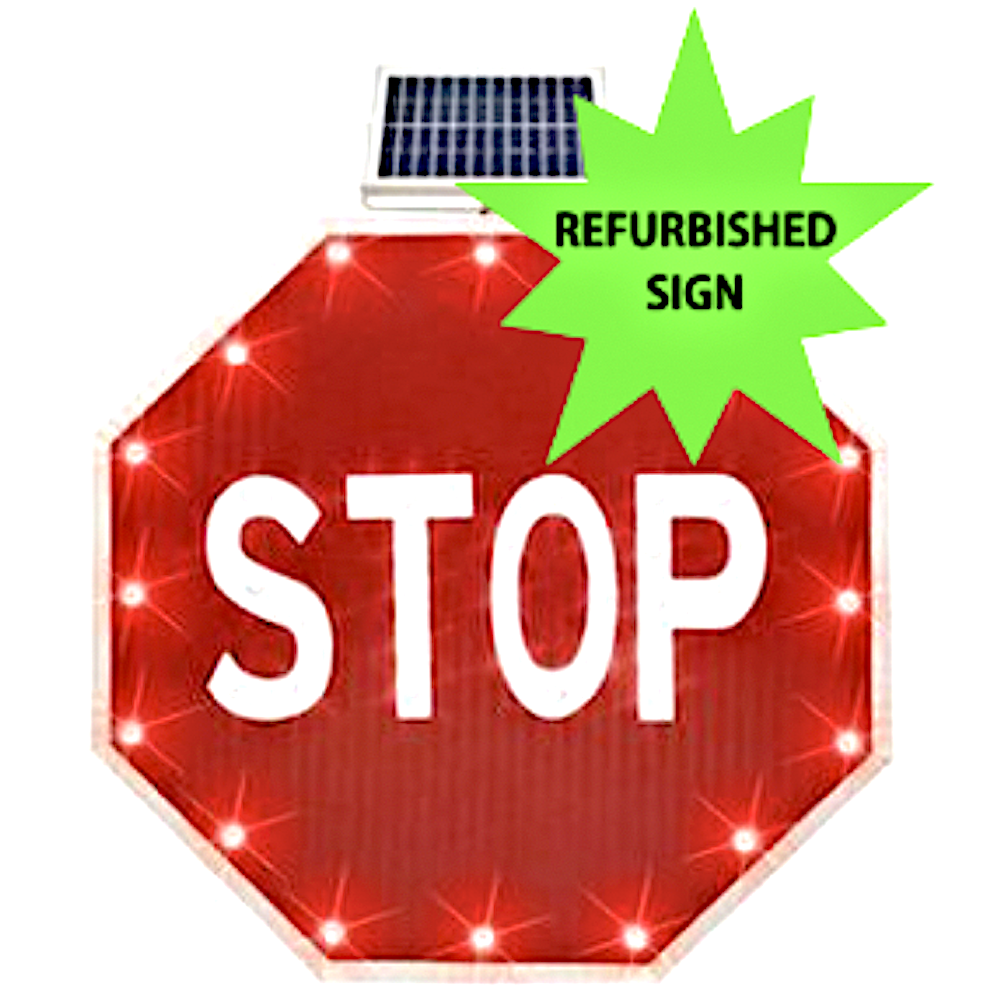
A solar flashing LED stop sign has four parts: the sign face, a ring of red LEDs set into the border, a solar panel, and a junction box with a rechargeable battery and controller. During the day the panel charges the battery. From dusk (or continuously, depending on the setting) the controller flashes the LEDs at 50 to 60 flashes per minute, the rate the MUTCD specifies.
Because everything is self-contained, there is no trench, no conduit, and no electric bill. A typical 5-watt panel keeps a lithium battery topped up through winter in most of the United States, with five or more days of reserve for cloudy stretches.
Some models add a vehicle-detecting radar or motion sensor so the LEDs flash only when a car approaches, which extends battery life and keeps neighbors happy.
Specs to check before you buy

| Spec | Look for | Why it matters |
|---|---|---|
| Sign face | MUTCD R1-1, 24 / 30 / 36 in. | Legal size and legend on public roads |
| Aluminum | 0.080 in. (0.100 in. for 36 in.) | Stays flat in wind, no rust |
| Sheeting | 3M High Intensity Prismatic or Diamond Grade | Reflectivity when the LEDs are off and for headlights |
| LEDs | 8 or more red, 50 to 60 flashes per minute | MUTCD flash rate; visibility beyond 2,500 ft |
| Solar panel | 5 W minimum, 8 to 20 W for northern sites | Winter charging |
| Battery | Lithium, 5+ days autonomy | Runs through cloudy weeks |
| Enclosure | IP65 or better, aluminum | Rain, snow, road spray |
| Operating range | -22 °F to 167 °F | Survives summer and winter extremes |
| Mounting | Pre-punched for U-channel and square posts | Fits existing posts |
Every LED Lighting Solutions solar flashing stop sign meets these specifications and ships with the panel, junction box, and brackets.
Which size do you need?

- 24 inch. Parking lots, private roads, campuses, and low-speed residential streets. Compact and the lowest cost. See the 24-inch solar flashing LED stop sign.
- 30 inch. The MUTCD standard for conventional public roads. If a municipality is buying, this is usually the size. See the Helios 30-inch solar flashing stop sign with Bluetooth control.
- 36 inch. Multi-lane roads, expressway ramps, and rural intersections with 50 mph or higher approach speeds. See the 36-inch flashing LED stop sign.
What LED stop signs cost
| Option | Typical price |
|---|---|
| 24-inch solar LED stop sign, complete | $700 to $1,000 |
| 30-inch solar LED stop sign, complete | $900 to $1,500 |
| 36-inch solar LED stop sign, complete | $1,100 to $2,000 |
| Retrofit LED kit for an existing sign | $700 to $900 |
| Push-button stop and pedestrian system | $2,500 to $4,500 |
LED Lighting Solutions catalog pricing and competing listings, September 2026. Posts and installation are extra.
For context, a Minnesota DOT study found LED stop signs cut right-angle crashes by 41.5 percent. One prevented injury crash covers the cost of a sign many times over.
Installation in four steps

- Mount the sign on a U-channel or square post at the MUTCD height: 7 feet to the bottom of the sign in areas with pedestrians, 5 feet in rural areas.
- Mount the solar panel above the sign, tilted about 45 degrees and facing south (in the Northern Hemisphere). Avoid tree shade.
- Connect the panel and sign to the junction box with the weatherproof plugs. Extension cables are available if the panel needs to sit higher for sun.
- Set the mode: continuous flash, dusk-to-dawn, or sensor-activated. Helios models are configured from a phone over Bluetooth.
Full instructions ship with every sign and are available on each product page under Documents.
Retrofit kit or new sign?
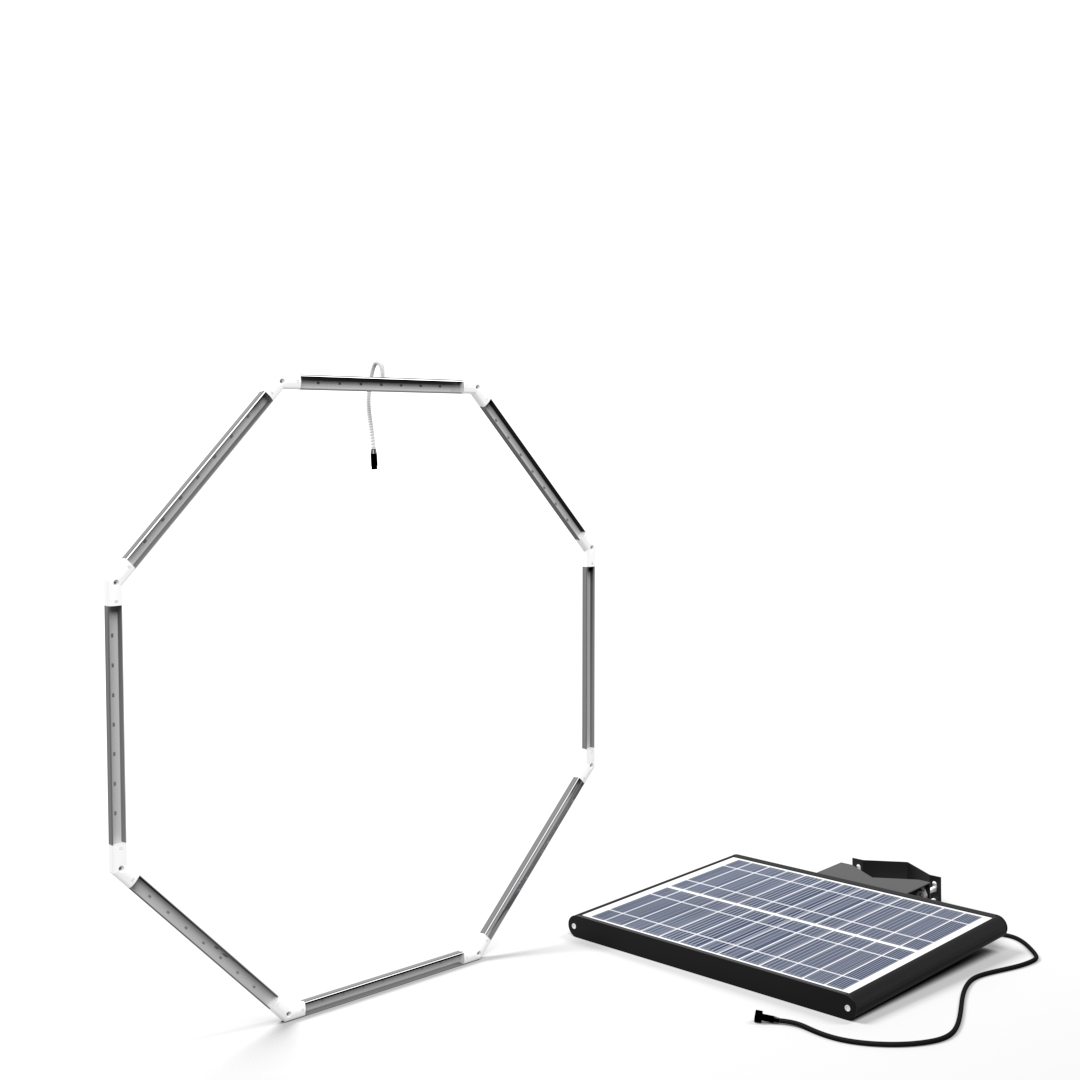
If your existing stop sign is in good condition (flat, reflective, correct size), a solar flashing octagon retrofit kit adds the LED ring, panel, and battery for less than a complete sign. If the sheeting is faded or the sign is dented, buy the complete unit; a dim face undermines the LEDs at night.
Frequently Asked Questions
What does a flashing stop sign mean?
It means stop, exactly like a standard stop sign. The flashing red LEDs around the border make the sign impossible to miss at night, in bad weather, or at intersections drivers do not expect.
Do flashing stop signs work?
Yes. Minnesota DOT measured a 41.5 percent reduction in right-angle crashes after installing LED-enhanced stop signs, and a Texas study found 52.9 percent fewer vehicles passing through without significantly slowing.
How do solar LED stop signs work?
A solar panel charges a battery during the day. A controller in the junction box flashes red LEDs in the sign border at 50 to 60 flashes per minute, either continuously, from dusk to dawn, or when a sensor detects a vehicle. No wiring or grid power is needed.
What size LED stop sign should I buy?
24 inch for parking lots and private roads, 30 inch for conventional public streets (the MUTCD standard), and 36 inch for multi-lane or high-speed roads.
How much does an LED stop sign cost?
Complete solar LED stop signs run about $700 to $2,000 depending on size. Retrofit kits that add LEDs to an existing sign cost $700 to $900.
How long does the battery last?
Most models run five or more days without sun on a full charge, and the lithium battery itself lasts three to five years before replacement.
Are LED stop signs legal on public roads?
Yes. The MUTCD 11th Edition permits red LEDs in the border of an R1-1 stop sign flashing 50 to 60 times per minute. The road authority must approve any sign on a public road.
Can I add LEDs to my existing stop sign?
Yes. A solar flashing retrofit kit mounts an LED ring, panel, and battery box to a standard 24-, 30-, or 36-inch stop sign that is already on a post.
Do LED stop signs work in winter?
Yes. Quality units are rated to -22 °F and use lithium batteries that hold charge in cold weather. A larger 8- to 20-watt panel is recommended for northern states with short winter days.
Need help choosing? LED Lighting Solutions stocks MUTCD-compliant solar signs, lighting, and work zone equipment and ships from our U.S. warehouse. Contact our team or call for volume pricing.