My Cart: 0 item(s)
_2.png "Shadows ReadyTheme")
Outdoor Basketball Court Lighting: Fixture Placement, Pole Height and How Many Lights You Need
Key Takeaways
- A full outdoor basketball court is usually lit with four poles about 20 feet tall, two on each sideline, carrying eight LED fixtures. With 300-watt shoebox lights that is about 358,000 lumens and 2,400 watts, enough for an estimated 23 foot-candles on the court.
- Recreational courts are designed to roughly 20 to 30 foot-candles. Industry summaries of the IES sports lighting practice put recreational (Class IV) basketball at 30 foot-candles; many residential guides use 200 to 300 lux, about 19 to 28 foot-candles.
- A half court needs about half the light: two poles and four fixtures. A driveway hoop can be lit from one pole with two fixtures.
- Keep poles along the sidelines, never behind the backboards, so a player looking up at the rim does not look into a light.
- Hardware for a full court runs about $2,240 to $3,480 in fixtures and brackets from LED Lighting Solutions (September 2026), plus poles, footings and wiring. Solar lights are fine for the path to the court but deliver roughly a tenth of the light a playable court needs.
An outdoor basketball court with no lights closes when the sun goes down, which in November is before most people get home from work. For an HOA, an apartment community or a park, lighting the court is often the single cheapest way to double how much it gets used. This guide covers how much light a court needs, how many fixtures that takes for a full court, half court or driveway, where the poles go, and what it costs.
LED Lighting Solutions supplies the shoebox and flood fixtures, poles and brackets used in the examples. We do not sell a dedicated stadium fixture, so this guide is about recreational and community courts, not arenas.
How much light does a basketball court need?
Light on a court is measured in foot-candles (fc): one lumen spread over one square foot. The Illuminating Engineering Society's sports lighting practice, IES RP-6, sorts facilities into four classes by level of play and spectators. The standard itself is sold by the IES; the figures below are as summarized by lighting suppliers.
| IES class | Typical court | Average light | Max-to-min |
|---|---|---|---|
| Class IV | Recreational: parks, HOAs, apartments, schoolyards with few spectators | 30 fc | 1.7 or better |
| Class III | High school competition, up to 2,000 spectators | 50 fc | 1.7 or better |
| Class II | College and tournament, up to 5,000 spectators | 75 fc | 1.7 or better |
| Class I | Professional and broadcast, 5,000+ spectators | 125 fc | 1.7 or better |
Source: National LED summary of IES sports lighting footcandle standards for basketball. The IES has updated RP-6 several times; check the current edition for a design that must meet it.
Almost every outdoor court we are asked about is Class IV. In practice, backyard and community courts are often built lower than the 30 fc figure: one court-equipment maker says 200 to 300 lux (about 19 to 28 fc) is generally enough for recreational play. A reasonable plan is 20 fc for a casual or driveway court and 30 fc for a community court people book and play games on.
The ratio column matters as much as the average. Max-to-min compares the brightest spot on the court with the darkest. A court that averages 30 fc but has dark corners plays badly, because the ball disappears exactly where a long shot or an outlet pass goes. More fixtures from more directions is what keeps the ratio low.
The area you are lighting
Light the whole playing surface plus the runout around it, not just the painted lines. For planning, we add about 5 feet on each side and behind each baseline:
| Court | Lines | Area to light | Square feet |
|---|---|---|---|
| Full court, college and pro size | 94 x 50 ft | 104 x 60 ft | 6,240 |
| Full court, high school size | 84 x 50 ft | 94 x 60 ft | 5,640 |
| Half court | 47 x 50 ft | 52 x 60 ft | 3,120 |
| Driveway or backyard pad | varies | 30 x 30 ft | 900 |
The 5 ft runout is a planning assumption. Driveway pads vary; 30 x 30 ft is an example size.
How many lumens and fixtures you need
Not every lumen a fixture makes lands on the court. Some spills past the edges, and fixtures lose output as they age and get dirty. To size a court we use a factor taken from a real photometric study: in the DIALux model behind our pickleball court lighting guide, 161,088 fixture lumens produced an average of 335 lux over a 200 square meter court, meaning about 42% of the rated lumens reached the surface after a 0.8 maintenance factor. We round that down to 40%:
Fixture lumens needed = area in square feet x target foot-candles ÷ 0.4
For a full court at 30 fc: 6,240 x 30 ÷ 0.4 = 468,000 lumens.
20 foot-candles (casual)30 foot-candles (IES Class IV)
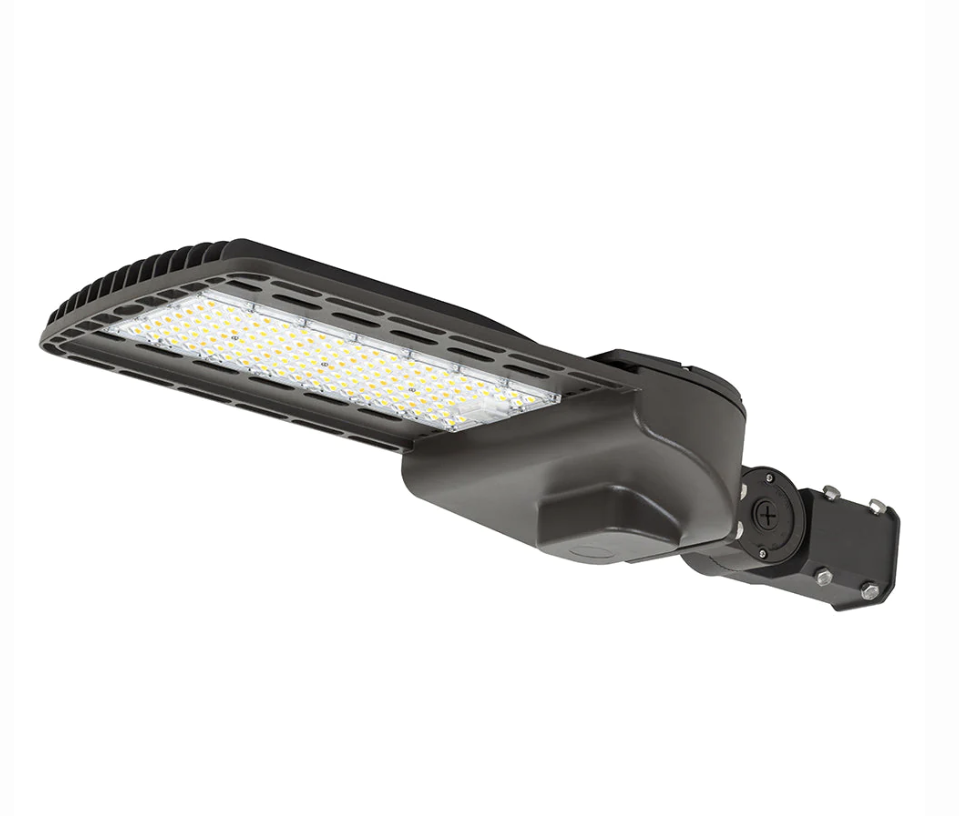
Turn lumens into fixtures and you get the layouts below. The main fixture is our 120 to 300 W adjustable shoebox, rated 44,714 lumens at 300 W.
| Court and target | Layout | Watts | Rated lumens | Est. avg. |
|---|---|---|---|---|
| Full court 94 x 50, casual | 4 poles, 8 shoebox at 300 W | 2,400 | 357,712 | 23 fc |
| Full court 94 x 50, Class IV | 4 poles, 12 shoebox at 300 W | 3,600 | 536,568 | 34 fc |
| High school 84 x 50, casual | 4 poles, 8 shoebox at 300 W | 2,400 | 357,712 | 25 fc |
| Half court, casual | 2 poles, 4 shoebox at 300 W | 1,200 | 178,856 | 23 fc |
| Driveway 30 x 30 | 1 pole, 2 shoebox at 180 W | 360 | 52,000 | 23 fc |
Poles are 20 ft (16 to 20 ft for the driveway), two fixtures per pole except the Class IV layout, which uses three. Estimates: average fc = rated lumens x 0.4 ÷ area. The driveway lumens (about 52,000) assume the fixture's rated efficacy of 145 lumens per watt. These are planning numbers; a photometric layout for your court replaces them with a real calculation and shows the max-to-min ratio.
Where to put the poles
Along the sidelines, not behind the baskets. A player shooting, rebounding or watching a lob looks up toward the rim. A pole behind the backboard puts a fixture directly in that line of sight, and it throws the backboard's shadow onto the lane. Poles on the sidelines light the court from the side, so the light crosses the players' view instead of meeting it head on.
- Full court: four poles, two on each sideline, roughly a quarter of the court length in from each baseline. Each pole's fixtures aim across the court and toward the nearer half, so every spot is lit from at least two directions.
- Half court: two poles, one on each sideline, about level with the free-throw line, both aimed toward the basket area.
- Driveway: one pole beside the pad, off to the side of the hoop rather than behind it, with two fixtures aimed across the pad.
Keep poles off the playing surface and out of the runout, so nobody chasing a loose ball runs into one. If the court is fenced, putting the poles outside the fence removes the hazard entirely.
Pole height and keeping light off the backboard
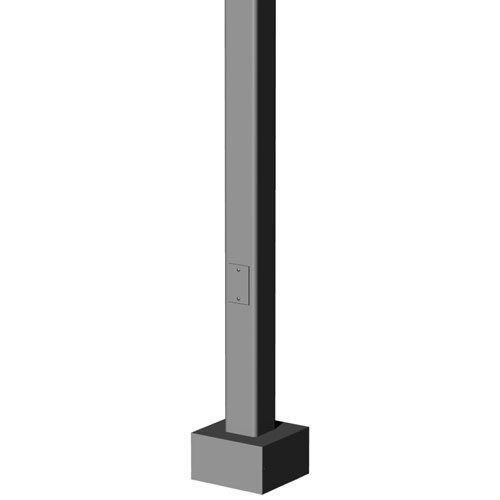
Backyard court kits commonly use 12 to 16 foot poles, and packaged full-court systems are sold on 20 to 25 foot poles. We recommend 20 feet for a community half or full court. The rim is 10 feet up, so a fixture at 20 feet sits well above a shooter's normal sightline, and height lets you spread the light over the far side of the court without tilting fixtures up toward players' eyes.
How you mount the fixture matters as much as how high. A shoebox mounted flat on a slip fitter points its light down, which keeps glare low. Floodlights are aimed, and the rule is to tilt them down far enough that the top of the beam stays below horizontal. Never aim a fixture at the backboard or across the court toward the far pole's players; aim at the floor on your side of center.
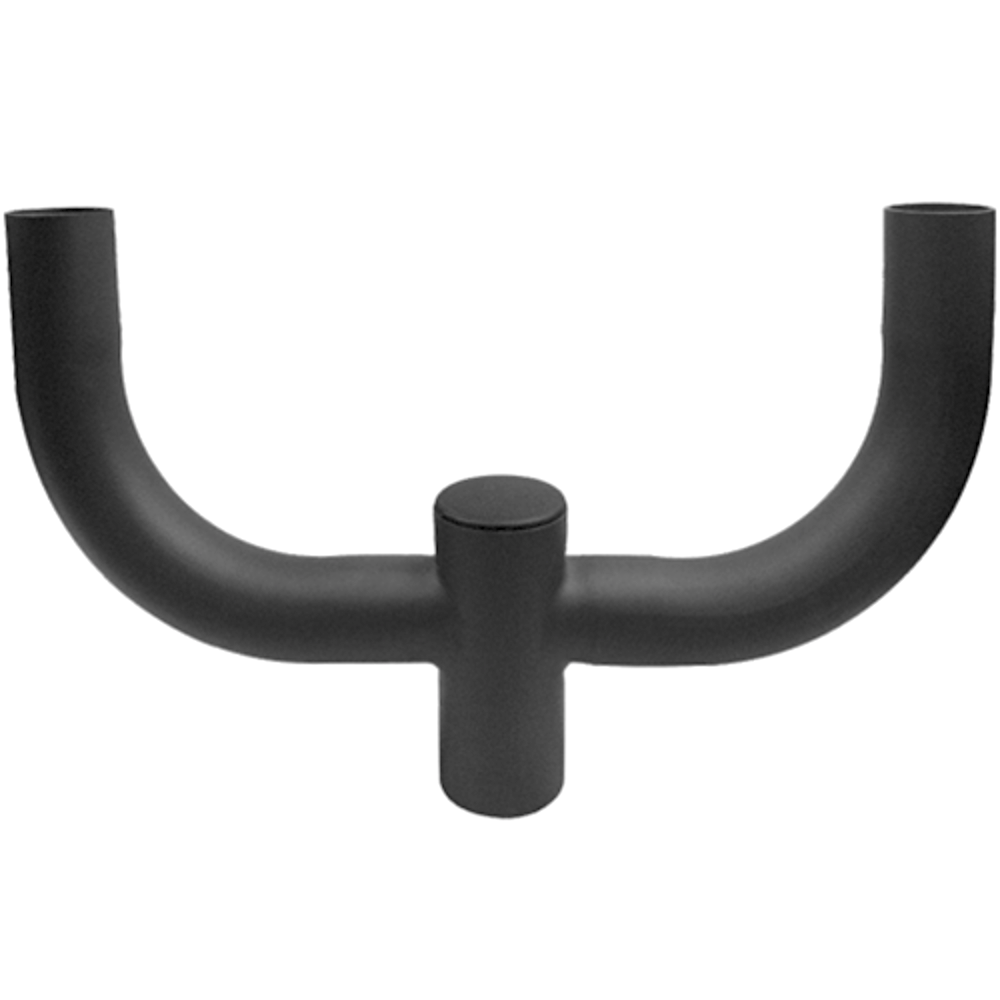
Our 20 ft aluminum anchor-base pole has a 2 3/8 inch tenon top, a 0.188 inch wall, a hand hole with a grounding provision and galvanized ASTM F1554 anchor bolts. Poles are priced by quote; see all light poles. Two fixtures per pole mount on a double bullhorn bracket ($79.99) and three on a triple bullhorn bracket ($149.99). The anchor-base footing should be sized for your wind zone and soil.
Choosing the fixture
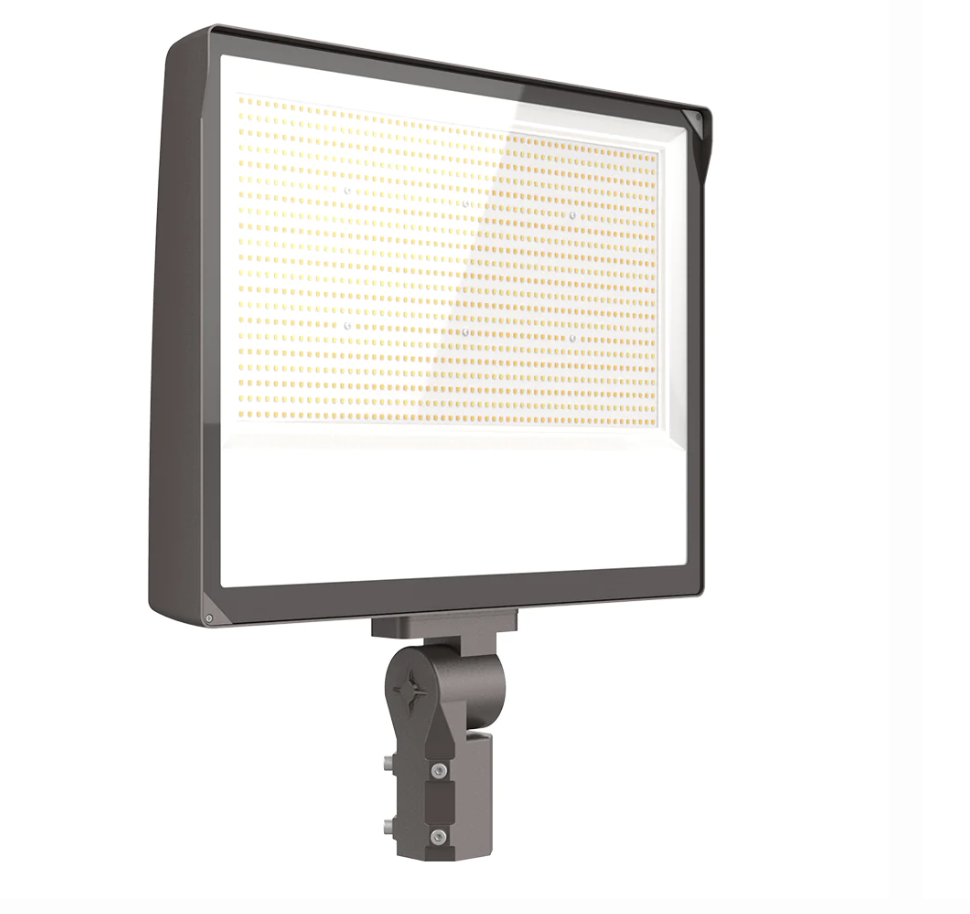
- Shoebox or flood. Shoebox fixtures have a Type III distribution that throws light forward across the court and mount flat, so they suit sideline poles and keep glare down. For a larger or brighter court, the 240 to 450 W selectable flood ($338.99) is rated 37,440 to 67,050 lumens with a 118 degree beam.
- Color temperature. 4000 K to 5000 K is the usual range for outdoor courts. 5000 K reads crisper; 4000 K is warmer and a better neighbor next to homes. The adjustable shoebox switches between 4000 K and 5000 K.
- Adjustable wattage. The 120 to 300 W shoebox has 120, 180, 240 and 300 W settings, so you can build the poles once and raise or lower the light later.
- Controls. Add a photocell ($19.99 option) so lights come on at dusk, and a timer so they go off at closing time. HOAs and apartment communities usually want both, and the timer is what keeps the power bill in check.
- Spill. Many cities and HOAs limit light at the property line. Sideline poles, flat-mounted shoeboxes and down-aimed floods all help; a photometric plan shows whether you meet the limit.
Residential courts vs community courts
| Question | Driveway or backyard | HOA, apartment or park court |
|---|---|---|
| Light level | About 20 fc is plenty for shooting around | Aim for 30 fc if people play full games |
| Poles | One pole, 16 to 20 ft | Two for a half court, four for a full court, 20 ft |
| Fixtures | Two, set to a lower wattage | Four to twelve at full wattage |
| Controls | Photocell and a switch | Photocell and timer set to posted court hours |
| Neighbors | Aim away from windows | Check local spill-light limits; a photometric plan may be required |
| Permits | Often an electrical permit | Electrical permit, often an engineered footing, sometimes a lighting plan |
What basketball court lighting costs
Fixture and bracket prices from our product pages, September 2026:
| Layout | Fixtures and brackets | Hardware | Power per year |
|---|---|---|---|
| Full court, casual | 8 shoebox at $239.99, 4 double brackets at $79.99 | $2,239.88 | About $526 |
| Full court, Class IV | 12 shoebox at $239.99, 4 triple brackets at $149.99 | $3,479.84 | About $788 |
| Half court | 4 shoebox at $239.99, 2 double brackets at $79.99 | $1,119.94 | About $263 |
| Driveway | 2 shoebox at $239.99, 1 double bracket at $79.99 | $559.97 | About $79 |
Hardware totals exclude poles (priced by quote), photocells, footings, trenching, wire and labor. Power per year = total watts x 4 hours a night x 365 nights x $0.15 per kWh; use your own rate. Packaged court systems seen on Google Shopping in September 2026 ranged from about $2,100 for a two-fixture 100 W kit to about $16,900 for a four-pole full-court package.
The rest of the budget is poles, concrete footings, trenching from the nearest panel, wire and an electrician. Those vary more with the distance to power and your soil than with anything else, so get a local quote once you know where the poles go.
Can you light a basketball court with solar?

For a court far from power, solar is tempting. Here is the honest math. Our 100 W solar parking lot and street light ($999.99) is rated 10,000 lumens and runs at full output for 5 hours, then at 20% until dawn. The 120 W model ($1,129.99) is rated 12,000 lumens on the same schedule.
Four 100 W solar lights on a full court give 40,000 lumens, or about 2.6 fc by the same planning formula (40,000 x 0.4 ÷ 6,240). That is roughly a tenth of a casual wired layout: enough to see the court and find the ball, not enough to play a game. Solar is the right answer for the walkway, the benches and the parking area around the court. Browse solar parking lot and street lights and area and walkway lighting for those.
Lighting a court? Tell us the court size, whether it is a driveway, HOA or park court, and how far the nearest power is, and we will recommend fixtures, poles and brackets and quote the order. See our outdoor commercial LED lights, contact us or call 888-925-1966.
Frequently asked questions
What type of lighting is best for an outdoor basketball court?
Pole-mounted LED shoebox or flood fixtures at about 20 feet, placed along the sidelines. Shoebox fixtures mount flat and throw light across the court with little glare; aimed floods suit larger or brighter courts. Choose 4000 K to 5000 K and add a photocell and timer.
What are the lighting requirements for an outdoor basketball court?
Industry summaries of the IES sports lighting practice put recreational (Class IV) basketball at 30 foot-candles average with a max-to-min ratio of 1.7 or better. High school competition is 50 fc. Many residential guides treat 200 to 300 lux, about 19 to 28 fc, as enough for casual play.
How many lights do you need for a full basketball court?
Typically eight to twelve LED fixtures on four poles. Eight 300 W shoebox lights (about 358,000 rated lumens) give an estimated 23 foot-candles on a 94 x 50 ft court with runout; twelve give about 34.
How to light a basketball court at night?
Put poles about 20 feet tall along the sidelines, two for a half court and four for a full court, never behind the backboards. Mount two or three LED fixtures per pole, aim them across the court and down, and control them with a photocell and a timer.
How tall should basketball court light poles be?
About 20 feet for a community half or full court. Backyard kits often use 12 to 16 foot poles, and larger packaged systems use 25 feet. Taller poles spread light more evenly and keep fixtures out of players' sightlines to the 10-foot rim.
How much does it cost to light a basketball court?
At LED Lighting Solutions, fixtures and brackets for a full court cost about $2,240 for eight 300 W shoebox lights or $3,480 for twelve, as of September 2026. A half court is about $1,120 and a driveway about $560. Poles, footings, trenching, wiring and labor are extra and depend on the site.
Can you use solar lights on a basketball court?
Not for real play. Four 100 W solar street lights give about 40,000 lumens, roughly 2.6 foot-candles on a full court, and run at full output for about 5 hours. Solar works well for the paths, benches and parking around the court.
What color temperature is best for basketball court lights?
4000 K to 5000 K. 5000 K looks crisper for tracking the ball; 4000 K is warmer and less intrusive next to homes. Adjustable fixtures let you switch after installation.
Sources
- National LED, Sports lighting footcandle standards for basketball (summary of IES sports lighting classes)
- Illuminating Engineering Society, ANSI/IES RP-6, Recommended Practice: Sports and Recreational Area Lighting
- Dominator Hoop, Outdoor court lighting basics (200 to 300 lux for recreational courts; 12 and 16 ft poles)
- LED Lighting Solutions, DIALux photometric report for a 20 x 10 m court, 8 x 20,136 lm luminaires, 335 lux average, maintenance factor 0.8 (October 2022)
- LED Lighting Solutions product pages, September 2026