My Cart: 0 item(s)
_2.png "Shadows ReadyTheme")
Parking Lot Signs Every Property Needs: No Parking, ADA Accessible, Fire Lane and Tow-Away Rules
Key Takeaways
- Most parking lots need four kinds of signs: accessible (handicap) parking signs, no parking signs where parking is banned, fire lane signs where the fire department designates one, and a tow-away sign at every entrance if you want to tow.
- The 2010 ADA Standards set the count: 1 accessible space for 1 to 25 spaces, 4 for 76 to 100, 5 for 101 to 150, and so on. At least 1 in every 6 accessible spaces must be van accessible, and its sign must say "van accessible."
- Accessible parking signs must be mounted at least 60 inches above the ground, measured to the bottom of the sign. A sign that stands over a sidewalk needs 7 feet under the MUTCD.
- The MUTCD color code: no parking signs are red on white, permissive signs such as time-limited or reserved parking are green on white, and emergency parking signs are black on white.
- In California, towing from private property needs a sign at least 17 by 22 inches, with 1-inch lettering, at every entrance. Other states set their own rules.
Every parking lot open to customers, tenants or visitors needs a core set of signs. At minimum: accessible parking signs at each accessible space (required by the ADA), no parking signs wherever parking is prohibited, fire lane signs or markings where the fire department designates a fire lane, and, if you plan to tow, a tow-away sign at each entrance worded to your state's law. Stop signs at exits and a speed limit sign round out most lots. This guide explains what each sign must say and look like, how many you need, how high to mount them, and what a typical set costs, using the 2010 ADA Standards, the MUTCD 11th Edition and California's Vehicle Code as sources.
The parking lot sign checklist by property type
| Property | Parking signs | Traffic control |
|---|---|---|
| Apartments and HOAs | R7-8 at accessible guest and unassigned spaces, with van plaques; no parking at hydrants, dumpster pads and drive aisles; fire lane signs as designated; tow-away sign at every entrance | Stop signs at exits; 5, 10 or 15 mph speed limit |
| Retail and restaurants | R7-8 at every accessible space near the entrance; no parking at entrances and loading zones; fire lane at the storefront curb; customer-only or tow-away sign at entrances | Stop signs at exits; do not enter at one-way drives |
| Offices and medical | R7-8 at every accessible space, with more spaces at outpatient medical facilities; no parking at drop-off zones and ambulance access; fire lane as designated; reserved and visitor signs | Stop signs at exits; speed limit on long drives |
| Warehouses and industrial | R7-8 at employee and visitor accessible spaces; no parking at dock aprons and truck turning areas; fire lane as designated; tow-away sign at gates | Stop signs where trucks and cars cross; speed limit |
R7-8 is the MUTCD accessible parking sign. The ADA Standards require a higher share of accessible spaces at hospital outpatient facilities (10 percent, Section 208.2.1) and at rehabilitation and outpatient physical therapy facilities (20 percent, Section 208.2.2).
Accessible (handicap) parking signs: how many and how high
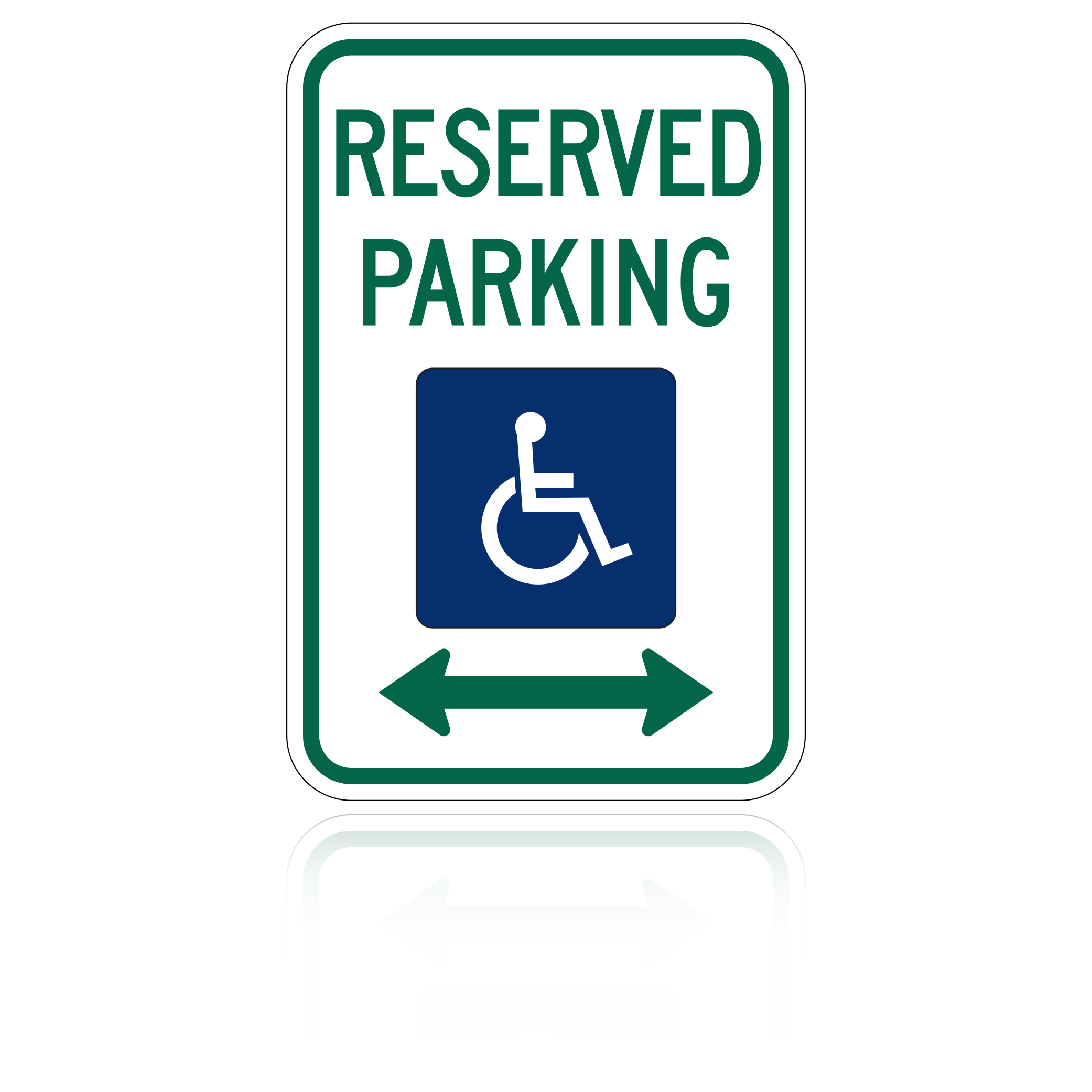
The 2010 ADA Standards for Accessible Design are the federal rule. Section 216.5 says accessible parking spaces must be identified by signs, and Section 502.6 says what those signs must be:
- Every sign shows the International Symbol of Accessibility (the wheelchair symbol).
- Signs at van spaces must also carry the words "van accessible."
- The bottom of the sign must be at least 60 inches above the ground or floor, so it stays visible when a vehicle is parked in the space.
The MUTCD agrees and names the signs: the Accessible Parking (R7-8) sign designates the space, and a VAN ACCESSIBLE (R7-8aP) plaque goes below it at van spaces (Section 2B.53). There are two exceptions in ADA 216.5: a site with four or fewer parking spaces in total does not have to sign its accessible space, and residential spaces assigned to a specific unit do not need signs.
How many accessible spaces does a parking lot need?
ADA Table 208.2 sets the minimum by the total number of spaces in each parking facility:
| Total spaces in the facility | Minimum accessible spaces | Of those, van accessible |
|---|---|---|
| 1 to 25 | 1 | 1 |
| 26 to 50 | 2 | 1 |
| 51 to 75 | 3 | 1 |
| 76 to 100 | 4 | 1 |
| 101 to 150 | 5 | 1 |
| 151 to 200 | 6 | 1 |
| 201 to 300 | 7 | 2 |
| 301 to 400 | 8 | 2 |
| 401 to 500 | 9 | 2 |
| 501 to 1,000 | 2 percent of total | 1 per 6 accessible |
| 1,001 and over | 20, plus 1 for each 100 over 1,000 | 1 per 6 accessible |
Source: 2010 ADA Standards, Table 208.2 and Section 208.2.4 ("for every six or fraction of six" accessible spaces, at least one is a van space). Van spaces are 132 inches wide with a 60-inch aisle, or 96 inches wide with a 96-inch aisle (Section 502.2).
Each accessible space gets its own sign, so the sign count equals the accessible space count, plus one van accessible plaque for each van space.
Mounting height
The ADA minimum is 60 inches from the ground to the bottom of the sign. The MUTCD adds a rule for signs next to walkways: a sign mounted over a sidewalk needs at least 7 feet of clearance underneath (Section 2A.15), and a lower secondary sign must not stick out more than 4 inches into the walkway. In practice, a post at the head of a stall behind a curb is usually set with the sign bottom between 60 inches and 7 feet; a sign that overhangs a sidewalk goes at 7 feet. Your local building department may set its own number, so check it before you drive posts.
No parking signs: which one to use
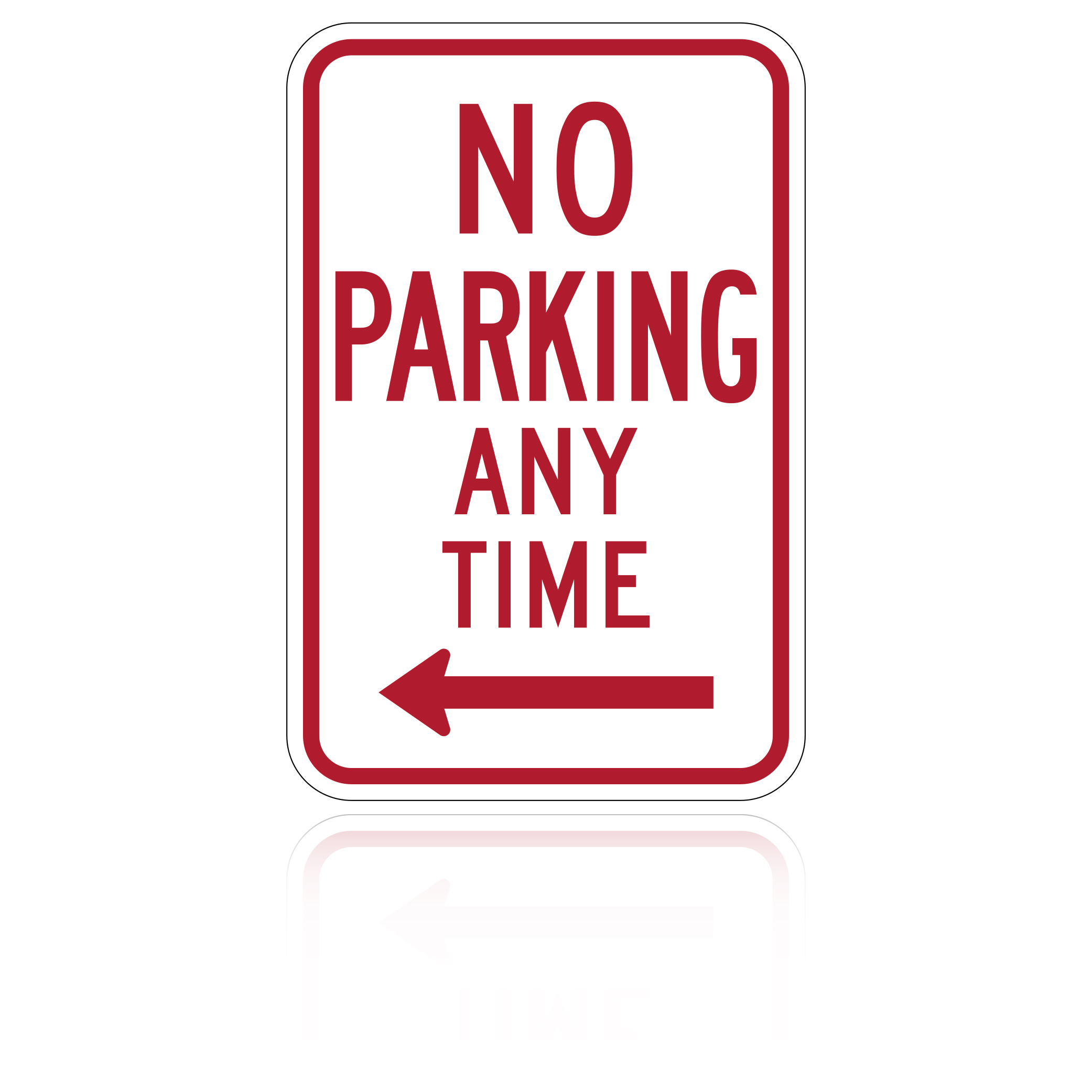
The MUTCD covers parking signs in Sections 2B.52 to 2B.54. The rules that matter for a lot:
- Shape. Parking, standing and stopping signs are rectangular or square.
- Color. Prohibitive signs (NO PARKING) have a red legend and border on white, with a black "P" in the symbol version. Permissive signs (time limits, reserved or customer parking) are green on white.
- Order of information, top to bottom: the restriction, the times, the days, any supplementary information, exemptions, and last, any tow-away message.
- Arrows show the zone. A single-headed arrow at the end of a zone, a double-headed arrow in the middle.
- Placement. At the head of perpendicular stalls, face the sign toward the stall. Along a long curb, angle it 30 to 45 degrees to traffic and repeat it at intermediate points.
"No parking," "no standing" and "no stopping" are not the same. The MUTCD defines standing as keeping a vehicle stationary while the driver stays in it, and stopping as any stop other than to avoid traffic or follow an official direction. A no parking zone lets a driver wait at the wheel; a no stopping zone does not.
| Sign | Use it for | Our sizes | Price from |
|---|---|---|---|
| No Parking Any Time (R7-1) | Curbs, drive aisles, hydrants, entrances | 18 × 24 to 30 × 36 in | $43.99 |
| No Parking symbol (R8-3) | A single sign where the symbol is enough | 24 to 36 in square | $52.42 |
| Reserved accessible parking (R7-8) | Each accessible space | 18 × 24 to 30 × 36 in | $43.99 |
| Emergency Parking Only (R8-4) | Areas kept clear for emergency parking only | 18 × 24 to 30 × 36 in | $43.99 |
| Custom rectangular sign | Tow-away, fire lane, private property, customer parking | 6 × 18 to 30 × 36 in | $23.45 |
Prices from ledlighting-solutions.com as of September 2026, for engineer grade sheeting; high intensity prismatic and diamond grade cost more. The stock R7 and R8 signs are 0.080-inch aluminum. The MUTCD minimum for R7 series signs on a conventional road is 12 × 18 inches (Table 2B-1), so all of our R7 sizes meet it. Custom signs take 4 to 6 weeks.
Fire lane signs
Fire lanes are set by the fire department or fire district with jurisdiction, not by the property owner, so start with a call to your fire marshal. They decide where the lane runs and how it must be marked.
California spells out the marking in Vehicle Code 22500.1. A fire lane in a public or private parking facility is designated in one of two ways: a sign next to the place, visible from it, stating in letters at least 1 inch high that it is a fire lane; or the curb or area painted red and marked "FIRE LANE" in a contrasting color. Other states and cities write their own rules, often through the local fire code. Our custom rectangular sign takes whatever legend your fire marshal approves, with red or white sheeting, in sizes from 12 × 24 up to 30 × 36 inches.
Tow-away signs
Towing from private property is governed by state law, and the sign is usually part of it. California Vehicle Code 22658(a)(1) shows how specific it gets. To tow a vehicle from private property without first ticketing it, the owner must display, in plain view at all entrances to the property, a sign that:
- measures at least 17 by 22 inches, with lettering at least 1 inch high;
- prohibits public parking and says vehicles will be removed at the owner's expense;
- gives the phone number of the local traffic law enforcement agency; and
- names each towing company the owner has a written towing agreement with, and gives its phone number.
An 18 × 24 inch custom sign clears the 17 × 22 minimum. Count one per entrance, not one per lot: a property with three driveways needs three. Georgia and other states set their own requirements, so confirm the wording with your towing company or city before you order.
Can I put up my own no parking sign? On your own lot, yes, and the ADA requires you to sign accessible spaces. On a public street or curb, no: signs there are installed by the city or agency that controls the road. Our guide to the MUTCD 11th Edition explains when the MUTCD applies to parking lots and private roads.
Worked example: signing a 120-space retail lot
Take a 120-space shopping center lot in California with two entrances, a loading zone and a fire lane along the storefront:
- Accessible spaces. 120 spaces falls in the 101 to 150 row of Table 208.2, so 5 accessible spaces, and at least 1 of them van accessible. That is 5 R7-8 signs at $43.99 each, $219.95, plus a van accessible plaque for the van space.
- Tow-away. Two entrances means two signs of at least 17 × 22 inches under Vehicle Code 22658. Order two 18 × 24 inch custom signs.
- Fire lane. Signs or red curb with "FIRE LANE" markings wherever the fire department designates the lane.
- No parking. Three R7-1 No Parking Any Time signs for the loading zone and the two drive aisles at the entrances: 3 × $43.99 = $131.97.
- Exits. Two 30-inch R1-1 stop signs at $62.99 each, $125.98.
The stock signs come to $219.95 + $131.97 + $125.98 = $477.90 with engineer grade sheeting, before the custom tow-away and fire lane signs, the van plaque and the posts. Our online catalog does not list a van accessible plaque, so call us for one. For posts, see our sign posts; the 12 ft breakaway post with anchor and hardware is $209.98.
Slowing traffic in the lot
Drivers cut across parking lots faster than anyone likes. A standard speed limit sign is the start; where it gets ignored, a solar flashing speed limit sign adds flashing LEDs drivers notice. Ours come in 5, 10 and 15 mph versions at $899.99, run on a 5 W solar panel with a lithium battery, and can run 24/7 or dusk to dawn. For lots and garages that also need light at night, our solar parking lot lighting guide covers fixtures that need no trenching.
Need a full sign set? Tell us how many spaces and entrances your lot has and which state it is in, and we will help you put together the list. Browse our regulatory signs, contact us, or call 888-925-1966.
Frequently asked questions
What signs does a parking lot need?
Most lots need accessible parking signs at every accessible space, no parking signs where parking is prohibited, fire lane signs or markings where the fire department designates a fire lane, and a tow-away sign at each entrance if the owner wants to tow. Stop signs at exits and a speed limit sign are common additions.
How high should a handicap parking sign be?
The 2010 ADA Standards require the bottom of the sign to be at least 60 inches above the ground. Where a sign is mounted over a sidewalk, the MUTCD requires at least 7 feet of clearance. Check your local building code, which can set a higher number.
How many handicap parking spaces does a parking lot need?
Under ADA Table 208.2, a lot with 1 to 25 spaces needs 1 accessible space, 26 to 50 needs 2, 76 to 100 needs 4, 101 to 150 needs 5, and 401 to 500 needs 9. Lots of 501 to 1,000 need 2 percent. At least one in every six accessible spaces must be van accessible.
Do I need a van accessible sign?
Yes, at every van accessible space. ADA Section 502.6 requires signs at van spaces to include the words "van accessible," and the MUTCD uses a VAN ACCESSIBLE plaque mounted below the R7-8 accessible parking sign.
What does a no parking sign mean?
A driver may not leave a vehicle parked there. Under MUTCD definitions, "no standing" also bars waiting in the vehicle, and "no stopping" bars any stop except to avoid traffic or follow an officer or traffic control device. Exact meanings come from state and local law.
Is it illegal to put up a no parking sign?
Not on your own property. Owners can post no parking, reserved and tow-away signs on their own lots and must sign accessible spaces. On a public street or curb, only the city or agency that controls the road can install parking signs.
What is the standard size for parking lot signs?
The MUTCD minimum for R7 series parking signs on a conventional road is 12 by 18 inches, and the R8-3 No Parking symbol sign is 24 by 24. Our R7 parking signs start at 18 by 24 inches. In California, a tow-away sign must be at least 17 by 22 inches.
What color are no parking signs?
Under the MUTCD, no parking signs have a red legend and border on a white background, and the "P" in the no parking symbol is black. Signs that allow parking with limits, such as time-limited or reserved parking, are green on white.
Sources
- U.S. Department of Justice, 2010 ADA Standards for Accessible Design (Sections 208.2, 208.2.4, 216.5, 502.2, 502.3 and 502.6)
- FHWA, MUTCD 11th Edition (Sections 2A.15, 2B.52 to 2B.55 and Table 2B-1)
- California Vehicle Code Section 22658 (removal of vehicles from private property)
- California Vehicle Code Section 22500.1 (fire lanes)
- LED Lighting Solutions product pages for the R7-1, R7-8, R8-3, R8-4 and R1-1 signs, custom signs, sign posts and solar speed limit signs, checked 28 September 2026