_2.png "Shadows ReadyTheme")
Solar Bollard and Walkway Lights for Community Paths: Spacing, Brightness and Cost
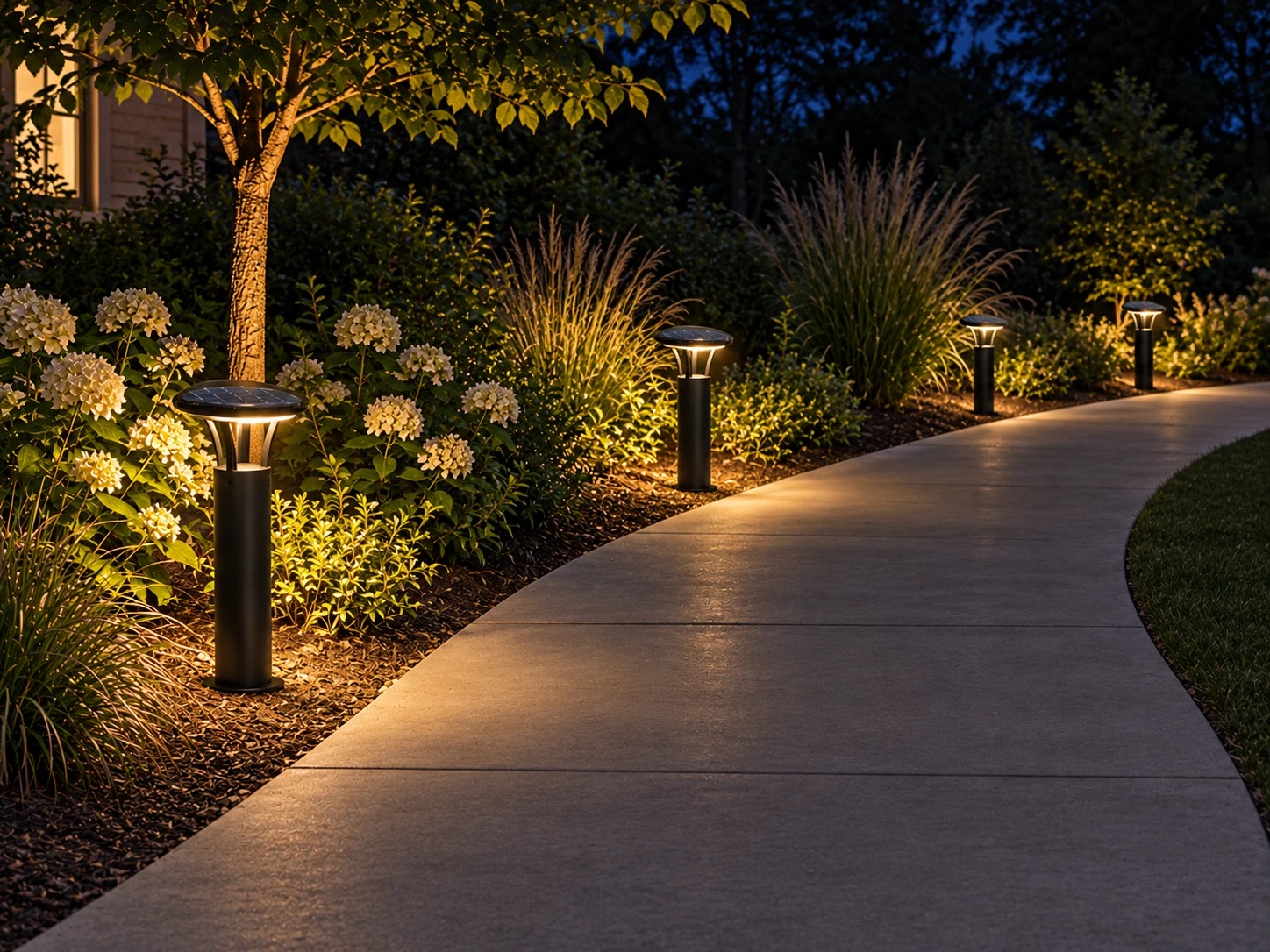
Key Takeaways
- A solar bollard carries its own panel and battery, so lighting a community path needs no trench, no conduit and no new circuit. On a 500 ft path, trench and conduit alone run about $3,000 to $6,750 before wire, an electrician or the fixtures.
- Most residential and community paths call for 0.3 to 1.0 foot-candles on average, per the IES-based table in the Texas DOT lighting manual. Busier paths near clubhouses, pools and parks sit at the higher end.
- By our lumen-budget estimate, our 350-lumen 15W solar bollard can be spaced up to about 32 ft apart on a 6 ft path at 0.5 foot-candles, or 16 ft at 1.0. A 500 ft path needs about 17 bollards at the lower level.
- Bollards keep light low and glare-free along the path edge. Pole and post-top lights put more light on faces and need fewer foundations. Many communities use both.
- The bollard's 76.8 Wh LiFePO4 battery holds about 3.7 nights of full output by our math, before its energy-saving controls stretch it further.
- The electricity saving per bollard is small, about $1 a year. The real saving is the trench you never dig through lawns, sidewalks and landscaping.
The short answer: for most community paths, a solar bollard every 16 to 32 ft lights a 6 ft walkway to the levels recommended for residential and park paths, with no trench, no wiring and no electric bill for those lights. Our 15W solar LED bollard puts out 350 lumens in a 360° pattern from a fixture about 3 ft tall, and a 500 ft path takes about 17 of them at the lower light level. Where you need more light on faces or fewer foundations, pole-mounted solar walkway lights cover more ground per fixture.
This guide is for HOA boards, property managers, parks staff and campus facilities teams planning lights for walking paths, sidewalks, pool and clubhouse approaches, and dog-walk loops. It covers how bright a path should be, how far apart to set bollards for your path width, how long they run, and what the wired alternative costs, with the math shown so you can redo it for your own property.
Bollard or pole light: which fits the path?
Both run on sunlight. The difference is height, and height decides what the light does.
- Solar bollards stand about knee to hip height and throw light across the walking surface. They mark the edge of the path, keep glare out of walkers' eyes and out of nearby windows, and suit landscaped paths, garden walks and pool decks. Because each one lights a short stretch, you need more of them.
- Pole and post-top lights mount 9 to 18 ft high and spread light over a wider area. They light faces as well as the ground, which matters for safety: the Texas DOT lighting manual notes that horizontal light helps people see the walkway, while vertical light helps them see and recognize other people on it. Fewer fixtures means fewer foundations to pour.
A common pattern is pole or post-top lights where paths meet parking, mailboxes and amenity buildings, and bollards along the quieter stretches between them. For entrance and roadway lighting, see our guide to solar lamp posts and pole lights for HOAs.
How bright should a community path be?
Lighting levels for walkways come from the Illuminating Engineering Society's roadway lighting practice, ANSI/IES RP-8. The Texas Department of Transportation publishes those values in a plain table in its Highway Illumination Manual. The levels that apply to community paths are:
| Area type | Average (fc) | Vertical min (fc) | Avg to min ratio |
|---|---|---|---|
| Rural or semi-rural | 0.2 | 0.06 | 10 : 1 |
| Low-density residential (2 or fewer homes per acre) | 0.3 | 0.08 | 6 : 1 |
| Medium-density residential (2.1 to 6 homes per acre) | 0.4 | 0.1 | 4 : 1 |
| Near community facilities (medium pedestrian activity) | 0.5 | 0.2 | 4 : 1 |
| Busy pedestrian-only areas | 1.0 | 0.5 | 4 : 1 |
Maintained illuminance for walkways, from TxDOT's Highway Illumination Manual, Pedestrian Areas, based on ANSI/IES RP-8-14. One foot-candle (fc) is one lumen per square foot.
For most HOA and apartment-community paths, 0.4 to 0.5 fc is the right target. Paths by a clubhouse, pool, school bus stop or park entrance that see steady evening use can justify 1.0 fc. The ratio column matters as much as the average: it limits how dark the darkest spot between two lights can get.
How far apart to space solar bollards
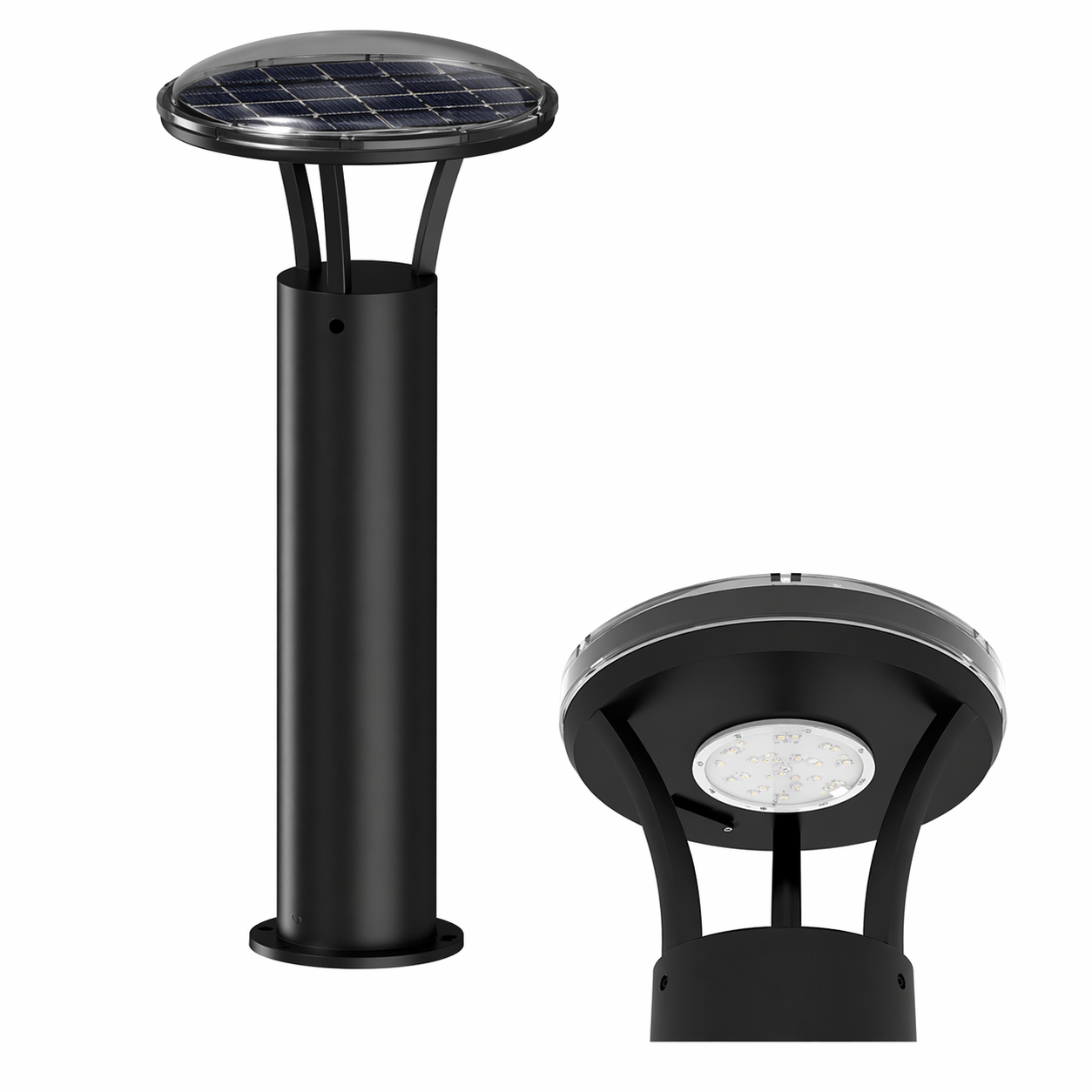
Spacing comes down to how many lumens actually land on the path. We used the standard lumen method to estimate the most each bollard can cover. Not every lumen from a 360° bollard reaches the walkway: some lights the lawn beside it. We assumed 35% lands on the path and allowed 20% for dirt and aging:
- 350 lumens x 0.35 x 0.8 = 98 lumens on the path per bollard
- Maximum spacing = 98 / (target foot-candles x path width in feet)
- Example: 98 / (0.5 fc x 6 ft) = 32.7, so about 32 ft between bollards
| Path width | Spacing at 0.5 fc | Spacing at 1.0 fc | Bollards per 500 ft at 0.5 fc |
|---|---|---|---|
| 5 ft | 39 ft | 19 ft | 14 |
| 6 ft | 32 ft | 16 ft | 17 |
| 8 ft | 24 ft | 12 ft | 22 |
| 10 ft | 19 ft | 9 ft | 28 |
Estimates for the 15W solar bollard (350 lm), one row of bollards along one side of the path. Bollard count = 500 ft divided by the spacing, rounded up, plus one for the far end. Not a photometric study.
Worked example: a 500 ft community path
Take a 6 ft wide concrete path that loops 500 ft from the clubhouse to the dog park, in a medium-density community. At 0.5 fc the table says bollards every 32 ft:
- Count: 500 / 32 = 15.6, rounded up to 16 gaps, plus one bollard at the far end = 17 bollards.
- Fixtures: 17 x $599.99 = $10,199.83 at the bollard's current sale price (November 23, 2026).
- Busier stretch: if the 100 ft nearest the clubhouse needs 1.0 fc, set bollards there every 16 ft. That adds about three bollards to that stretch.
- Power: none. Each bollard charges from its own panel and switches on at dusk.
What the wired alternative costs
With wired path lights, the fixture is rarely the expensive part. Getting power to it is. HomeGuide's 2026 trenching cost guide puts a trench with half-inch PVC electrical conduit at $6.00 to $13.50 per linear foot installed, and electricians at $50 to $130 an hour. For the same 500 ft path:
| Cost item | Wired path lights | Solar bollards |
|---|---|---|
| Trench and conduit, 500 ft | $3,000 to $6,750 | None |
| Wire, new circuit, electrician time | Extra, quoted locally | None |
| Fixtures | Depends on the fixture chosen | 17 x $599.99 = $10,199.83 |
| Base or footing for each light | Needed | Needed |
| Repairing lawn, sidewalk or pavers | Along the whole trench | Only at each light |
| Electricity for the lights | On the community's bill | None |
Trench and conduit rates from HomeGuide (updated February 6, 2026). Bollard price from our product page, November 23, 2026. Poles, bases and installation are not included in either column.
Be honest with the board about the electricity. Our bollard's LED draws 1.75 W. A wired LED path light of the same output would use about the same: 1.75 W x 12 hours x 365 nights = 7.7 kWh a year, or about $1.11 at the U.S. commercial average of 14.47 cents per kWh. Seventeen of them come to about $19 a year. Path lighting is not a big line on the utility bill.
The case for solar is the digging. A path that winds through mature landscaping, crosses a sidewalk, runs along a pool deck or sits far from any electrical panel gets expensive to wire fast, and the trench leaves a scar the length of the path. Solar puts a light wherever the path goes, and adding one more later takes no electrician.
All-night runtime and the battery
The 15W bollard pairs a 15 W monocrystalline panel with a 6.4 V, 12 Ah lithium iron phosphate (LiFePO4) battery. Its LED draws 1.75 W, so the panel is more than eight times the size of the load. Here is how far a full charge goes:
- Battery: 6.4 V x 12 Ah = 76.8 Wh
- One night: 1.75 W x 12 hours = 21 Wh
- 76.8 / 21 = about 3.7 nights at full output from a full battery, before conversion losses
The bollard's built-in ASW 3.0 energy-saving system manages output to stretch the charge, so a light that starts a cloudy spell full will usually run longer than that. The product page does not publish a nights-of-autonomy figure, so treat ours as an estimate.
Two things still decide how well any solar light runs in December: open sky over the panel and a clean panel. Keep bollards out of the shade of hedges, eaves and evergreens, and rinse the panels a few times a year.
Solar path lights we stock
Prices and specifications from each product page, checked November 23, 2026:
| Fixture | Height | Lumens | Color | Price |
|---|---|---|---|---|
| 15W solar LED bollard | 35.4 in. tall | 350 | 3000K or 5000K | $599.99 |
| 30W solar post top light | 9 to 12 ft | 3,000 | 4000K | $349.99 |
| 20W solar LED pole light | 10 to 14 ft | 3,000 | 2700K or 5000K | $499.99 |
| 15W solar walkway light | 6 to 12 ft | 1,694 to 2,100 | White (5000K stock) | $179.99 |
| 18W solar walkway light | 12 to 18 ft | 1,900 to 2,500 | Ask us | $260.99 |
One-unit prices. The bollard is on sale from $649.99; both walkway lights are on sale and marked limited stock. Walkway light lumens are shown as a range because the product page, spec sheet and lab report list different figures; plan on the lower number. The 20W pole light's height is from its spec sheet. Poles and installation are not included.
- 15W bollard: 350 lumens in a Type V, 360° pattern; 1.75 W LED; 15 W panel; 6.4 V / 12 Ah LiFePO4 battery; selectable 3000K warm white or 5000K cool white; black housing 35.4 in. tall and 14.6 in. wide; 2-year warranty.
- 30W post top light: 360° light on a 2 3/8 in. round pole, with motion sensing, three dimming modes and a 3-year warranty. A good fit where paths meet mailboxes, gates and building entrances.
- 20W pole light: the warmest option at 2700K, with three motion modes and 4 to 7 nights of working time on a full charge per its page, and a 1-year warranty. It is the fixture our HOA entrance guide leads with.
- 15W and 18W walkway lights: pole-mounted heads for longer, plainer paths and sidewalks, while stock lasts, each with a 3-year limited warranty. The 18W adds Bluetooth app control (Android only).
See the full range in our area and walkway lighting and pathway and bollard lights categories, and poles in light poles.
Warm or cool white, and the night sky
Most residents read warm white (2700K to 3000K) as homey and cool white (5000K) as institutional. Warm white also sends less blue light into the sky, which matters in communities with an outdoor lighting ordinance. The bollard switches between 3000K and 5000K, so you can match it to the 2700K pole lights at the entrance. Our guide to dark-sky friendly solar lighting covers color, shielding and dimming in more detail.
A planning checklist for the board
- Measure the path. Length and width of each stretch, and which stretches see steady evening use.
- Pick a light level. 0.4 to 0.5 fc for most community paths, 1.0 fc near amenities.
- Set the spacing. Use the table above, then test two bollards at that spacing after dark.
- Check the sky. Note trees, hedges and buildings that shade the path, especially with the low winter sun.
- Get a wiring quote to compare. Trench, conduit, wire and electrician. On a long or landscaped path, this number usually settles it.
- Budget for upkeep. Panel cleaning, and battery replacement in the reserve study.
Frequently asked questions
How far apart should solar bollard lights be?
For our 350-lumen 15W solar bollard, our lumen-budget estimate gives a maximum of about 32 ft between bollards on a 6 ft path at 0.5 foot-candles, and about 16 ft at 1.0 foot-candle. Wider paths need closer spacing: about 24 ft on an 8 ft path at 0.5 foot-candles. Test two bollards at your planned spacing after dark before buying for the whole path.
How bright should walkway lights be?
The IES-based table in the Texas DOT Highway Illumination Manual recommends an average of 0.3 to 0.4 foot-candles for residential walkways, 0.5 near community facilities such as libraries and recreation centers, and 1.0 for busy pedestrian-only areas.
How long do solar bollards last?
Our 15W solar bollard carries a 2-year warranty and uses a lithium iron phosphate (LiFePO4) battery. The battery is the part that wears first, and how long it lasts depends on climate and how hard the light runs each night, so plan for battery replacement in the long-range budget.
Do solar bollard lights stay on all night?
Yes. They switch on at dusk and off at dawn. Our 15W bollard's 76.8 Wh battery holds about 3.7 nights at full output by our estimate, and its ASW 3.0 energy-saving system manages output to stretch the charge.
Can you solarize bollard lighting?
The simplest way is to replace a wired bollard with a self-contained solar bollard that carries its own panel and battery. Check that the spot gets open sky for most of the day and that the new bollard's base fits the existing pad or footing.
What is the downside of solar lights?
They cost more per fixture than many wired lights, they need open sky to charge, and their batteries lose capacity over the years. Long cloudy spells and winter shade shorten runtime. On a short path right next to an electrical panel, wiring can be the cheaper choice.
Why do solar lights fail so quickly?
Most early failures come from small panels and batteries, shade over the panel, dirty panels or cheap batteries that cannot handle daily cycling. A commercial solar bollard with a 15 W panel feeding a 1.75 W LED and a LiFePO4 battery is built with far more margin, but it still needs open sky and an occasional rinse.
Are you supposed to leave solar lights on all the time?
Yes. Leave them switched on so they charge by day and light by night on their own. Turn a solar light off only for storage or shipping.
- Texas Department of Transportation, Highway Illumination Manual, Section 2: Illumination Levels, Pedestrian Areas, Maintained Illuminance Values for Walkways (based on ANSI/IES RP-8-14, Roadway Lighting, Tables 4 to 7): txdot.gov
- HomeGuide, How Much Does Trenching Cost Per Foot? (updated February 6, 2026): trench with half-inch non-metallic PVC conduit $6.00 to $13.50 per linear foot installed; electricians $50 to $130 per hour: homeguide.com
- U.S. Energy Information Administration, Electric Power Monthly, Table 5.6.A, August 2026 (U.S. commercial average 14.47 cents per kWh, preliminary): eia.gov
- LED Lighting Solutions product pages, checked November 23, 2026: 15W solar LED bollard, 30W solar post top light, 20W solar LED pole light (and its spec sheet, SSLL10-20), 15W walkway light (and its spec sheet and photometric report, SGDW015), 18W walkway light (and its spec sheet, SGDW018)
- Spacing estimate (lumen method): 350 lm x 0.35 (assumed share of light on the path) x 0.8 (assumed light loss factor) = 98 lm; spacing = 98 / (foot-candles x path width). Not a photometric study.
- Runtime estimate: 6.4 V x 12 Ah = 76.8 Wh; 1.75 W x 12 h = 21 Wh a night; 76.8 / 21 = 3.7 nights. Energy estimate: 1.75 W x 12 h x 365 = 7.7 kWh x $0.1447 = $1.11 a year.