My Cart: 0 item(s)
_2.png "Shadows ReadyTheme")
Solar Light Towers vs. Diesel Generator Light Towers: Light Output, Runtime and Cost Compared
Key Takeaways
- A solar light tower is a trailer with LED heads on a telescoping mast, solar panels and a battery bank. There is no generator, no fuel, and no trenching or wiring. One person can tow it in, raise the mast and switch it on.
- On rated output, solar towers run 30,000 to 90,000 lumens. A current LED diesel tower is rated near 188,000 lumens, and an older four-lamp metal halide tower at 440,000 initial lamp lumens. One solar tower does not match one diesel tower lumen for lumen.
- Most jobs do not need that much. OSHA asks for 3 to 5 foot-candles on general construction areas, and a 60,000-lumen solar tower covers roughly 6,000 to 10,000 square feet at those levels.
- An LED diesel tower running 12 hours a night burns about 1,051 gallons a year, roughly $4,200 in fuel and 10.7 metric tons of CO2. A solar tower burns none, and it is silent.
- For long nights, winter, or 24-hour sites, pick a model with more panel area or a hybrid tower with a backup generator.
Light towers are one of the most rented pieces of equipment on a job site, and most of them still have a diesel engine bolted to the trailer. That engine needs fuel deliveries, oil changes and someone to check on it, and it runs all night beside the crew. A solar light tower does the same job with panels and batteries. This guide compares the two on the numbers that matter: how much light you get, how long it runs, what it costs to operate, and how much work it takes to put one on site.
What a solar light tower is
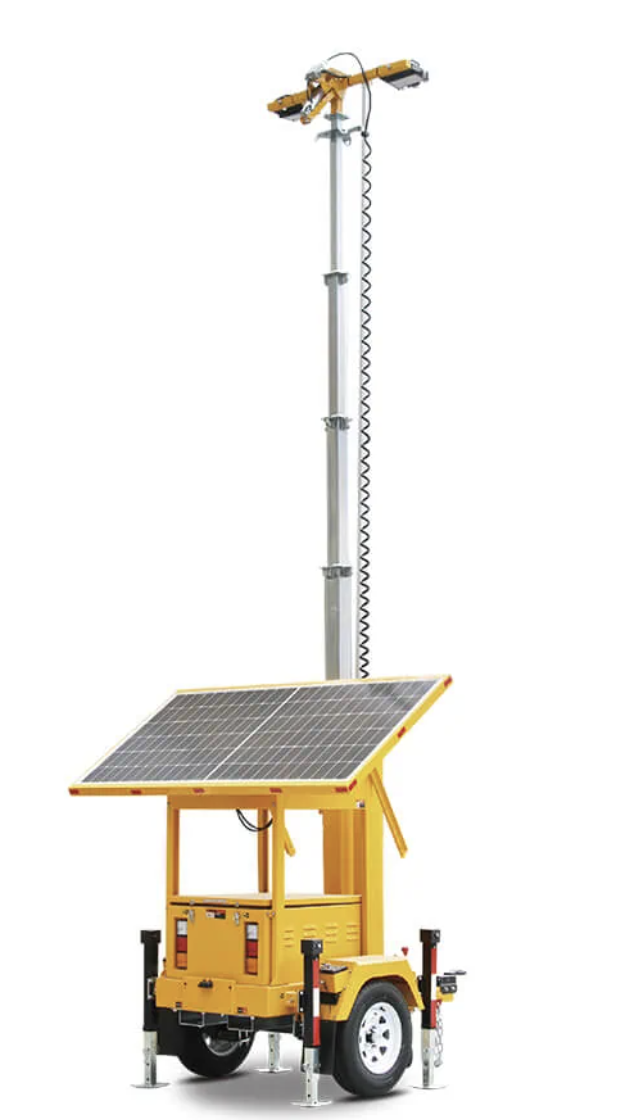
A solar light tower is a towable trailer that carries three things: high-output LED flood heads on a telescoping mast, solar panels that charge during the day, and a bank of deep-cycle batteries that run the lights at night. A charge controller manages the batteries automatically. There is no engine on a fully solar model.
The Medi400 is a typical mid-size example: four 100 W LED heads rated at 60,000 lumens in total, two 455 W solar panels, four 200 Ah maintenance-free gel batteries, a telescoping mast with a winch, heads that rotate and tilt, and an optional CCTV camera for site security. It is sold by LED Lighting Solutions for $12,599.00 as of September 2026.
How easy is it to use?
This is where solar towers win most clearly. There is no fuel to order, store or spill, no generator to start and service, and no electrician, trenching or temporary power drop. The towers are built for one-person operation:
- Tow it in. It moves behind a pickup like any small trailer, so it can follow the work from site to site.
- Park it in the sun. Face the panels toward open sky, away from the shade of buildings and trees.
- Level and stabilize the trailer.
- Raise the mast with the winch and aim the LED heads. Each head rotates and tilts, so you can put the light where the work is.
- Switch it on. LEDs reach full brightness instantly, with no warm-up and no restrike delay after a power interruption.
After that, the tower looks after itself. The panels recharge the batteries every day, so there is no refueling run and nobody has to visit a remote site just to keep the lights on.
Light output: solar vs. diesel, in lumens
Here is the honest comparison. These are manufacturers' rated figures for complete towers.
Solar and solar hybridDiesel generator
| Tower | Light source | Rated lumens | Power source |
|---|---|---|---|
| Mini and Medi200 | 2 × 100 W LED | 30,000 | Solar and battery |
| Medi400 and Super | 4 × 100 W LED | 60,000 | Solar and battery |
| Mega400 and Mega600 | 6 × 100 W LED | 90,000 | Solar and battery with diesel generator backup |
| LED diesel tower (Generac MLTS-4) | 4 × 320 W LED | 188,000 | Diesel generator, 0.24 gal/hour |
| Metal halide diesel tower (Larson 4 × 1,000 W) | 4 × 1,000 W metal halide | 440,000 | Diesel generator, about 0.56 gal/hour |
Sources: LED Lighting Solutions product pages; Generac Mobile MLTS-4 specifications; Larson Electronics WCDE-7.5K-4X1000W specifications (28-gallon tank, 50-hour runtime). Metal halide figures are initial lamp lumens, before fixture losses, and metal halide lamps dim as they age; LED figures hold far longer.
Two things follow from that table. First, a diesel tower puts out more light per trailer. If you need to match an LED diesel tower lumen for lumen, plan on about three 60,000-lumen solar towers, or two of the 90,000-lumen hybrids. Second, and more important for most buyers, the question is not how much light a tower can make but how much light the job needs.
How much light does the job actually need?

OSHA sets the minimums for construction in 29 CFR 1926.56, Table D-3:
| Foot-candles | Area or operation |
|---|---|
| 3 | General construction areas, concrete placement, excavation and waste areas, access ways, active storage areas, loading platforms, refueling, and field maintenance areas |
| 5 | General construction area lighting; warehouses, corridors, hallways and exitways; tunnels, shafts and general underground work areas |
| 10 | General construction plant and shops, such as batch plants, equipment rooms and carpenter shops |
| 30 | First aid stations, infirmaries and offices |
A foot-candle is one lumen per square foot, so you can turn lumens into a rough coverage area. Not every lumen lands on the work surface; a common planning assumption for aimed floodlights on a mast is that about half do.
| Tower output | Area at 5 fc | Area at 3 fc |
|---|---|---|
| 30,000 lumens | 3,000 sq ft | 5,000 sq ft |
| 60,000 lumens | 6,000 sq ft | 10,000 sq ft |
| 90,000 lumens | 9,000 sq ft | 15,000 sq ft |
| 188,000 lumens (LED diesel) | 18,800 sq ft | 31,300 sq ft |
Planning estimates only: area = lumens × 0.5 ÷ foot-candles. Real coverage depends on mast height, aiming and surroundings. Confirm with a light meter on site.
Ten thousand square feet is a work area about 100 feet on a side: a road crew's active work space, an intersection, a laydown yard, a parking area, an event entrance or a gate. That is the kind of job where one solar tower replaces one diesel tower directly. Lighting several acres at once is where diesel output, or several solar towers spaced around the site, still makes sense. Spacing smaller towers around a site also gives more even light and fewer shadows than one very bright source.
Runtime and recharging
Runtime comes from simple arithmetic. Four 200 Ah batteries at 12 V store about 9.6 kWh. Four 100 W heads draw 400 W. That works out to roughly 12 to 19 hours of light between charges, depending on how deeply the batteries are discharged (50 to 80 percent is the usual range for gel batteries).
The other half of the equation is recharging. Two 455 W panels collect somewhere around 2 to 3.5 kWh on a typical day, less in a northern winter and more in a southwestern summer. That is five to nine hours of full-power light put back each day. For short summer nights that balances. For long winter nights at full power it does not, so plan for one of these:
- Choose more panel area. The Super carries three 455 W panels on the same four-head, four-battery package as the Medi400.
- Run two heads instead of four when the work allows.
- Choose a hybrid. The Mega600 adds a diesel generator that starts only when solar cannot keep up, for sites that must stay lit around the clock.
Runtime and recharge figures are calculated from the published battery, panel and lamp specifications and assume 12 V batteries. Ask us for the rated runtime of a specific model and location.
Operating cost and emissions
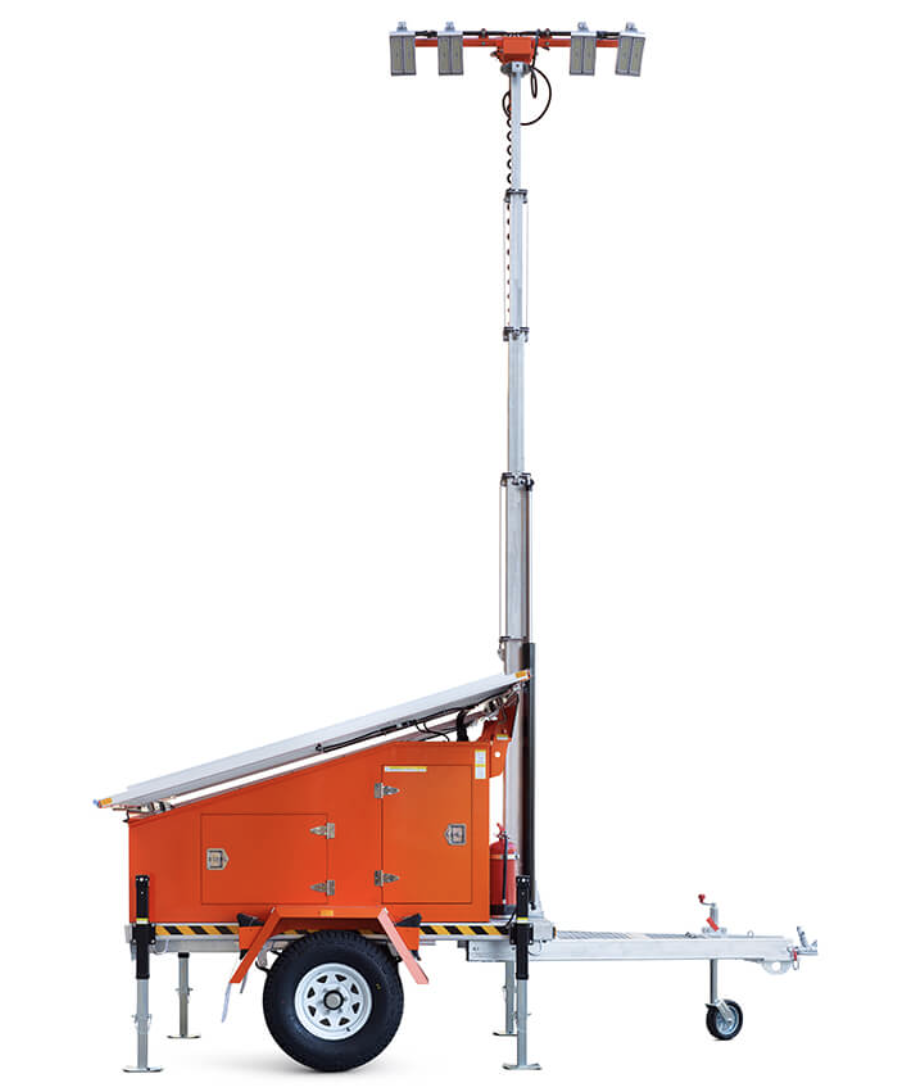
A diesel tower's purchase price is only the start. Using the manufacturers' published fuel rates, 12 hours a night, every night, and diesel at $4.00 a gallon:
| Per tower, per year | Solar tower | LED diesel tower | Metal halide diesel tower |
|---|---|---|---|
| Fuel burned | 0 gallons | 1,051 gallons | 2,453 gallons |
| Fuel cost | $0 | About $4,200 | About $9,810 |
| CO2 from fuel | 0 | 10.7 metric tons | 25.0 metric tons |
| Engine service | None | Oil, filters, coolant | Oil, filters, coolant, lamp replacement |
| Refueling visits | None | About every 165 hours of run time | About every 50 hours of run time |
| Noise | No engine | 67 dB(A) at 23 ft | Engine noise |
Fuel rates: Generac MLTS-4, 0.24 gal/hour, 165-hour runtime, 67 dB(A) at 23 ft; Larson 4 × 1,000 W metal halide tower, 28-gallon tank and 50-hour runtime. CO2 at 10,180 grams per gallon of diesel (U.S. EPA). Diesel price is an assumption; use your own.
Where one solar tower lights the area, the math is short. A Medi400 at $12,599 costs about $1,922 more than a comparable LED diesel tower at $10,677, and the diesel tower then burns about $4,200 of fuel a year. At 12 hours a night the difference is paid back in roughly 5 months, before counting oil changes, fuel deliveries or the labor to check on an engine.
Quiet matters as well. With no engine, a solar tower can run all night next to homes, hospitals, hotels and events, and crews can hear each other and approaching traffic.
Where solar fits, and where diesel or hybrid still makes sense
| Choose a solar tower for | Choose a hybrid or diesel tower for |
|---|---|
| Work areas up to about 10,000 sq ft per tower | Several acres lit from a single position |
| Long deployments: months-long projects, permanent temporary lighting, security lighting | One-night jobs where fuel cost hardly registers |
| Remote sites where refueling means a special trip | 24-hour operation through long, overcast winters |
| Noise- or fume-sensitive sites: neighborhoods, events, hospitals, campuses | Sites that also need the generator's auxiliary power outlets |
| Owners with emissions targets or idling restrictions | Shaded sites where panels cannot see the sky |
| Parking lots, gates and laydown yards that need light and a camera |
Pair the tower with the rest of the site: work zone safety equipment, arrow boards and message boards run on the same solar principle, and our temporary traffic control guide covers where lighting belongs in a night work zone.
The LED Lighting Solutions light tower range

| Model | LED heads | Lumens | Solar panels | Batteries | Price |
|---|---|---|---|---|---|
| Mini | 2 × 100 W | 30,000 | 1 × 455 W | 1 × 200 Ah | $4,899.99 |
| Medi200 | 2 × 100 W | 30,000 | 1 × 455 W | 2 × 200 Ah | $10,599.99 |
| Medi400 | 4 × 100 W | 60,000 | 2 × 455 W | 4 × 200 Ah | $12,599.00 |
| Super | 4 × 100 W | 60,000 | 3 × 455 W | 4 × 200 Ah | $12,699.99 |
| Mega400 (hybrid) | 6 × 100 W | 90,000 | 4 × 455 W | 4 × 200 Ah | $14,899.99 |
| Mega600 (hybrid) | 6 × 100 W | 90,000 | 4 × 455 W | 6 × 200 Ah | $15,499.99 |
Specifications and prices from ledlighting-solutions.com, September 2026. All models are trailer-mounted with a telescoping mast and winch, rotating and tilting heads, an MPPT charge controller, gel batteries and an optional CCTV camera. Hybrid models add a backup diesel generator.
See the full light tower range, or the 81,600-lumen LED balloon light if you have power on site and want glare-free light on a tripod.
Ready to retire the generator? Solar light towers are in stock and ready to go. Tell us the size of the area, the hours you need light and where the site is, and we will recommend a model. Contact us or call 888-925-1966.
Frequently asked questions
Can a solar light tower replace a diesel light tower?
Yes, where the area to light matches the tower's output. A 60,000-lumen solar tower lights roughly 6,000 to 10,000 square feet to OSHA construction levels. A current LED diesel tower is rated near 188,000 lumens, so very large areas need about three solar towers per diesel unit, or a hybrid tower.
How many lumens does a solar light tower produce?
LED Lighting Solutions solar towers are rated at 30,000 lumens (two 100 W LED heads), 60,000 lumens (four heads) and 90,000 lumens (six heads). For comparison, an LED diesel tower with four 320 W heads is rated at 188,000 lumens and a four-lamp 1,000 W metal halide tower at 440,000 initial lamp lumens.
How long does a solar light tower run at night?
It depends on battery size, lamp wattage and how much sun the panels collected. A tower with four 200 Ah, 12 V batteries stores about 9.6 kWh, which works out to roughly 12 to 19 hours of a 400 W lamp load between charges depending on how deeply the batteries are discharged. Ask us for the rated runtime of the model you are considering.
Do solar light towers work in winter or cloudy weather?
They work, but short days put in less energy than long nights take out. Choose a model with more panel area, run fewer heads or a dimmed setting, or choose a hybrid tower with a backup generator for 24-hour or mission-critical lighting.
How much does a solar light tower cost?
LED Lighting Solutions solar light towers range from $4,899.99 for the Mini to $15,499.99 for the Mega600 hybrid, as of September 2026. A comparable LED diesel tower lists near $10,700 and then burns roughly $4,200 of diesel a year at 12 hours a night.
What are the downsides of a solar light tower?
Lower light output per tower than a diesel unit, dependence on sun exposure, and a higher purchase price than some diesel towers. They suit small to mid-size areas, long deployments and places where noise, fumes or refueling are a problem.
How much light does OSHA require on a construction site?
OSHA 29 CFR 1926.56 requires at least 5 foot-candles for general construction area lighting and 3 foot-candles for areas such as excavation, concrete placement, access ways, loading platforms and refueling areas. Shops and plants need 10 foot-candles, and first aid stations and offices need 30.
Is a solar light tower hard to set up?
No. It tows behind a pickup like any small trailer. One person parks it with the panels facing the sun, levels it, raises the mast with the winch, aims the LED heads and switches it on. There is no fuel to store, no generator to service and no trenching or wiring.
Sources
- OSHA, 29 CFR 1926.56, Illumination, Table D-3
- U.S. EPA, Greenhouse Gas Equivalencies Calculator: calculations and references
- Generac Mobile MLTS-4 LED light tower specifications
- Larson Electronics, 4 × 1,000 W metal halide diesel light tower specifications
- LED Lighting Solutions product specifications, September 2026