_2.png "Shadows ReadyTheme")
Shine a Light on Savings: How Solar Parking Lot Lighting Helps Churches and Nonprofits Do More for Their Communities
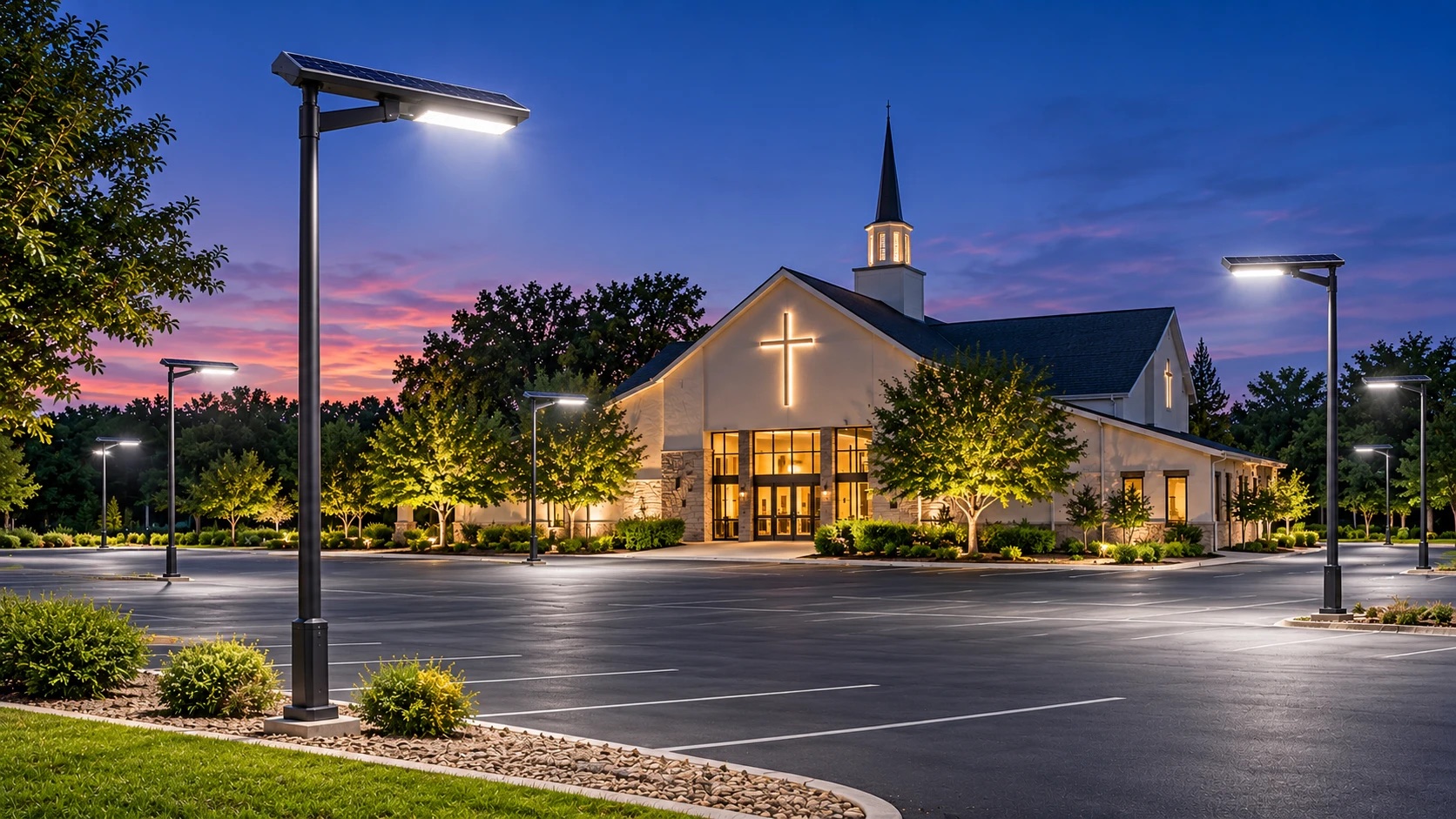
Key Takeaways
- Solar parking lot lights run on their own panels and batteries, so the grid electricity for those fixtures drops to zero. They do not change the bill for the building itself.
- The energy math: a wired 100W LED fixture running 12 hours a night uses 438 kWh a year, about $63 at the U.S. commercial average of 14.47 cents per kWh. That is about $634 a year for a 10-pole lot and $1,584 for 25 poles.
- On energy alone, a solar head takes years to pay back its higher price. The bigger saving for most churches is skipping the trench, conduit and wiring across a finished lot.
- Built-in night modes fit a church calendar: full brightness through evening services and programs, then dim, with full light again when the motion sensor sees someone.
- Batteries are a wear item and warranties are 1 to 3 years depending on the model, so budget for upkeep. Solar is low-maintenance, not maintenance-free.
The short answer: solar parking lot lighting helps a church or nonprofit in two ways. It takes the parking lot lights off the electric bill, about $63 a pole each year compared with a wired LED fixture of similar output, and it avoids trenching power across a lot that is already paved and landscaped. The money saved can go back into ministry, outreach and programs instead of the utility company. Solar is not free, though. The fixtures cost more up front than wired ones, and the batteries wear out over time. This guide shows the numbers so a finance committee or board can decide with clear eyes.
It is written for churches, nonprofits and community centers whose lots are busiest after dark: evening worship, youth group, recovery meetings, food distribution, shelters and choir practice. For fixture counts and spacing for a specific lot, use our solar parking lot lighting guide. This page covers the budget, the schedule and the products.
1. What solar takes off the electric bill (and what it does not)
A solar parking lot light charges from its own panel during the day and runs from its own battery at night. No wire runs back to the building, so the lot lights draw nothing from the utility. That is the whole saving on the energy side. The sanctuary, offices, kitchen and HVAC keep the same bill they had before.
To keep the comparison fair, we matched light output rather than watts. Our 80W solar parking lot light lists 9,600 lumens. The closest wired fixture we sell is the 100W LED shoebox light at 11,000 lumens. Here is what that wired fixture costs to run from dusk to dawn:
- 100 watts x 12 hours a night x 365 nights = 438 kWh a year
- 438 kWh x $0.1447 per kWh (U.S. commercial average, August 2026) = $63.38 a pole a year
Your own rate may be higher or lower than the national average, so swap in the cents per kWh from your church's electric bill. If your lot lights run on a timer that shuts them off at 11 p.m., the hours drop and so does the cost.
2. Safer, more welcoming lots after evening services
For many congregations the parking lot is the first and last thing people see. A dark lot after a Wednesday night service, a late youth event or an AA meeting is a real worry for seniors, parents with small children and volunteers locking up. Food pantries and shelters often run before sunrise or after sunset in winter, when the days are shortest.
Solar lights switch on at dusk and off at dawn by themselves, with no timer to reset when the clocks change. Our motion-sensor parking lot lights use a 120° sensor that picks up movement from 26 feet away and brings the light to full brightness when someone walks or drives under it. The light is there when people are, without running at full power all night for an empty lot.
3. Less trenching, wiring and electrical work
Adding wired lights to a lot that is already paved usually means saw-cutting the asphalt, digging a trench, laying conduit, pulling wire back to a panel and patching the surface. If the lot is far from the building, or the panel has no spare capacity, the electrical work can cost more than the fixtures.
A solar pole needs a foundation and a pole, and that is the end of the site work. Nothing runs between poles, so you can add a light at the far end of an overflow lot, a walkway to the fellowship hall or a driveway entrance without touching the rest of the property. Get a quote for the trench and electrical work on your lot and compare it with the price of solar heads; that number usually settles the question.
4. Putting the savings back into the mission
Every dollar a church or nonprofit does not spend on keeping the lights on is a dollar it can spend on people. Using the figures above, a 10-pole lot that runs on solar instead of the grid keeps about $634 a year, or about $6,338 over ten years at today's rate. For a 25-pole campus it is about $1,584 a year.
In a church budget that is real money: camp scholarships, food pantry stock, a youth mission trip or a seniors' lunch. Add the trench and electrical work you avoided, and the case gets stronger for any lot that needs new lights.
5. Stewardship and a smaller footprint
Many congregations see care for creation as part of their calling. Solar parking lot lights run on sunlight collected by their own panels, so the energy those fixtures use comes from no power plant. That is a clear, visible step a church can point to. We will not put a tonnage of carbon on it, because that depends on how your local utility generates its power, but the fixtures themselves draw nothing from the grid.
If your town has an outdoor lighting ordinance or you want to protect the night sky, color temperature and aiming matter as much as the power source. The 80W light below is cool white (6500K), so it is not the pick for a dark-sky area. Read our guide to dark-sky friendly solar lighting for the warm-white options.
6. The 80W solar parking lot light: where we would start
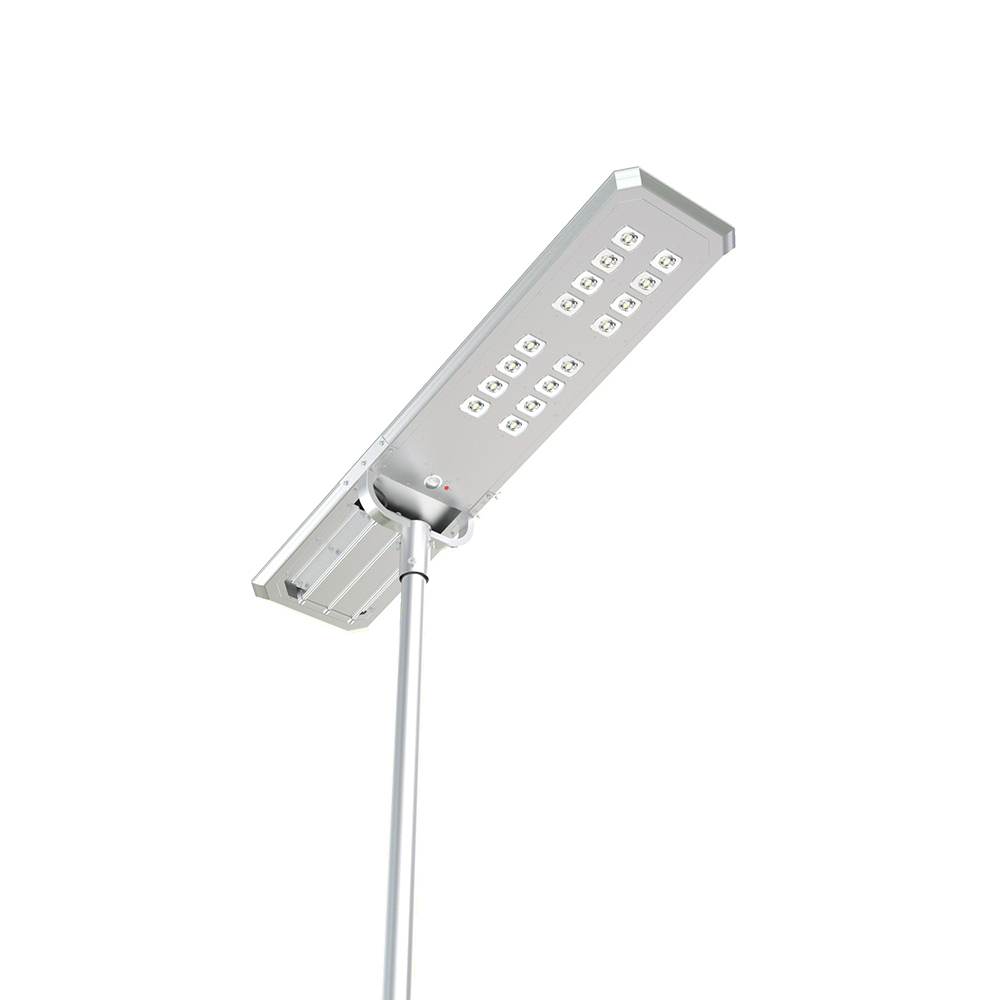
For a typical church lot, the 80W solar parking lot light (SKU SSLL30-080) is the fixture we would look at first. It is an all-in-one head with the panel, battery and LEDs in one housing. Here is what its product page lists, checked November 17, 2026:
- 9,600 lumens at 6500K
- 72W monocrystalline solar panel and a 150Ah, 3.7V battery
- 120° motion sensor with a 26 ft range
- Mounts 19.5 to 26 ft high
- 3-year warranty
- $769.99 each
Its three night modes match how churches use a lot:
- Evening program nights: mode 2 runs at 100% for the first 5 hours after dusk, covering services, classes and events, then drops to 25% for the rest of the night and returns to full brightness on motion.
- Quiet nights: mode 1 runs at 30% all night and jumps to full brightness when the sensor picks up a person or car. This is the most frugal setting for a lot that sits empty most evenings.
- Steady light: mode 3 holds 70% all night, until the battery runs low. Use it where a constant level matters more than saving charge.
The 80W head charges only from its own panel, so place the poles where the panel sees open sky. Shade from a steeple, a tall building or mature trees will cut into the charge, especially in winter.
Other fixtures for church and nonprofit properties

A larger lot or a wide entrance drive may need more output, and walkways need less. These are the other solar lights we would consider, all with prices and specifications from their product pages on November 17, 2026:
| Fixture | Lumens | Color | Night mode | Price |
|---|---|---|---|---|
| 80W parking lot light | 9,600 | 6500K | 3 motion modes | $769.99 |
| 100W parking lot light | 12,000 | 6500K | 3 motion modes | $899.99 |
| 100W parking lot and street light | 10,000 | 4000K | 100% for 5 h, then 20% | $999.99 |
| 120W parking lot and street light | 12,000 | 4000K | 100% for 5 h, then 20% | $1,129.99 |
| 20W pole light | 3,000 | 2700K or 5000K | 3 motion modes | $499.99 |
| 30W post top light | 3,000 | 4000K | Motion dimming | $349.99 |
| 15W bollard | 350 | 3000K or 5000K | Dusk to dawn | $599.99 |
Prices for one unit from ledlighting-solutions.com product pages, November 17, 2026 (the 15W bollard is on sale from $649.99). Warranties are listed under Upkeep below. Poles, foundations and installation are not included.
- Main lot, more output: the 100W motion model adds 2,400 lumens over the 80W with the same three modes. The 100W and 120W parking lot and street lights are 4000K, a less bluish white, and mount higher (32.8 ft and 30 ft).
- Entrances and the walk to the door: the 20W pole light comes in 2700K warm white, which suits a church entrance, and fits a 2 3/8 to 3 inch pole. The 30W post top light gives 360° light for paths at 9 to 12 ft. HOAs use the same fixtures; see our guide to solar lamp posts.
- Garden paths and memorial gardens: the 15W bollard keeps a soft 350 lumens at knee height.
Browse the full range in our commercial parking lot and street lights, the solar parking lot and street light category and our light poles.
Upkeep: what to budget for
Solar lights have no wiring to fail and no bulbs to change, but they are not maintenance-free. Plan for three things:
- Batteries. Every rechargeable battery loses capacity with age. How long it lasts depends on the model, the climate and how hard the light runs each night, so plan for replacement in the long-range budget.
- Clean panels. Dust, pollen, leaves and bird droppings cut the charge. A rinse a few times a year keeps the panels working.
- Warranty terms. Our four parking lot heads and the 30W post top light carry 3-year warranties, the bollard 2 years and the 20W pole light 1 year. Keep the invoice with your building records.
A checklist for the board or finance committee
- List when the lot is used after dark. Services, programs, meetings and pantry hours tell you which night mode to use.
- Find your electric rate. Take the cents per kWh from a recent bill and redo the math above for your number of poles.
- Get a quote for wiring new lights. Trenching, conduit, wire and any panel upgrade. This is usually the deciding number.
- Check sun and shade. Each solar head needs open sky. Note the trees and buildings that shade the lot in winter.
- Size the lot. Use our solar parking lot lighting guide for fixture counts, pole heights and spacing.
- Budget for upkeep. Battery replacement and panel cleaning belong in the long-range plan.
Frequently asked questions
Are solar parking lot lights worth it for a church?
They are worth it where a lot needs new lights and bringing power to them would mean trenching, conduit and wiring. On energy alone, a solar head saves about $63 a year compared with a wired 100W LED fixture at the U.S. commercial average rate, which takes years to repay its higher price. If your lot already has working wired lights, solar is harder to justify.
How much can a church save with solar parking lot lights?
A wired 100W LED parking lot light running 12 hours a night uses 438 kWh a year, about $63 at 14.47 cents per kWh. A 10-pole lot comes to about $634 a year and a 25-pole lot about $1,584. Solar lights of similar output use no grid electricity, so that is what the church keeps. Use your own rate and hours for an exact figure.
How much do solar parking lot lights for churches cost?
On our site, the 80W solar parking lot light is $769.99 each as of November 2026. Higher-output 100W and 120W heads run $899.99 to $1,129.99. Poles, foundations and installation are extra.
What is the downside of solar lights?
They cost more up front than wired fixtures, they need open sky to charge, and their batteries lose capacity over the years and eventually need replacing. Long stretches of cloudy weather can also shorten how long they run. Motion and dimming modes help by saving charge when the lot is empty.
How many years do solar parking lot lights last?
Our solar parking lot heads carry 3-year warranties. The battery is the part that wears out first, and how long it lasts depends on the model, the climate and how hard the light runs each night. Plan for battery replacement in your long-range budget.
Can solar parking lot lights stay on all night?
Yes. They switch on at dusk and off at dawn. Most save charge by dimming late at night: the 80W light can run at 100% for the first 5 hours and then 25%, or at 30% all night with full brightness on motion, or at 70% all night until the battery runs low.
Do solar parking lot lights need wiring or trenching?
No. Each light has its own solar panel and battery, so nothing runs between poles or back to the building. Each pole still needs a proper foundation.
- U.S. Energy Information Administration, Electric Power Monthly, Table 5.6.A, Average Price of Electricity to Ultimate Customers by End-Use Sector, August 2026 (U.S. commercial average 14.47 cents per kWh, preliminary): eia.gov
- LED Lighting Solutions product specifications and prices, checked November 17, 2026: 80W solar parking lot light and 100W LED shoebox light (the wired comparison), plus the other product pages linked above
- Savings estimate: 100 W x 12 hours x 365 nights = 438 kWh; 438 kWh x $0.1447 = $63.38 a pole a year. Energy only; excludes fixture, pole, installation and upkeep costs.