My Cart: 0 item(s)
_2.png "Shadows ReadyTheme")
Tennis Court Lighting: Pole Height, Fixture Layout and LED vs Metal Halide Retrofits
Key Takeaways
- A recreational tennis court is usually lit from four poles about 20 feet tall, two on each side of the court, never behind the baselines. Eight 300 W LED shoebox fixtures on those poles give an estimated 20 foot-candles over the full 120 x 60 ft court enclosure.
- Recreational courts are commonly designed to 20 to 30 foot-candles. For a Class III facility (club and high school play), USTA recommends 50 foot-candles average, 40 minimum, with a maximum uniformity ratio of 2. That level takes eight poles.
- Keep every pole outside the court enclosure. USTA recommends 12 feet (10 minimum) between a sideline and any fixed object.
- Retrofitting 1,000 W metal halide? One 300 W LED per old head is not a like-for-like swap: it makes about half the light of a 1,000 W lamp. One 450 W LED flood, or two 300 W shoeboxes on a bullhorn, per old head is the honest replacement, and it still cuts the wattage by 40 to 55 percent.
- Fixtures and brackets for a four-pole recreational court run about $2,240 from LED Lighting Solutions (October 2026). Poles, footings, wiring and labor are extra.
To light a tennis court, put the poles along the sides of the court outside the fence line, mount the fixtures at 20 feet or higher, and size the fixtures to the level of play: about 20 to 30 foot-candles for recreational courts and 50 for club and high school courts. A single court needs four poles for casual play and eight for competition, and LED fixtures do the job at roughly half the wattage of the metal halide lights most older courts still run.
Below: light levels, the 4-pole and 8-pole layouts, pole height, fixture counts, cost, and how to retrofit a metal halide court on its existing poles. We supply the shoebox and flood fixtures, poles, brackets and slip fitters in the examples. We do not sell a dedicated stadium fixture, so the numbers are for recreational, HOA, park, school and club courts.
How much light does a tennis court need?
Court light is measured in foot-candles (fc), one lumen spread over one square foot; 1 fc is about 10.8 lux. The Illuminating Engineering Society's sports lighting practice, IES RP-6, groups facilities into four classes by level of play and spectators, and USTA guidance uses the same classes.
| Class | Typical court | Average light | Uniformity |
|---|---|---|---|
| Class IV | Recreational: parks, HOAs, apartment communities, backyard courts | 20 to 30 fc | Max-to-min about 2 |
| Class III | Club play, high school matches, local tournaments | 50 fc (40 min) | Max-to-min 2 |
| Class II | College and regional events | Higher, by design | Tighter than Class III |
| Class I | Professional and televised | Highest, by design | Tightest |
Class III figure: USTA recommendation as quoted in the District of Columbia Department of General Services concept design for the South East Tennis and Learning Center (2022). Class IV range: industry summaries of USTA and IES levels, which put the recreational minimum at 20 fc. The IES standard itself is sold by the IES; Class I and II courts need a lighting designer, so we do not quote figures for them.
Almost every court we are asked about is Class IV. A practical plan is 20 fc for a casual or backyard court, 30 fc for an HOA or park court people book for matches, and 50 fc for club and high school courts.
Uniformity matters as much as the average. A max-to-min ratio of 2 means the brightest spot is no more than twice the darkest; a dark patch near the baseline is exactly where a deep shot disappears. More poles, lighting from more directions, keep the ratio down.
The area you are lighting
A doubles court is 78 x 36 ft. The International Tennis Federation recommends at least 21 ft of runout behind each baseline and 12 ft beside each sideline, which makes the standard enclosure 120 x 60 ft, or 7,200 square feet. That whole area gets lit, because players chase balls well past the lines. Every estimate below uses 7,200 square feet for one court; courts side by side share the middle runout and are lit as one larger rectangle.
Where to put the poles: 4-pole and 8-pole layouts
Along the sides, never behind the baselines. A server tosses the ball up and looks into the sky, and so does a player tracking a lob. A pole at the end of the court puts a fixture straight in that line of sight. Side poles light the court across the players' view instead of into it.
- 4-pole layout (recreational): two poles on each side of the court, set outside the side fence, each roughly level with the service lines. Fixtures aim across the court and toward the nearer half, so every spot is lit from at least two directions.
- 8-pole layout (club and Class III): four poles on each side, evenly spaced along the 120 ft length. More poles means each fixture covers a smaller patch, which brings the uniformity ratio down to the level club play needs.
- Two or more courts: poles between adjacent courts can carry fixtures aimed both ways on a bullhorn bracket, so a two-court battery can share its middle poles instead of doubling the pole count.
Keep every pole out of the playing area. USTA recommends 12 feet (10 feet minimum) between the sideline and any fixed object, so poles belong at or outside the fence. Most courts put them just outside the fence line.
How tall should tennis court light poles be?
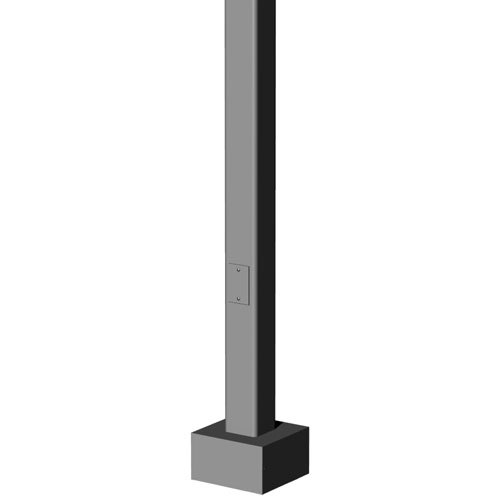
Height is what lets a fixture spread light across the court while still pointing down, away from players' eyes. Lighting design guides commonly use these ranges:
| Level of play | Typical pole height | Poles per court |
|---|---|---|
| Backyard and recreational | 20 to 26 ft | 4 |
| Club and high school | 26 to 40 ft | 6 to 8 |
| College and professional | 50 ft and up | 8 or more |
Ranges from the Sports Venue Calculator tennis court lighting layout guide; they are design practice, not a code requirement.
We recommend 20 feet as the minimum for a recreational court and 25 feet for an eight-pole club layout. Our 20 ft aluminum anchor-base pole has a 2 3/8 inch tenon top, a 0.188 inch wall and a hand hole with a grounding provision. For taller or heavier loads, the 25 ft square steel pole is hot-dip galvanized and powder-coated, with tenon or side-drilled tops. Poles are priced by quote; see all light poles. Size the footing and anchor bolts for your wind zone and soil.
How many fixtures a tennis court needs
Not every lumen lands on the court. Some spills past the fence, and fixtures lose output as they age and collect dirt. To size a court we use a factor from a real photometric study: in the DIALux model behind our pickleball court lighting guide, about 42% of the rated fixture lumens reached the court after maintenance losses. We round that down to 40%:
Average foot-candles = fixture lumens x 0.4 ÷ 7,200 sq ft
The main fixture in our examples is the 120 to 300 W adjustable shoebox, rated 44,714 lumens at 300 W. Eight of them make 357,712 lumens: 357,712 x 0.4 ÷ 7,200 = about 20 fc.
Estimated average, 300 W shoeboxesUSTA Class III target
| Target | Layout | Watts | Rated lumens | Est. avg. |
|---|---|---|---|---|
| Casual, Class IV | 4 poles, 8 shoebox at 300 W | 2,400 | 357,712 | 20 fc |
| Match play, Class IV | 4 poles, 12 shoebox at 300 W | 3,600 | 536,568 | 30 fc |
| Strong Class IV | 8 poles, 16 shoebox at 300 W | 4,800 | 715,424 | 40 fc |
| Class III, 50 fc | 8 poles, 24 shoebox at 300 W | 7,200 | 1,073,136 | 60 fc |
Two fixtures per pole on a double bullhorn, three on a triple. The Class III layout is sized above 50 fc so the court still meets the target as fixtures age and the minimum stays near 40. Estimates only: a photometric layout replaces them with a point-by-point calculation and shows the real max-to-min ratio. The study behind the 0.4 factor used 60 degree lenses; the shoebox has a wider Type III pattern, so a real layout may need more fixtures.
Choosing the fixtures
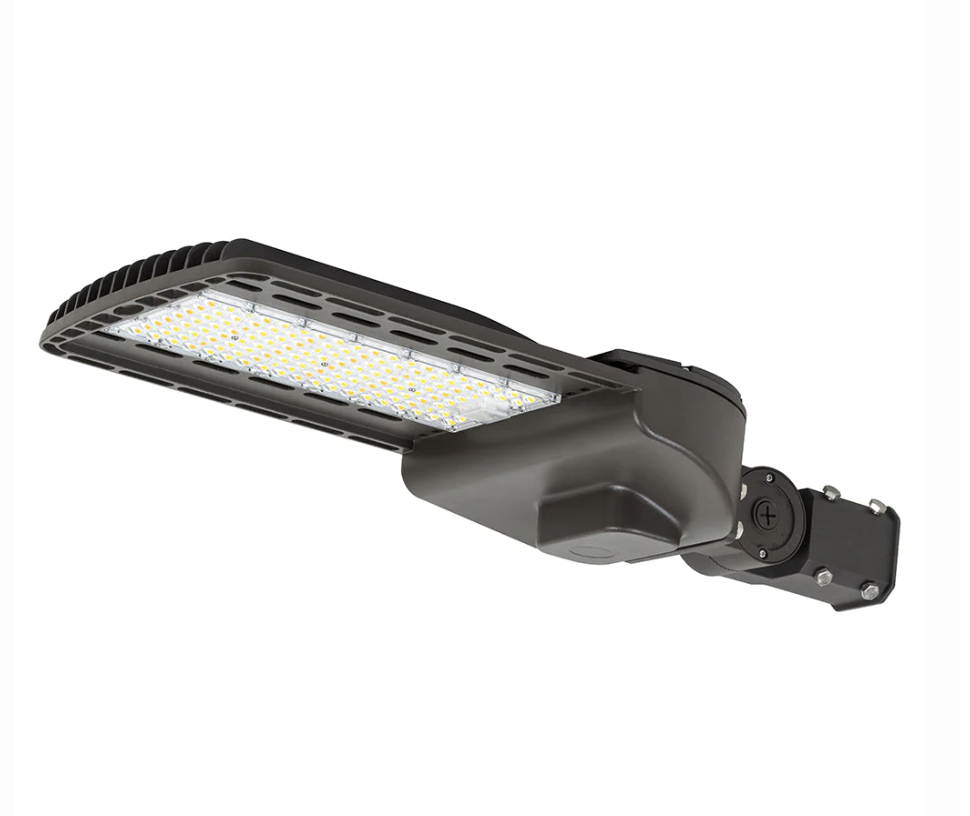
- Shoebox for new poles. The adjustable shoebox ($239.99) switches between 120, 180, 240 and 300 W, so you can build the poles once and tune the light later. It is rated over 145 lumens per watt, has a Type III distribution that throws light forward across the court, a rated life over 75,000 hours and a 5-year limited warranty. It mounts by slip fitter, trunnion or arm.
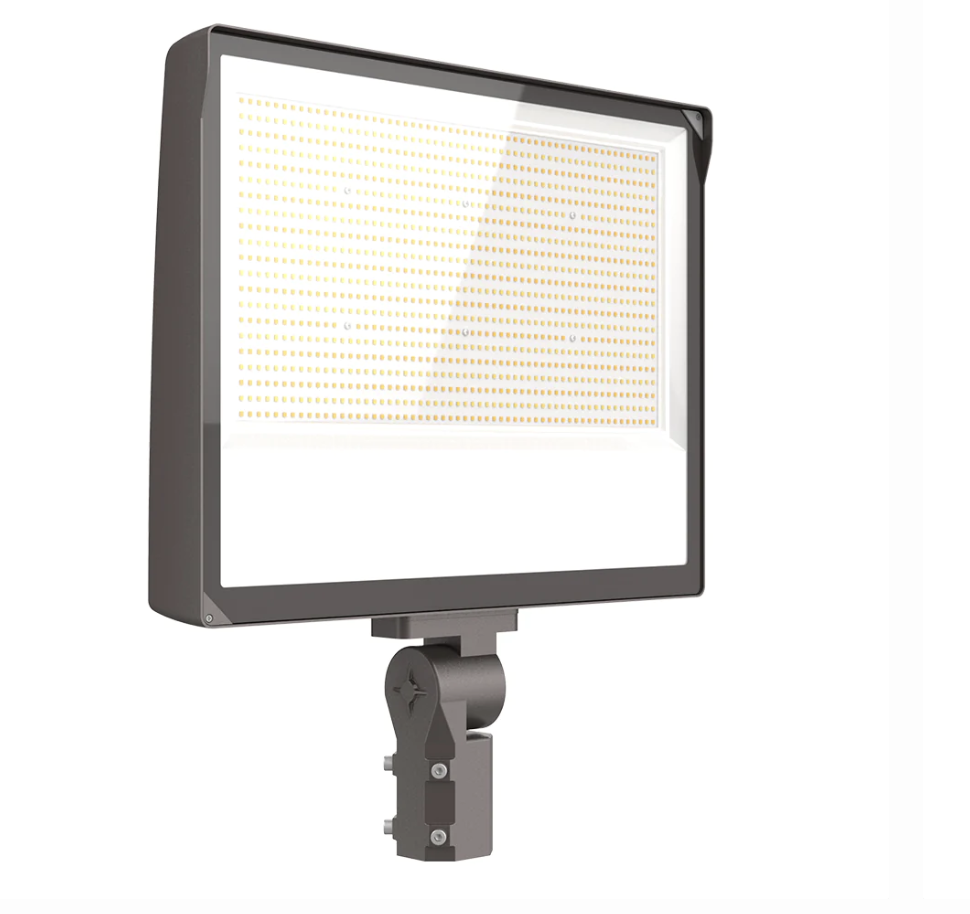
- Flood for retrofits and tall poles. The 240 to 450 W selectable flood ($338.99) is rated 37,440, 53,200 or 67,050 lumens with a 118 degree beam and a 5-year limited warranty. It is the closer match for the aimed flood heads on most older courts.
- Color temperature. 4000 K to 5000 K is the usual range. 5000 K reads crisper against a yellow ball; 4000 K is warmer and kinder to neighbors. Both fixtures let you choose.
- Glare. Mount shoeboxes flat. Tilt floods down so the top of the beam stays below horizontal, aimed at your own side of the net.
- Controls. Add a photocell ($19.99) for dusk-on and a timer for closing time.
Retrofitting a metal halide tennis court to LED
Many older lit courts still run 1,000 W metal halide heads. A common claim is that a 300 W LED replaces each one. Here are the actual numbers.
A standard 1,000 W metal halide lamp is rated about 110,000 lumens new and 86,000 mean lumens over its life. Our 300 W shoebox is rated 44,714 lumens, about half the lamp's mean output. Lamp lumens are measured on the bare lamp, and a metal halide fixture loses part of them in its reflector and lens, while LED ratings are for the complete fixture. That gap narrows the difference, but it does not close a two-to-one shortfall. Swap one 300 W fixture for each 1,000 W head and the court gets noticeably darker.
The swaps that keep the court at its current level are one 450 W flood per old head, or two 300 W shoeboxes on a bullhorn bracket. Here is the math for a court lit by eight 1,000 W heads, one per pole:
| Option and fixture cost | Watts | Lumens | Saved per year |
|---|---|---|---|
| Existing: 8 metal halide at 1,000 W | 8,000 plus ballast | 688,000 mean lamp lumens | Baseline |
| 8 floods at 450 W, $2,711.92 | 3,600 | 536,400 | About $964 |
| 16 shoeboxes at 300 W, 2 per pole, $4,479.76 | 4,800 | 715,424 | About $701 |
| 8 shoeboxes at 300 W, 1 per pole, $1,919.92 | 2,400 | 357,712 | About $1,226, but the court is about half as bright |
Power saved = watts removed x 4 hours a night x 365 nights x $0.15 per kWh, counting lamp watts only; ballast losses on the old fixtures make the real savings larger. Use your own hours and rate. The two-shoebox option adds eight double bullhorn brackets at $79.99. Metal halide lumens: Sylvania M1000/U lamp specification. LED prices from our product pages, October 2026.
Our LED fixtures are rated for 50,000 to 75,000 hours, so lamp changes at the top of the pole mostly stop. They also come on at full output instantly, with no metal halide warm-up, so a court can switch off between players on a push-button timer.
Reusing the existing poles

Sound poles rarely need to come down. Most of the work is at the top: our shoebox and bullhorn brackets fit a 2 3/8 inch tenon, and older poles often end in a 3, 4 or 5 inch top. A slip fitter reducer bridges the two:
- 2 3/8 in. reducer for a 3 in. pole, $29.99
- 2 3/8 in. reducer for a 4 in. pole, $34.99
- 2 3/8 in. reducer for a 5 in. pole, $44.99
- Slip fitter adapter, $24.99, to set the fixture angle
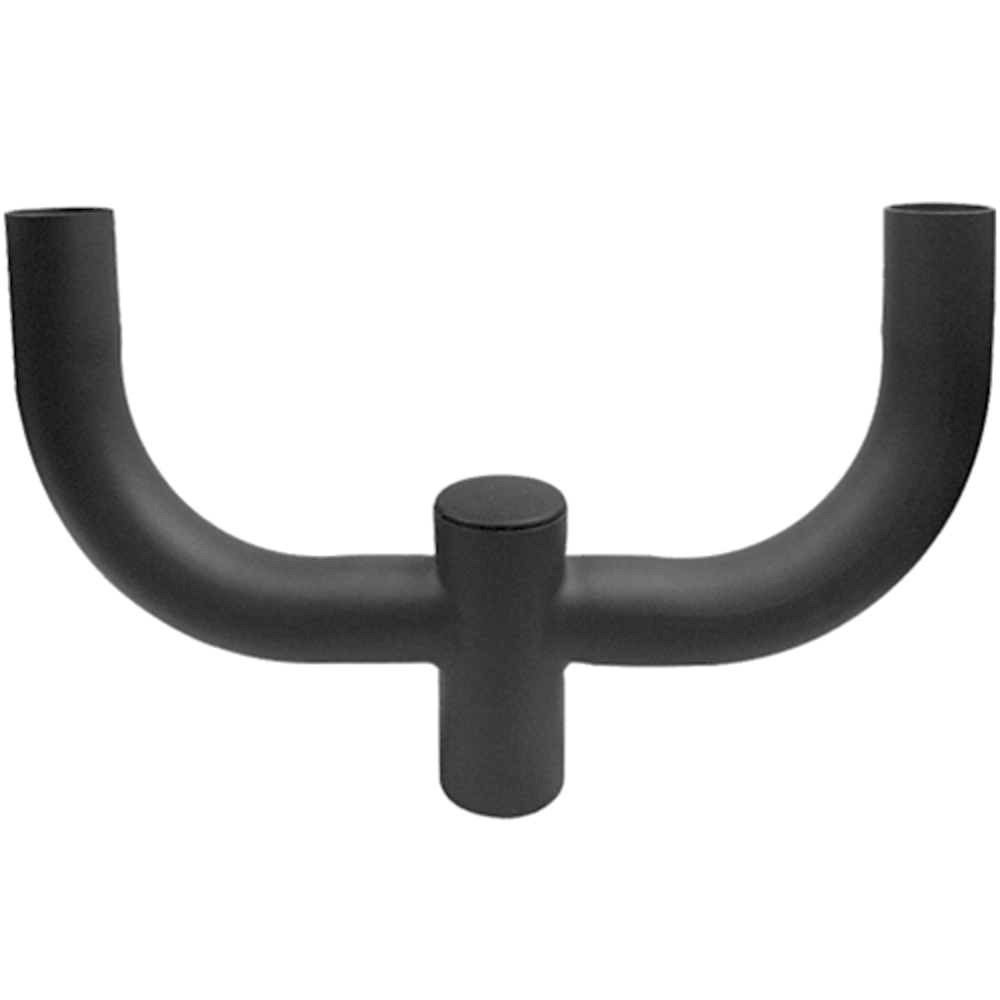
- Double bullhorn bracket, $79.99, and triple bullhorn bracket, $149.99, for two or three fixtures per pole
Before you order, measure the pole top's outside diameter, check the pole and footing for rust and cracks, and confirm the pole is rated for the weight and wind area of the new layout.
What tennis court lighting costs
Fixture and bracket prices for one new court, from our product pages, October 2026:
| Layout | Fixtures and brackets | Hardware | Power per year |
|---|---|---|---|
| 4 poles, about 20 fc | 8 shoebox at $239.99, 4 double brackets at $79.99 | $2,239.88 | About $526 |
| 4 poles, about 30 fc | 12 shoebox at $239.99, 4 triple brackets at $149.99 | $3,479.84 | About $788 |
| 8 poles, about 40 fc | 16 shoebox at $239.99, 8 double brackets at $79.99 | $4,479.76 | About $1,051 |
| 8 poles, Class III | 24 shoebox at $239.99, 8 triple brackets at $149.99 | $6,959.68 | About $1,577 |
Hardware totals exclude poles (priced by quote), photocells, footings, trenching, wire and labor. Power per year = total watts x 4 hours a night x 365 nights x $0.15 per kWh; use your own hours and rate.
Poles, footings, trenching, wire and an electrician make up the rest, and they depend on distance to power and soil, so get a local quote once pole positions are set.
Converting a tennis court to pickleball
A tennis court enclosure holds four pickleball courts, and the existing tennis poles are usually in roughly the right places for them. The lighting targets are similar: the ASBA pickleball manual puts recreational play at 30 fc average and 20 minimum. A court lit to 30 fc for tennis is already close; a 20 fc court needs more fixtures per pole, which the bullhorn brackets above allow. Our pickleball court lighting guide covers the conversion and the photometric study, and the outdoor basketball court lighting guide covers the same fixtures on a basketball court.
For the paths, benches and parking around the courts, where there is often no power, see our area and walkway lighting. Solar lights do not make enough light for tennis itself.
Lighting or retrofitting a court? Tell us how many courts, the level of play, whether the poles are new or existing, and the pole-top size if they are, and we will recommend fixtures, brackets and fitters and quote the order. Browse outdoor commercial LED lights, contact us or call 888-925-1966.
Frequently asked questions
What are the lighting requirements for a tennis court?
Recreational (Class IV) courts are commonly lit to 20 to 30 foot-candles average. For a Class III facility, such as club and high school courts, USTA recommends 50 foot-candles average and 40 minimum, with a maximum uniformity ratio of 2. Poles should stay at least 10 feet, ideally 12, from the sidelines.
How many lights do you need for a tennis court?
A recreational court typically uses eight to twelve LED fixtures on four poles. Eight 300 W shoebox lights give an estimated 20 foot-candles over a 120 x 60 ft court, and twelve give about 30. A Class III court needs eight poles and about 24 fixtures.
How many lumens to light a tennis court?
Using a 0.4 factor for light that actually reaches the court, about 360,000 rated fixture lumens for 20 foot-candles, 540,000 for 30 and 900,000 for 50 on a single 120 x 60 ft court.
How many watts should tennis court lights be?
With LED fixtures rated around 145 lumens per watt, a recreational court needs about 2,400 to 3,600 watts in total, usually as 300 W fixtures, two or three per pole. A Class III court needs about 7,200 watts.
How tall should tennis court light poles be?
At least 20 feet for a recreational court, and 25 feet or more for an eight-pole club court. Design guides use 20 to 26 feet for recreational play and 26 to 40 feet for club and high school play. Taller poles spread light more evenly and keep fixtures out of a server's line of sight.
What type of lights are best for lighting up tennis courts?
Pole-mounted LED shoebox or flood fixtures at 4000 K to 5000 K, placed along the sides of the court and aimed down. Shoeboxes suit new poles and low glare; aimed floods suit retrofits and taller poles. Add a photocell and a timer.
Can you replace metal halide tennis court lights with LED?
Yes, usually on the existing poles with a slip fitter reducer. Replace each 1,000 W metal halide head with one 450 W LED flood or two 300 W LED shoeboxes. A single 300 W LED makes about half the light of a 1,000 W lamp, so a one-for-one swap leaves the court darker.
How much does tennis court lighting cost?
At LED Lighting Solutions, fixtures and brackets for one recreational court cost about $2,240 for eight 300 W shoebox lights or $3,480 for twelve, as of October 2026. An eight-pole Class III court is about $6,960. Poles, footings, trenching, wiring and labor are extra.
Sources
- District of Columbia Department of General Services, South East Tennis and Learning Center concept design (2022), quoting USTA: Class III 50 fc average, 40 minimum, maximum uniformity ratio 2; 12 ft (10 ft minimum) sideline clearance
- International Tennis Federation, court size and recommended runout (21 ft behind baselines, 12 ft beside sidelines)
- Sports Venue Calculator, LED tennis court lighting layout and design guide (USTA and IES class levels; pole heights and counts by level of play)
- Sylvania M1000/U metal halide lamp specification (110,000 initial and 86,000 mean lumens)
- Illuminating Engineering Society, ANSI/IES RP-6, Recommended Practice: Sports and Recreational Area Lighting
- LED Lighting Solutions, DIALux photometric report for a 20 x 10 m court, 8 x 20,136 lm luminaires, 335 lux average, maintenance factor 0.8 (October 2022)
- LED Lighting Solutions product pages, October 2026