My Cart: 0 item(s)
_2.png "Shadows ReadyTheme")
Crosswalk Signs Explained: W11-2, R1-6, S1-1 and What Each One Means
Key Takeaways
- The yellow diamond with a walking person is the W11-2 Pedestrian Crossing sign. It is a warning sign: it tells drivers that people may be crossing, either ahead (with an AHEAD or distance plaque) or right here (with a downward arrow plaque).
- The R1-6 In-Street Pedestrian Crossing sign stands in the road on the center line or an island. It is a regulatory reminder of the state law to yield to (or stop for) people in the crosswalk.
- The S1-1 School sign is a fluorescent yellow-green pentagon. With a downward arrow plaque it marks a school crossing. The MUTCD requires the fluorescent yellow-green color on school warning signs.
- MUTCD 11th Edition sizes: W11-2 is 30 x 30 inches on a single-lane road and 36 x 36 on multi-lane roads; S1-1 is 36 x 36 (30 x 30 minimum); the in-street R1-6 is 12 x 36 with its top no more than 4 feet above the pavement.
- At a marked crosswalk with no signal or STOP sign, a flashing LED sign or a rectangular rapid flashing beacon (RRFB) can be added to the W11-2 or S1-1 assembly. FHWA reports RRFBs can cut pedestrian crashes by up to 47%.
A crosswalk sign warns drivers that people walk across the road at or near that spot, so they should slow down and be ready to yield. The most common one, the yellow diamond showing a walking person, is the MUTCD W11-2 Pedestrian Crossing sign. Two others often stand beside it: the R1-6 In-Street Pedestrian Crossing sign, a narrow sign in the middle of the road that restates the state law to yield to or stop for pedestrians, and the S1-1 School sign, a fluorescent yellow-green pentagon used at school crossings. Below: what each sign means, the plaques that go with them, MUTCD 11th Edition sizes and colors, placement, and when to add a flashing sign or beacon.
The crosswalk sign family at a glance
Most crossings use an assembly: a main sign plus a small plaque underneath that tells drivers where the crossing is. Here is how the pieces fit together.
| Sign or assembly | What it tells drivers | Where it goes |
|---|---|---|
| W11-2 yellow diamond + W16-7P arrow | The crossing is right here | At the crosswalk, on a post |
| W11-2 + AHEAD or XX FEET plaque | A crossing is coming up | In advance of the crosswalk |
| R1-6 or R1-6a, tall white in-street sign | State law: yield to (or stop for) pedestrians in the crosswalk | In the road at the crosswalk: center line, island or lane line |
| R1-5 series, square white sign | Yield or stop at this line, before the crosswalk | 20 to 50 ft before the crosswalk on multi-lane roads |
| S1-1 yellow-green pentagon + W16-7P arrow | School crossing right here | At a school crosswalk |
| S1-1 + AHEAD or XX FEET plaque | School crossing coming up | In advance of the first school crossing |
| R1-6b or R1-6c, in-street school sign | State law: yield to (or stop for) children in the crosswalk | In the road at a school crosswalk |
Source: MUTCD 11th Edition, Sections 2B.19, 2B.20, 2C.55 and 7B.03.
The colors carry meaning on their own. Yellow and fluorescent yellow-green diamonds are warning signs: they advise. White rectangles such as the R1-6 are regulatory: they state a law. The pentagon shape is reserved for the S1-1 School sign, which is why drivers read it as "school" before they can make out the symbol.
W11-2 Pedestrian Crossing sign

The W11-2 is a Non-Vehicular Warning sign under Section 2C.55, and every pedestrian crossing assembly is built around it. What it means depends on the plaque below it:
- With a diagonal downward arrow (W16-7P): the crossing is at this spot. A W11-2 post-mounted at the crossing shall carry the arrow; an overhead one shall not.
- With an AHEAD (W16-9P) or XX FEET plaque: a crossing is ahead. MUTCD guidance says a W11-2 used in advance of a crossing should carry one of these.
Two rules trip people up. The assembly shall not be installed on an approach controlled by a STOP or YIELD sign, apart from a few roundabout and channelized right-turn cases. And the background may be yellow or fluorescent yellow-green, but guidance says not to mix the two in one area, so pick one color for the whole corridor or campus.
What size W11-2 do you need?
| Road type | MUTCD size | Our price: yellow / yellow-green |
|---|---|---|
| Conventional road, single lane each way | 30 x 30 in | $85.99 / $110.06 |
| Conventional road, multi-lane | 36 x 36 in | $124.99 / $159.99 |
| Expressway | 36 x 36 in | $124.99 / $159.99 |
| Oversized | 48 x 48 in | Call us |
Sizes: MUTCD 11th Edition, Table 2C-2; diamond-shaped warning signs on multi-lane conventional roads shall be at least 36 x 36. Prices from the W11-2 product page as of October 2026: engineer grade yellow / diamond grade fluorescent yellow-green; high intensity prismatic yellow is $91.99 (30 in) and $133.06 (36 in). A 24 inch size is also sold for private lots and campuses, but it is smaller than any size in the MUTCD table.
R1-6 In-Street Pedestrian Crossing sign
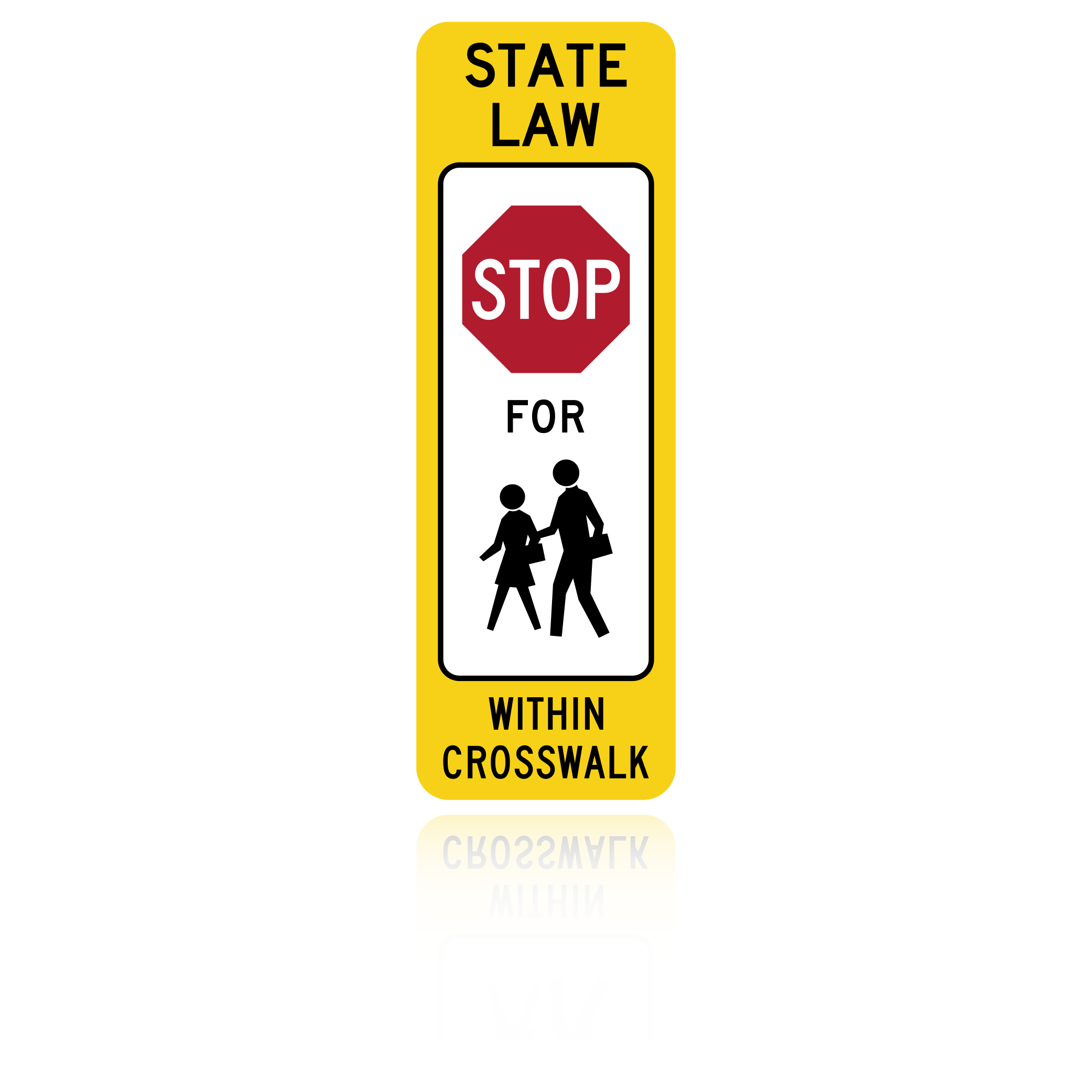
The R1-6 is the sign people mean when they search for a "stop for pedestrians in crosswalk sign." It stands in the street, not beside it, and reminds drivers of the right-of-way law at an unsignalized crosswalk. The R1-6 uses a YIELD symbol and the R1-6a a STOP symbol; the words YIELD or STOP may replace the symbol, and STATE LAW may be shown across the top. Section 2B.20 sets the rules:
- STOP FOR only where the law says stop. The STOP FOR legend shall only be used in states whose law specifically requires drivers to stop for a pedestrian in a crosswalk. Elsewhere, use YIELD TO.
- In the road, at the crosswalk. On the center line, a median island, a lane line or an edge line. It shall not be post-mounted at the roadside, and it shall not be placed in advance of the crosswalk as an "education" sign.
- A supplement, not a substitute. At an uncontrolled crossing it shall only supplement a W11-2 with a W16-7P arrow plaque at the crosswalk.
- Not at signals. It shall not be used where the approach is controlled by a traffic signal or a pedestrian hybrid beacon.
- Short and flexible. The top of the sign may be no more than 4 feet above the pavement, and unless it sits on a raised island its support shall bend over and spring back when a vehicle hits it.
Table 2B-1 sizes the R1-6 at 12 x 36 inches. We stock the school versions, the R1-6b (yield) and R1-6c (stop), at 12 x 36 inches from $68.99 in engineer grade to $82.99 in diamond grade fluorescent yellow-green, as of October 2026. If you need the general R1-6 or R1-6a, or a flexible in-street base, call us before you order.
R1-5: Yield Here to Pedestrians
On a multi-lane road with no signal, one car stopped for a pedestrian can hide that pedestrian from a driver in the next lane. The R1-5 series pulls drivers back to a yield or stop line 20 to 50 feet before the crosswalk. Section 2B.19 requires it wherever such lines are used on an uncontrolled multi-lane approach, bans the STATE LAW legend on it, and says it shall not share a post with the W11-2. Table 2B-1 sizes it at 36 x 36 inches.
S1-1 School sign and school crossings
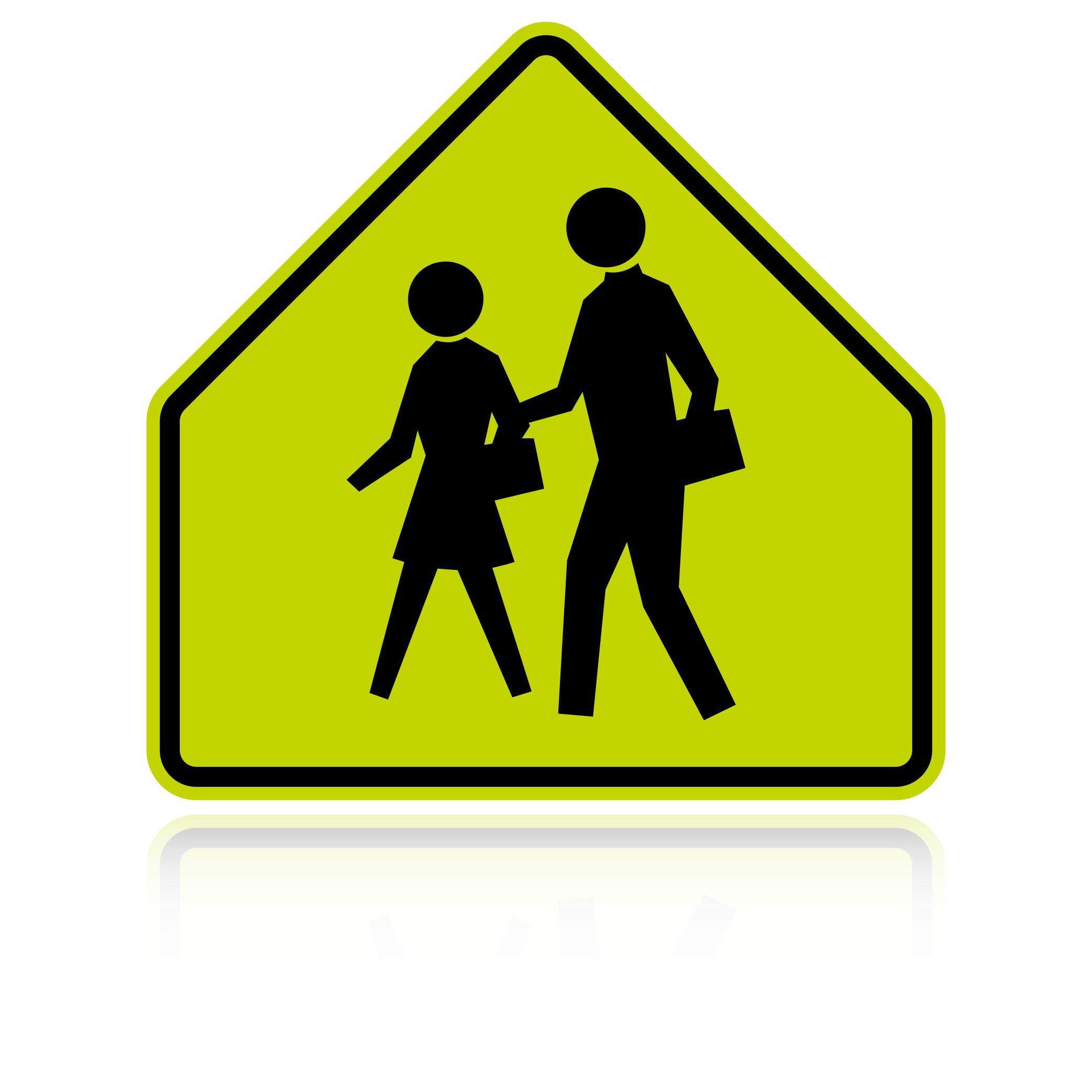
The S1-1 is the School sign. Section 7B.02 gives it four uses: a school area, the start of a designated school zone, an advance school crossing (with an AHEAD or XX FEET plaque) and the school crossing itself (with a W16-7P arrow). The two crossing assemblies work like the W11-2 versions:
- School Advance Crossing assembly: S1-1 plus AHEAD or XX FEET. Required in advance of the first school crossing in each direction, unless an S1-1 already marks the start of the school zone.
- School Crossing assembly: S1-1 plus the downward arrow, at the crossing or as close to it as possible. It shall not be used at crossings other than those next to schools or on established school walking routes, and not on approaches controlled by a STOP or YIELD sign.
Color is not optional here. Section 7B.01 says school warning signs and their plaques shall have a fluorescent yellow-green background with a black legend and border. Our S1-1 sign is offered in standard yellow too, so for a school crossing order the diamond grade fluorescent yellow-green option: $110.06 at 30 inches or $159.99 at 36 inches, as of October 2026. Table 7B-1 lists 36 x 36 inches for conventional roads, 30 x 30 as the minimum and 48 x 48 as the oversized size for roads with four or more lanes at 40 mph or more.
Where crosswalk signs go
The MUTCD placement numbers to plan around:
- Mounting height. In business, commercial and residential areas where people walk or park, the bottom of a roadside sign must be at least 7 feet above the top of the curb. In rural areas the minimum is 5 feet above the pavement edge. A plaque mounted below the main sign may sit 1 foot lower (Section 2A.15).
- The crossing assembly (W11-2 or S1-1 with the arrow) goes at the crosswalk, or as close to it as possible.
- The advance assembly goes far enough back for a driver to react. Table 2C-3 gives advance placement distances; its column for a possible stop, the case at a crosswalk, is a sound starting point.
Those distances assume a sign with a 6-inch or larger legend. The table's notes add at least 100 feet when the legend is smaller or the sign has more than four words. The engineer or agency with jurisdiction makes the final call; the table is guidance.
When a crosswalk needs a flashing sign or beacon
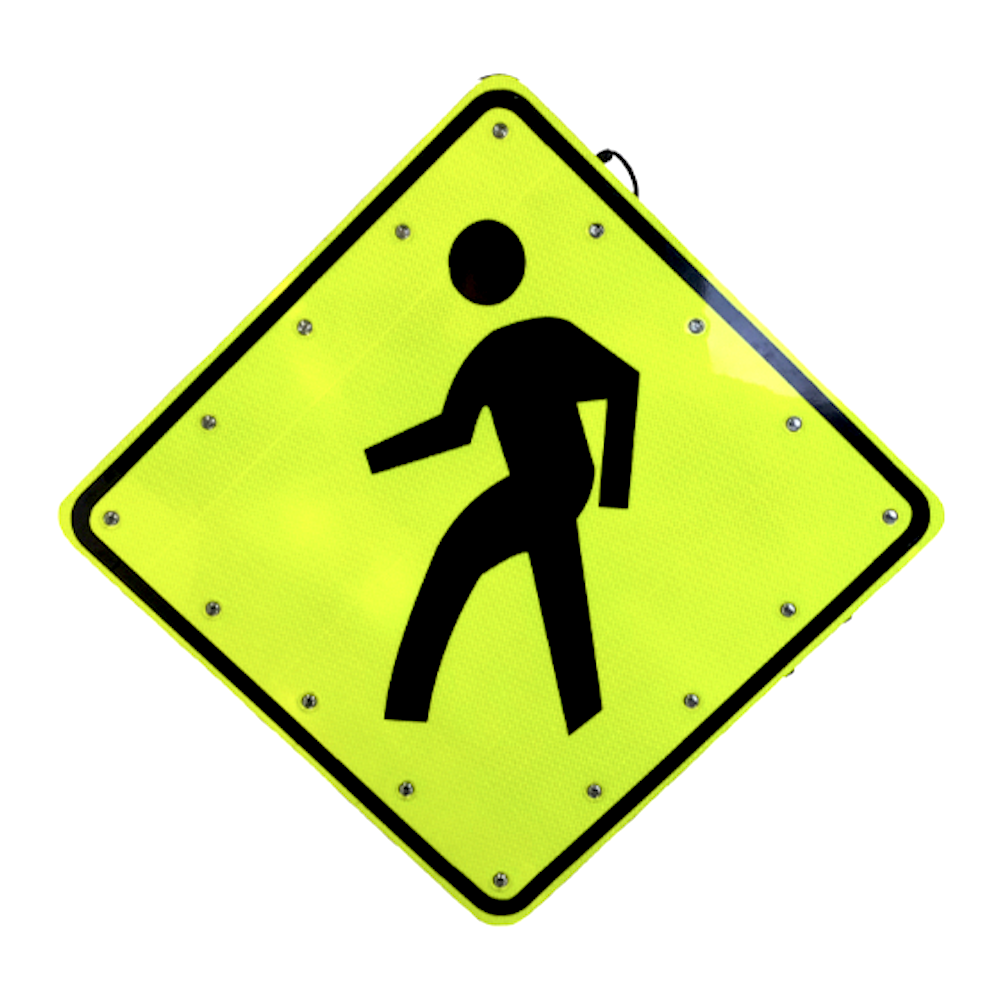
Where drivers routinely fail to yield, on wide roads, at night or near schools, agencies add light. The MUTCD treats the three options differently:
- LED-enhanced sign. LEDs in the border or symbol of the W11-2 or S1-1. Section 2A.12 allows white, yellow or fluorescent yellow-green LEDs on these signs; if they flash, all must flash together 50 to 60 times a minute. Our 30 inch solar flashing crosswalk sign runs 24/7 or dusk to dawn, 5 to 7 days per full charge per its spec sheet, with a 3-year warranty, for $999.99 as of October 2026. The push-button system starts at $4,399.99 for two signs.
- Rectangular rapid flashing beacon (RRFB). Two amber lights under the sign that flash rapidly when a pedestrian pushes the button. Chapter 4L allows them only to supplement a W11-2, S1-1 or W11-15 crossing sign at a marked crosswalk on an uncontrolled approach. Our solar one-direction RRFB kit is $2,499.99 and the back-to-back kit $3,499.99, before signs.
- Pedestrian hybrid beacon or signal. These stop traffic with a red indication and follow the signal chapters of Part 4. Once an approach has one, the R1-6 and the RRFB are no longer allowed there.
FHWA lists RRFBs as a Proven Safety Countermeasure, with up to 47% fewer pedestrian crashes. Our RRFB guide covers placement and cost in full, and the RRFB crosswalk kits page compares the kits.
Worked example: signing a midblock crosswalk
Say a city is marking a new crosswalk across a two-lane, 30 mph street between a library and a park, with no signal. Here is how the rules above turn into a sign list for both directions:
- At the crosswalk: one W11-2 with a W16-7P arrow plaque on each side, facing each direction of traffic. A single-lane road takes the 30 x 30 inch W11-2.
- In advance: one W11-2 with an AHEAD plaque per direction, about 200 feet back, from the 30 mph row of Table 2C-3.
- Optional in-street sign: one R1-6 on the center line at the crosswalk, on a flexible base, reading YIELD TO or STOP FOR depending on state law.
- Mounting: bottoms of the post-mounted signs at least 7 feet above the curb, since people walk here; the arrow plaques may sit 1 foot lower.
- Color: all yellow or all fluorescent yellow-green, not a mix.
Four 30 inch W11-2 signs in high intensity prismatic sheeting cost 4 x $91.99 = $367.96, and two 12 x 24 inch arrow plaques in the same sheeting 2 x $33.99 = $67.98: $435.94 before posts, the AHEAD plaques and the in-street sign. If drivers still do not yield once the crossing opens, the same assemblies can take a solar RRFB later without replacing the signs.
A note on the arrow plaque: our W16-7 diagonal arrow comes in 12 x 24 and 18 x 30 inch sizes, and a bundle of six 18 x 30 plaques is $226.99. The 11th Edition table lists 21 x 15 inches, so check which size your agency specifies.
Signing a crosswalk? Tell us the road width, the speed limit and whether the crossing serves a school, and we will help you put together the signs, plaques and any flashing option. Browse crosswalk and pedestrian signs, school crossing signs and solar crosswalk signs, contact us, or call 888-925-1966.
Frequently asked questions
What does a crosswalk sign mean?
A crosswalk sign warns drivers that people cross the road at or near that point. The yellow diamond W11-2 sign with a downward arrow plaque marks the crossing itself; with an AHEAD plaque it warns of a crossing coming up. Drivers should slow down and be ready to yield.
What are the different types of crosswalk signs?
The main ones are the W11-2 Pedestrian Crossing warning sign, the R1-6 In-Street Pedestrian Crossing sign, the R1-5 Yield Here to Pedestrians sign, the S1-1 School sign for school crossings, and the plaques that go under them: the W16-7P downward arrow, AHEAD and XX FEET.
Do drivers have to stop at a crosswalk sign?
It depends on state law. Some states require drivers to stop for a pedestrian in a crosswalk and others require them to yield. The MUTCD only allows the STOP FOR legend on in-street signs in states whose law specifically requires a stop.
What color are crosswalk signs?
Pedestrian crossing warning signs are yellow or fluorescent yellow-green with a black symbol. School crossing signs must be fluorescent yellow-green. In-street R1-6 signs are white with a yellow or fluorescent yellow-green panel behind the pedestrian symbol.
What is the difference between a crosswalk sign and a school crossing sign?
A crosswalk sign (W11-2) is a yellow diamond with one walking person and can be used at any pedestrian crossing. A school crossing sign (S1-1) is a fluorescent yellow-green pentagon with two children and may only be used at crossings next to schools or on established school walking routes.
What is an R1-6 sign?
The R1-6 is the In-Street Pedestrian Crossing sign. It is a 12 by 36 inch regulatory sign placed in the road at a crosswalk, on the center line, a lane line or an island, reminding drivers to yield to or stop for pedestrians. Its top must be no more than 4 feet above the pavement.
What size is a crosswalk sign?
Under the MUTCD 11th Edition, the W11-2 is 30 by 30 inches on single-lane conventional roads and 36 by 36 inches on multi-lane roads and expressways, with a 48 by 48 inch oversized option. The S1-1 school sign is 36 by 36 inches, with a 30 by 30 inch minimum.
How high should a crosswalk sign be mounted?
In towns and neighborhoods where people walk or park, the bottom of the sign must be at least 7 feet above the curb. In rural areas the minimum is 5 feet above the edge of the pavement. A plaque under the main sign may be 1 foot lower.
Sources
- FHWA, MUTCD 11th Edition, Chapter 2B (Sections 2B.19 and 2B.20; Table 2B-1)
- FHWA, MUTCD 11th Edition, Chapter 2C (Section 2C.55; Tables 2C-2 and 2C-3)
- FHWA, MUTCD 11th Edition, Chapter 2A (Sections 2A.05, 2A.12 and 2A.15)
- FHWA, MUTCD 11th Edition, Part 7 (Sections 7B.01 to 7B.03; Table 7B-1)
- FHWA, MUTCD 11th Edition, Part 4 (Chapter 4L, rectangular rapid flashing beacons)
- FHWA, Proven Safety Countermeasures: Rectangular Rapid Flashing Beacons (highways.dot.gov), citing NCHRP Research Report 841 (2017)
- LED Lighting Solutions product pages for the W11-2, S1-1, R1-6b, R1-6c and W16-7 signs, solar flashing crosswalk signs and RRFB kits, checked 5 October 2026