My Cart: 0 item(s)
_2.png "Shadows ReadyTheme")
Rectangular Rapid Flashing Beacons (RRFB): The Complete Guide to MUTCD Rules, Cost and Solar Installation
Key Takeaways
- A rectangular rapid flashing beacon (RRFB) is a pair of yellow LED lights mounted under a pedestrian, school or trail crossing sign. It stays dark until someone pushes the button, then flashes in a fast, irregular pattern that tells drivers a person is about to cross.
- The Federal Highway Administration (FHWA) lists RRFBs as a Proven Safety Countermeasure: up to 47% fewer pedestrian crashes, and driver yielding rates as high as 98% depending on speed, lanes and crossing distance.
- The MUTCD 11th Edition, Chapter 4L, sets the rules. RRFBs go only at marked crosswalks on uncontrolled approaches, never where a STOP sign, YIELD sign, traffic signal or pedestrian hybrid beacon already controls traffic. Each approach needs a sign and beacon on both sides of the road.
- Our solar RRFB crosswalk kits cost $1,249.99 for a single beacon, $2,499.99 for a two-sided one-way crossing and $3,499.99 for a back-to-back two-way crossing, as of September 2026. A complete two-way crossing with signs, arrow plaques and push-button signs comes to $3,897.89 before posts and installation.
- Solar RRFBs need no trenching or power drop, which is why FHWA suggests solar panels for them. Each beacon system clamps to an existing sign post.
If you are responsible for a crosswalk that drivers keep rolling through, a rectangular rapid flashing beacon is usually the first upgrade engineers reach for. It costs a fraction of a signal, it goes up on the sign posts you already have, and a solar unit needs no electrical service. This guide covers what an RRFB is, the MUTCD rules that decide where it can go, what a complete crossing costs, and how a solar kit is installed.
What is a rectangular rapid flashing beacon?
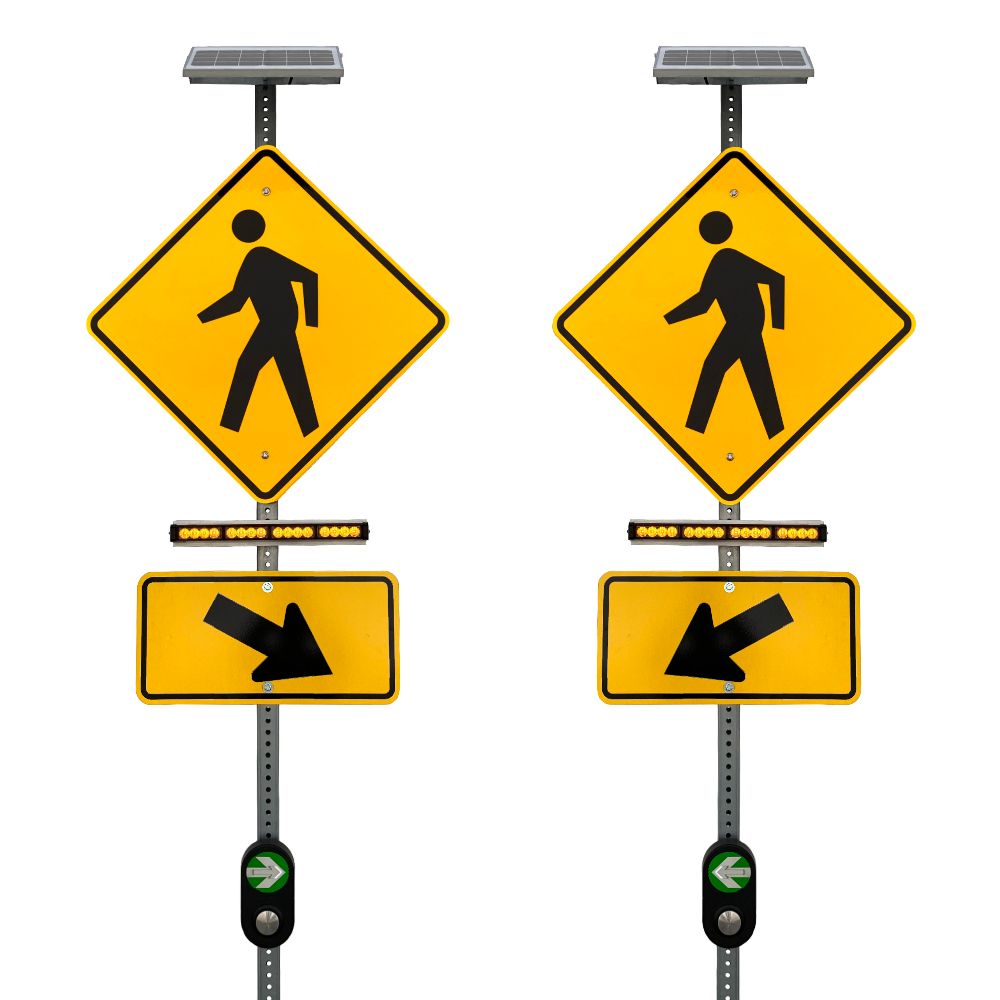
An RRFB is a warning beacon made of two rectangular yellow LED indications side by side. It mounts on the same post as a crossing warning sign, between the sign and the downward arrow plaque that points at the crosswalk. When a pedestrian presses the push button (or a passive detector sees them), the two lights flash left, right, left, right, then together, over and over. That pattern is called wig-wag plus simultaneous, or WW+S, and it is deliberately hard for a driver to ignore.
When nobody is crossing, the beacon is dark. That matters: drivers learn that a flashing RRFB means a person is actually there, which is a big part of why yielding rates climb. FHWA also warns agencies not to overuse them for the same reason.
An RRFB does not stop traffic. Legally it is a warning beacon, so drivers must still obey the state's crosswalk law, but the beacon itself only warns. If you need a device that turns red and stops traffic, that is a pedestrian hybrid beacon, covered below.
How well do RRFBs work?
FHWA's Proven Safety Countermeasures program, which only lists treatments with strong research behind them, reports two numbers for RRFBs:
- Up to 47% fewer pedestrian crashes, from the crash modification factors in NCHRP Research Report 841 (2017).
- Driver yielding rates as high as 98%, from a Texas A&M Transportation Institute study (2016). FHWA is careful to say this varies with the posted speed limit, the number of lanes, the crossing distance, one-way versus two-way traffic and the time of day. Treat 98% as the best case, not the average.
FHWA says RRFBs are particularly effective at multilane crossings with speed limits under 40 mph. On faster or wider roads, a pedestrian hybrid beacon or a signal may be the better tool, and that is an engineering call for the agency that owns the road.
MUTCD rules for RRFBs (11th Edition, Chapter 4L)
RRFBs started under an FHWA interim approval (IA-21) and became part of the manual itself in the 11th Edition of the MUTCD. The current version is the 11th Edition with Revision 1, dated December 2025. Chapter 4L has three sections. Here is what they require, in plain English.
Where an RRFB can go (Section 4L.01)
- Only at a marked crosswalk across an uncontrolled approach.
- Only to supplement a W11-2 pedestrian, S1-1 school or W11-15 trail crossing warning sign. Post-mounted signs also need a W16-7P diagonal downward arrow plaque.
- Not at crosswalks across approaches controlled by a STOP sign, YIELD sign, traffic signal or pedestrian hybrid beacon. The exceptions are crosswalks at the entry or exit of a roundabout and across free-flow turn lanes separated by an island.
- An extra RRFB may go in advance of the crosswalk with an AHEAD or distance plaque, but only in addition to the one at the crosswalk, never instead of it.
How it must be built and mounted (Section 4L.02)
- Each unit has two rectangular yellow LED indications, each at least 5 inches wide by 2 inches high, side by side with at least 7 inches between them.
- The beacon housing may not stick out past the edges of the sign it supplements.
- It goes on the same post as the sign, either between the bottom of the sign and the top of the arrow plaque or within 12 inches above the sign.
- Two assemblies per approach: one on the right side of the road and one on the left. On a divided road, the left one should go in the median if practical.
- Daytime brightness must meet SAE J595 Class 1 yellow. An automatic dimmer is allowed at night.
- If a push button is used, an R10-25 push button sign is required to explain it. In the current MUTCD (Revision 1) its legend reads PUSH BUTTON FOR WARNING LIGHTS / WAIT FOR GAP IN TRAFFIC. An audible message ("Warning lights are flashing") is recommended for pedestrians with vision disabilities.
How it must operate (Section 4L.03)
- Dark until actuated, then off after a set time.
- Every RRFB at the crosswalk starts and stops flashing at the same moment.
- The flash cycle is fixed: 75 sequences per minute, each 800 milliseconds long, in the WW+S pattern. No single indication may flash more than 5 times per second, to avoid triggering seizures.
- The flash time should be long enough for a pedestrian to cross, based on the pedestrian clearance timing used for walk signals, and it restarts every time someone presses the button.
What you need for one crossing

Put the rules together and a standard post-mounted crossing needs the same set of parts on each post:
- A crossing warning sign: W11-2 pedestrian, S1-1 school or W11-15 trail.
- An RRFB unit under the sign, facing the traffic that sign faces.
- A W16-7P diagonal arrow plaque under the beacon, pointing at the crosswalk.
- A push button (or passive detection) and an R10-25 push button sign.
- A post on each side of the road, or in the median.
On a one-way street, traffic comes from one direction, so you need two assemblies facing it: one on each side. On a two-way street, each post carries beacons and signs facing both directions (back to back), so two posts still cover the crossing but you need four beacons, four signs and four arrow plaques.
How much does an RRFB cost?
Here is what the hardware for a crossing costs from LED Lighting Solutions, using the product pages as of September 2026. Posts and installation are separate because they depend on the site. To compare the kits side by side, see our RRFB crosswalk kits page.
| Item | What it covers | Price |
|---|---|---|
| Single solar RRFB | 1 beacon, 1 control box, 1 solar panel, 1 push button, mounting hardware | $1,249.99 |
| Solar RRFB system, one direction | 2 beacons (one per side of the street), 2 control boxes, 2 solar panels, 2 push buttons, hardware | $2,499.99 |
| Solar RRFB system, back to back | 4 beacons (both directions on both posts), 2 control boxes, 2 solar panels, 2 push buttons, hardware | $3,499.99 |
| W11-2 crossing sign, 24 in | Engineer grade yellow, each; fluorescent yellow-green diamond grade costs more | From $56.99 |
| W16-7P arrow plaque, 12 x 24 in | Engineer grade, each, added with a kit | $31.99 |
| R10-25 push button sign, 9 x 12 in | Engineer grade, each | $20.99 |
Prices from ledlighting-solutions.com, September 2026. Kits do not include posts, signs or sign hardware; signs and arrows can be added on the kit page.
Two worked examples
One-way street: the one-direction system ($2,499.99), two 24-inch W11-2 signs ($113.98), two arrow plaques ($63.98) and two R10-25 signs ($41.98) come to $2,719.93.
Two-way street: the back-to-back system ($3,499.99), four W11-2 signs ($227.96), four arrow plaques ($127.96) and two R10-25 signs ($41.98) come to $3,897.89.
Hardware before posts and installation
Add posts if the existing ones will not carry the new assembly, plus labor. Because a solar RRFB needs no conduit, trench or utility service, installation is usually a crew with a bucket truck or ladder and hand tools rather than an electrical contract. Get a local quote for the labor, and check whether your agency or state requires a traffic engineer to approve the location.
Solar or hardwired?
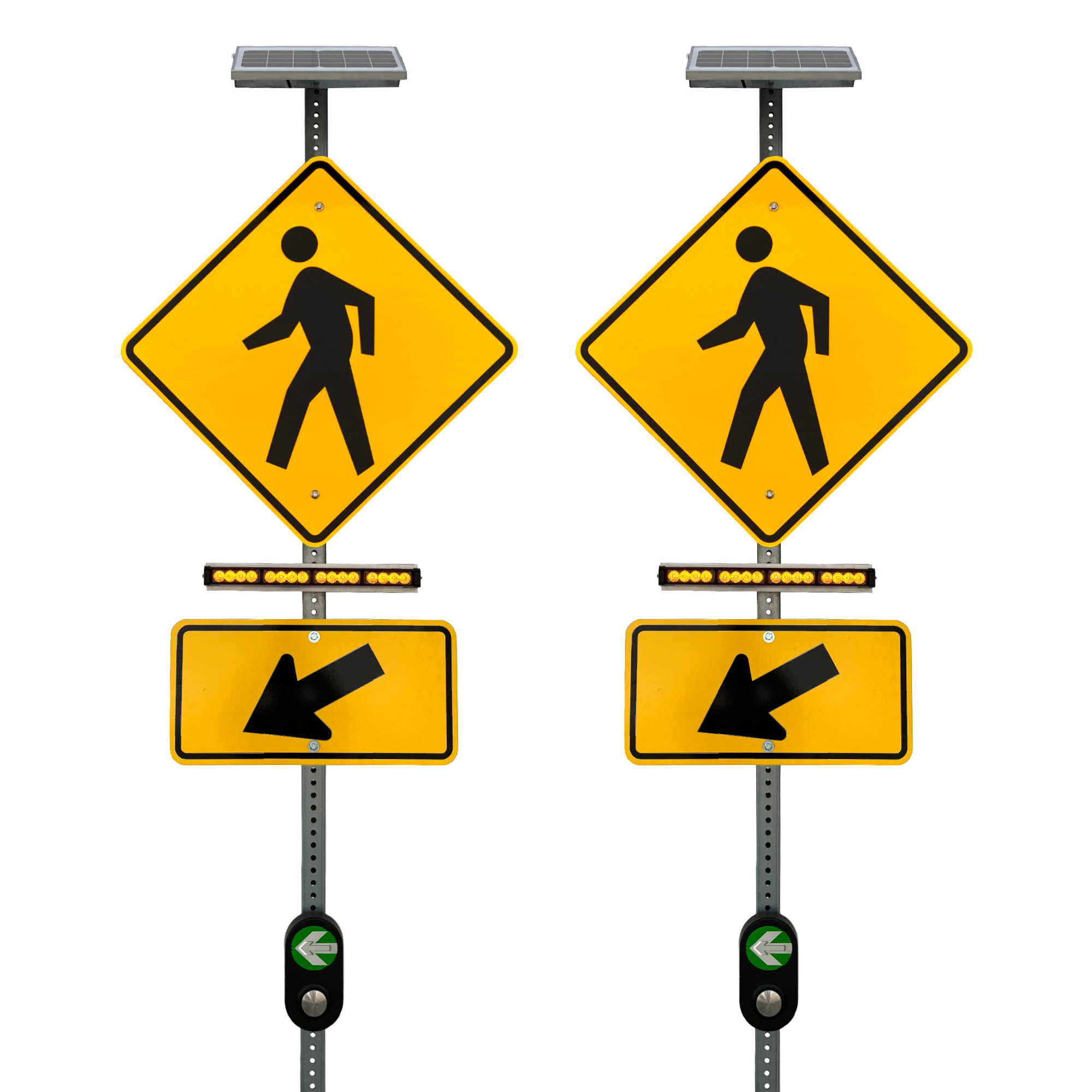
Most RRFBs installed today are solar, and FHWA's own guidance suggests solar panels to remove the need for a power source. An RRFB is dark most of the day and only draws power while it flashes, so a small panel and battery keep up easily at most crossings.
Our solar systems are rated for up to 12 hours of working time on a full charge, with a lithium battery rated for 3 to 5 years of life and a 2-year full warranty. The beacons talk to each other by radio, so pressing the button on either side starts both beacons together, which is what Section 4L.03 requires. Our spec sheet states that the beacons flash in the WW+S pattern and meet SAE J595 Class 1 yellow, the two requirements in Chapter 4L that buyers most often ask about.
A hardwired RRFB makes sense where power is already at the pole and the crossing is heavily shaded, such as under a tree canopy or between tall buildings. Where the panel cannot see open sky for most of the day, ask us before ordering solar.
How to install a solar RRFB kit
Our installation guide walks through it with pictures. The short version, with a flat-head screwdriver and a half-inch socket wrench:
- Charge first. Set each solar panel, connected to its control box, in full sun for one to two days before installation.
- Mount the sign and arrow plaque on the post, leaving room for the beacon between them.
- Band the control box to the back of the post behind the sign (above the signs on a back-to-back install).
- Band the beacon to the front of the post directly under the sign, facing traffic. On a back-to-back install, both beacons share one band.
- Mount the solar panel as high on the post as possible, facing the sunniest direction.
- Bolt the push button about 3 feet below the sign, within about 4 feet of the control box. Drilling is needed on posts other than perforated square tube.
- Connect and switch on. Plug the panel, beacon and button into the control box, fit the antenna, turn the switch on, and lock the box. Press each button and confirm both sides flash together.
The standard hardware fits posts from 3 to 4 inches in diameter, and the product page notes it also mounts to u-channel, perforated square tube and round posts. Check local rules for the push button's height and reach before you drill; the MUTCD sends you to Section 4I.05 for push button location. If you need a new post, our warning sign pages list post options.
RRFB vs HAWK signal (pedestrian hybrid beacon)
| Question | RRFB | Pedestrian hybrid beacon (HAWK) |
|---|---|---|
| What it is | A warning beacon under a crossing sign | A traffic control device over the road with two red lenses above one yellow |
| What drivers see | Rapid yellow flashing | Flashing yellow, steady yellow, then steady red (stop), then flashing red |
| Does it stop traffic? | No, it warns | Yes, it assigns the right of way to the pedestrian |
| Typical road | Multilane crossings under 40 mph | Speed limits over 35 mph, three or more lanes, or more than 9,000 vehicles a day |
| FHWA crash figure | Up to 47% fewer pedestrian crashes | 55% fewer pedestrian crashes |
| Hardware | Post-mounted, often solar | Mast arm or span wire, with a marked crosswalk and pedestrian countdown signal |
| MUTCD chapter | Chapter 4L | Chapter 4J |
Sources: FHWA Proven Safety Countermeasures fact sheets for RRFBs and pedestrian hybrid beacons; MUTCD 11th Edition, Chapters 4J and 4L. We supply RRFBs; we do not sell pedestrian hybrid beacons.
The short answer: an RRFB suits the neighborhood, school and trail crossings where drivers can see a pedestrian but do not reliably stop. A HAWK is for higher-speed, wider roads where the crossing needs a red light. Remember too that neither device goes where the other one already controls the approach.
Where RRFBs work well
- School crossings on routes to school, paired with an S1-1 sign. See our solar crosswalk signs for flashing sign options.
- Trail and greenway crossings where a path meets a road mid-block, paired with a W11-15 sign.
- Mid-block crossings near transit stops, parks, campuses and hospitals.
- Roundabout crosswalks, one of the few places Chapter 4L allows them next to a YIELD control.
For a signed stop that drivers ignore, a flashing stop sign is a different tool, and our flashing LED stop sign guide covers it. Our MUTCD updates article covers other changes in the 11th Edition.
Planning a crossing? Tell us whether the street is one-way or two-way, which sign you need (pedestrian, school or trail) and the sign size, and we will put together the kit, signs and plaques for a quote. Compare our RRFB crosswalk kits, see the full rapid flashing beacon range, contact us or call 888-925-1966.
Frequently asked questions
What is a rectangular rapid flashing beacon?
A rectangular rapid flashing beacon (RRFB) is a pedestrian-activated warning device made of two rectangular yellow LED lights mounted under a pedestrian, school or trail crossing sign. It stays dark until someone presses the button, then flashes in a rapid wig-wag plus simultaneous pattern to warn drivers that a person is crossing.
How much does a rectangular rapid flashing beacon cost?
At LED Lighting Solutions, a single solar RRFB is $1,249.99, a two-sided one-direction system is $2,499.99 and a back-to-back two-way system is $3,499.99, as of September 2026. With signs, arrow plaques and push-button signs, a complete two-way crossing comes to $3,897.89 before posts and installation.
What are the MUTCD requirements for an RRFB?
MUTCD 11th Edition Chapter 4L allows RRFBs only at marked crosswalks on uncontrolled approaches, supplementing a W11-2, S1-1 or W11-15 sign with a W16-7P arrow plaque. Each approach needs an assembly on both sides of the road. The beacons must be at least 5 by 2 inches each with 7 inches between them, flash 75 times a minute in the WW+S pattern, start and stop together, and have an R10-25 sign if push buttons are used.
Where can you not use an RRFB?
Not at crosswalks across approaches controlled by a STOP sign, YIELD sign, traffic signal or pedestrian hybrid beacon, except at roundabout crosswalks and free-flow turn lanes separated by an island. An RRFB also cannot be used without a pedestrian, school or trail crossing warning sign.
What are the benefits of an RRFB?
FHWA reports RRFBs can reduce pedestrian crashes by up to 47% and raise driver yielding rates as high as 98%, depending on speed, lanes and crossing distance. They cost far less than a signal, mount on standard sign posts, and solar models need no power service or trenching.
What is the difference between a HAWK signal and an RRFB?
An RRFB is a warning beacon that flashes yellow under a crossing sign; it does not stop traffic. A HAWK, or pedestrian hybrid beacon, hangs over the road and shows a red light that requires drivers to stop. HAWKs are used on faster, wider roads, and neither device is used on an approach the other already controls.
How long does an RRFB flash after the button is pushed?
Our solar RRFB systems flash for 60 seconds after each press, and pressing again restarts the timer. The MUTCD says the flash period should be based on the time a pedestrian needs to cross, and that it must restart every time someone is detected.
Do solar RRFBs work at night and in winter?
Yes. The battery stores the energy the panel collects, and the beacon only draws power while it flashes. Our systems are rated for up to 12 hours of working time on a full charge. Mount the panel high on the post, facing the sunniest direction, and ask us before ordering for a heavily shaded crossing.
Sources
- FHWA, Manual on Uniform Traffic Control Devices, 11th Edition with Revision 1 (December 2025): Chapter 4L, Rectangular Rapid Flashing Beacons; Chapter 4J, Pedestrian Hybrid Beacons
- FHWA, Interim Approval IA-21 for Rectangular Rapid Flashing Beacons at Crosswalks (2018)
- FHWA, Proven Safety Countermeasures: Rectangular Rapid Flashing Beacons, FHWA-SA-21-053 (highways.dot.gov), citing NCHRP Research Report 841 (2017) and Fitzpatrick et al., TTI-CTS-0010 (2016)
- FHWA, Proven Safety Countermeasures: Pedestrian Hybrid Beacons, FHWA-SA-21-045 (highways.dot.gov)
- LED Lighting Solutions, solar RRFB system specification sheet and installation guide
- LED Lighting Solutions product pages, September 2026