My Cart: 0 item(s)
_2.png "Shadows ReadyTheme")
Portable Light Towers: A Buyer's Guide to Light Output, Power, Mast Height and Cost
Key Takeaways
- A portable light tower, also called a light plant, is a trailer or skid carrying floodlights on a telescoping mast plus its own power source. It lights a work area where there is no power or no fixed lighting.
- There are three main power types: diesel generator, solar with batteries, and solar hybrid with a backup generator. Plug-in electric towers also exist for sites with power on hand.
- Compare towers on rated lumens (not watts), mast height, run time, towing weight, noise and setup. Our solar towers run 30,000 to 90,000 lumens; a current LED diesel tower is rated at 188,000.
- Size by area: OSHA asks for 3 to 5 foot-candles on general construction areas. As a planning estimate, lumens needed = area in square feet x foot-candles / 0.5.
- Our solar and hybrid towers cost $4,899.99 to $15,499.99, and a solar camera tower $9,999.99, as of October 2026. One dealer lists a Generac LED diesel tower at $10,677 before fuel.
A portable light tower is a mobile light source for night work: a set of LED or metal halide floodlights on a mast that telescopes up to spread light over a wide area, mounted on a towable trailer or a skid with its own power. Contractors, road crews, utilities, mines and event organizers use them anywhere permanent lighting is missing. To choose one, decide how you will power it (diesel, solar or a hybrid of the two), how much light the area needs, how long it has to run each night, and how you will move it between sites. This guide walks through each of those, compares the six solar and hybrid towers we sell, and shows how to estimate how many towers a site needs and what they cost to buy and run.
What is a light tower?

Every light tower has the same four parts, whatever powers it:
- Light heads. Usually four or six floodlights. Newer towers use LED; older fleets still run 1,000 W metal halide lamps, which need a warm-up and dim with age.
- Mast. A telescoping steel or aluminum mast, raised by a hand winch or an electric winch. Height is what lets one tower spread light across a wide area instead of blinding the people next to it.
- Power source. A diesel generator, solar panels and batteries, or both.
- Base. A road-towable trailer with outriggers or leveling jacks, or a skid with forklift pockets.
You will see the same equipment called a light plant, a mobile light tower or a towable light tower. They are the same thing.
The types of portable light tower
| Type | How it is powered | Strengths | Trade-offs |
|---|---|---|---|
| Diesel | An on-board diesel generator runs the lights | Highest output per trailer; runs any hours in any weather | Fuel, oil changes, engine noise and exhaust; someone has to refuel it |
| Solar | Panels charge a battery bank by day; the batteries run LED heads at night | No fuel, no engine, silent; one person sets it up | Less light per trailer; long winter nights need more panel area or dimming |
| Solar hybrid | Solar and batteries first, with a backup diesel generator | Stays lit through cloudy spells and long nights, using little fuel | Still carries an engine to service; costs more up front |
| Plug-in electric | Runs from site power or a separate generator | Simple and quiet where power exists | Needs a power source within cable reach |
The full head-to-head between solar and diesel, with lumens, OSHA light levels, run time, fuel cost and CO2, is in our solar vs diesel light tower comparison. In short: a diesel tower makes more light per trailer, and a solar tower makes the light most work areas need with no fuel bill.
What to compare before you buy
- Light output in lumens. Compare rated lumens, not lamp watts, because a 100 W LED head and a 1,000 W metal halide lamp are not comparable by watts. Our two-head towers are rated at 30,000 lumens, four-head at 60,000 and six-head at 90,000. Generac's MLTS-4 LED diesel tower is rated at 188,000 lumens from four 47,000-lumen fixtures.
- Heads you can aim. Heads that rotate and tilt put light on the work and keep it out of drivers' eyes. The Medi towers have rotatable, tiltable heads; the Super, Mega400 and Mega600 rotate a full 360 degrees.
- Mast height. A taller mast spreads light further with less glare. For reference, the MLTS-4 has a 23 ft mast and our Mini Pro CCTV tower a 21 ft mast rated for winds up to 50 mph. Our solar light tower pages do not list mast height, so ask us for the model you are considering.
- Run time and recharge. For diesel, it is tank size divided by fuel burn: the MLTS-4 runs 165 hours on a 39.9 gallon tank at 0.24 gallons an hour. For solar, it is battery size against lamp load, plus how much the panels put back each day (see the chart below).
- Transport. Check the towing weight against your truck and the hitch. The MLTS-4 weighs 1,440 lb in operating trim on a 2 inch ball; the Mini Pro CCTV tower weighs 772 lb and has forklift pockets.
- Noise and neighbors. Engine noise matters next to homes, hospitals, hotels and events. The MLTS-4 is rated at 67 dB(A) at 23 ft with the lights running. A fully solar tower has no engine.
- Security. Several towers take an optional CCTV camera, which turns the tower into a site security post overnight.
Our light towers compared
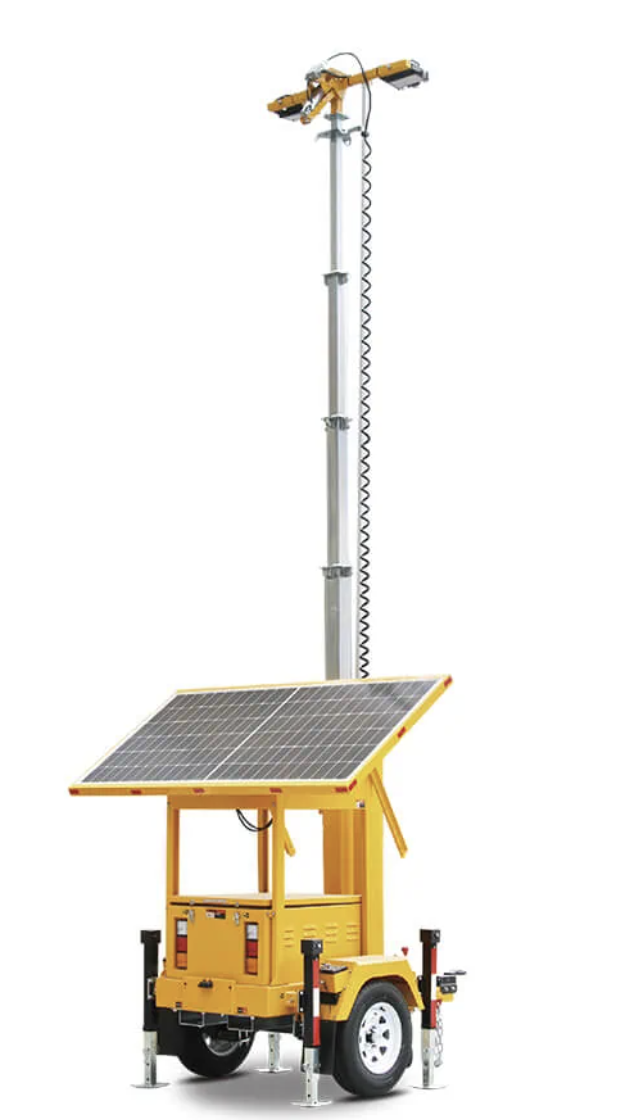
All six use 100 W LED heads, 455 W solar panels, maintenance-free deep-cycle gel batteries, an MPPT charge controller and a telescoping mast with a manual winch. They differ in head count, panel area and battery size.
| Model | Light output | Solar and battery | Price |
|---|---|---|---|
| Mini | 2 x 100 W, 30,000 lm | 1 x 455 W panel, 1 x 200 Ah | $4,899.99 |
| Medi200 | 2 x 100 W, 30,000 lm | 1 x 455 W panel, 2 x 200 Ah, trailer | $10,599.99 |
| Medi400 | 4 x 100 W, 60,000 lm | 2 x 455 W panels, 4 x 200 Ah, trailer | $12,599.00 |
| Super | 4 x 100 W, 60,000 lm | 3 x 455 W panels, 4 x 200 Ah, trailer | $12,699.99 |
| Mega400 hybrid | 6 x 100 W, 90,000 lm | 4 x 455 W panels, 4 x 200 Ah, backup diesel generator | $14,899.99 |
| Mega600 hybrid | 6 x 100 W, 90,000 lm | 4 x 455 W panels, 6 x 200 Ah, backup diesel generator | $15,499.99 |
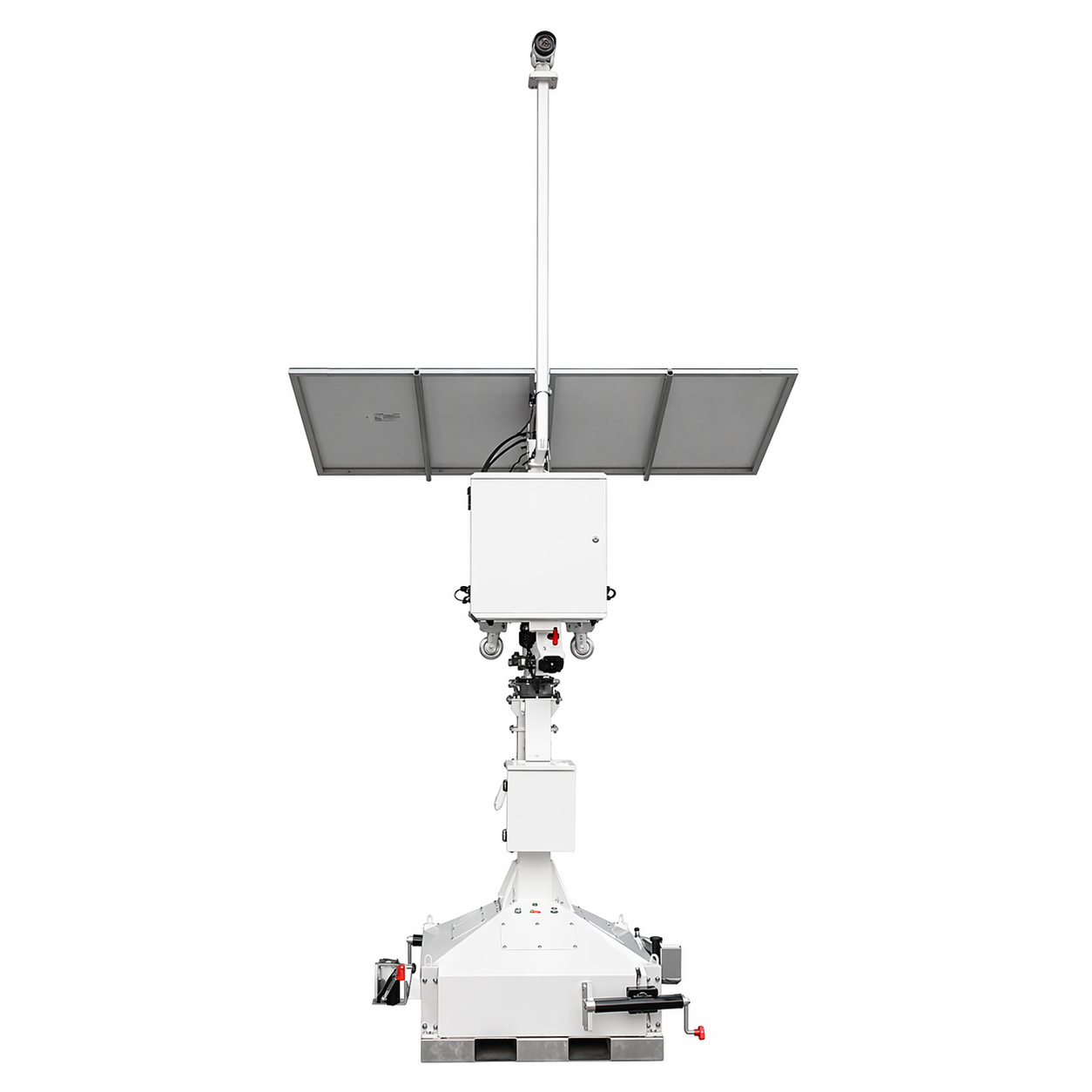
| Mini Pro CCTV | Three 4K cameras, no light heads | 1 x 455 W panel, 200 Ah LiFePO4, 21 ft mast | $9,999.99 |
Specifications and prices from each product page, checked 5 October 2026. The Mini through Super offer an optional CCTV camera. Only the Mega400 and Mega600 carry a generator.
How long does a solar tower run at full output?
Our solar tower pages list battery and lamp sizes but not a rated run time, so here is the arithmetic. Assuming 12 V batteries, each 200 Ah battery stores about 2.4 kWh. Gel batteries are usually discharged to 50 to 80 percent of that. Divide the usable energy by the lamp load:
A full battery only matters if the panels can refill it. That is where the Super earns its extra $100.99 over the Medi400: three panels instead of two on the same four heads and batteries. For short summer nights, either works. For long winter nights at full output, or a site that must stay lit around the clock, choose the Super, dim to fewer heads, or choose a hybrid. The Mega400's generator starts when solar cannot keep up, and the Mega600 adds two more batteries on top.
How many light towers do you need?
Start from the light level the work needs. OSHA's construction standard, 29 CFR 1926.56, sets minimum illumination in foot-candles: 3 for general construction areas, excavation, access ways and storage; 5 for general construction area lighting and tunnels; 10 for shops and equipment rooms; 30 for first aid stations and offices.
A foot-candle is one lumen per square foot. Not every lumen from an aimed floodlight lands on the work, so a common planning assumption is that about half does. That gives a quick estimate:
Lumens needed = area in square feet x foot-candles / 0.5
| Work area | Target | Lumens needed | Tower options |
|---|---|---|---|
| Intersection work space, 100 x 60 ft | 5 fc | 60,000 lm | One Medi400 or Super |
| Laydown yard, 150 x 200 ft | 3 fc | 180,000 lm | Two Mega hybrids, or three Medi400 or Super towers |
| Event parking area, 200 x 300 ft | 3 fc | 360,000 lm | Four Mega hybrids, or two LED diesel towers |
| Gate or guard post, 50 x 50 ft | 5 fc | 25,000 lm | One Mini or Medi200 |
Planning estimates only. Example: 150 x 200 = 30,000 sq ft; 30,000 x 3 / 0.5 = 180,000 lumens. Real coverage depends on mast height, aiming and surroundings; confirm with a light meter on site.
Several smaller towers spaced around a site also light it more evenly, with fewer hard shadows, than one very bright tower in the middle. That is the practical case for solar on big sites: you spread the light and skip the fuel runs.
What does a portable light tower cost?
Purchase price is only half of it. What a tower costs to run each night decides the total.
- Solar towers: $4,899.99 for the Mini up to $12,699.99 for the Super, as of October 2026. No fuel. The batteries are a wear item over the life of the tower.
- Solar hybrid towers: $14,899.99 and $15,499.99. Fuel only when the backup generator runs.
- LED diesel towers: one dealer lists the Generac MLTS-4 at $10,677. At 0.24 gallons an hour, 12 hours a night is 2.88 gallons, or about $11.52 a night at an assumed $4.00 a gallon diesel. Over a year of nightly use that is roughly $4,200, plus engine service.
The arithmetic is simple: a Medi400 costs about $1,922 more than the MLTS-4 up front and burns no fuel, so at 12 hours a night ($11.52 x 30 = about $346 of fuel a month) the gap closes in five to six months. The solar vs diesel comparison works this through in full. If you only need light for a few nights a year, renting a tower may cost less than owning one; compare the rental days you expect against the purchase price and fuel.
Solar, hybrid or diesel: which fits your job?
- Choose solar for work areas up to about 10,000 square feet per tower, remote sites without fuel deliveries, noise-sensitive locations, and long jobs where fuel and refueling visits add up. The Medi400 and Super are the workhorses; the Mini suits gates, short nights and lighter duty.
- Choose a hybrid when the site must stay lit every night regardless of weather, or in northern winters. The Mega400 and Mega600 put out 90,000 lumens and only burn fuel when solar falls short.
- Choose diesel when one trailer has to light several acres at once, or you need 188,000 lumens or more in one spot. Lumen for lumen, one diesel tower matches roughly three 60,000-lumen solar towers.
- Add a camera tower if theft or vandalism is the bigger overnight risk. The Mini Pro CCTV runs three 4K cameras on solar power.
Light towers are one piece of a night work zone. For the signs, devices and layout around them, see our temporary traffic control guide and work zone safety guide, and for advance warning on the road, our arrow boards.
Choosing a light tower? Tell us the size of the area, how many hours a night you work, the time of year and how you will tow it, and we will help you pick the model and quantity. Browse all light towers or our construction and trades products, contact us, or call 888-925-1966.
Frequently asked questions
What is a light tower called?
A light tower is also called a light plant, a mobile light tower, a portable light tower or a towable light tower. All describe a trailer or skid with floodlights on a telescoping mast and its own power source.
What is the purpose of a light tower?
A light tower lights a work area at night where there is no power or no permanent lighting: road work, construction sites, mines, utility repairs, emergency response, parking areas and outdoor events. Some also carry security cameras.
How much does a portable light tower cost?
Our solar light towers cost $4,899.99 to $12,699.99 and our solar hybrid towers $14,899.99 to $15,499.99, as of October 2026. One dealer lists a Generac LED diesel tower at $10,677, which then burns about 0.24 gallons of diesel an hour.
How many hours does a light tower last?
A diesel tower runs as long as its fuel lasts; the Generac MLTS-4 is rated at 165 hours on a full tank. A solar tower runs overnight on its batteries and recharges each day. Our estimate for the Medi400 at full output is 12 to 19 hours per charge, depending on how deeply the batteries are discharged.
Is a light tower a generator?
A diesel light tower has a generator built in to power its lights. A fully solar tower has no generator: panels charge batteries that run LED heads. Solar hybrid towers, such as our Mega400 and Mega600, carry a backup diesel generator that runs only when solar power falls short.
Can a light tower power a house?
Light towers are built to power their own lights, not a building. Some diesel towers have a small auxiliary outlet; the Generac MLTS-4 has a 20 amp, 120 volt duplex receptacle. Our solar towers do not list an outlet. For backup power to a home, use a generator sized for the job.
How do you set up a solar light tower?
Tow or forklift it into place where the panels get open sky, level it with the outriggers or jacks, raise the mast with the winch, aim the heads and switch it on. Our solar towers are designed for one-person setup, with no fuel to add.
How many lumens does a light tower put out?
Our solar towers are rated at 30,000, 60,000 or 90,000 lumens depending on the number of 100 watt LED heads. A four-head LED diesel tower such as the Generac MLTS-4 is rated at 188,000 lumens.
Sources
- OSHA, 29 CFR 1926.56, Illumination (Table D-3, minimum illumination intensities in foot-candles)
- Generac Mobile MLTS-4 LED light tower specifications and dealer price (Steady Power), checked 5 October 2026
- LED Lighting Solutions, Solar Light Towers vs. Diesel Generator Light Towers (fuel, CO2 and payback math)
- LED Lighting Solutions product pages for the Mini, Medi200, Medi400, Super, Mega400, Mega600 and Mini Pro CCTV towers, checked 5 October 2026