My Cart: 0 item(s)
_2.png "Shadows ReadyTheme")
U-Channel vs Square Tube vs Breakaway Sign Posts: How to Choose and Install Them
Key Takeaways
- There are two common steel sign posts: U-channel (a flanged channel bar, sold by weight per foot) and perforated square tube (a hollow square post punched on all four sides). "Breakaway" is not a third shape. It describes how a post is installed so it gives way when a vehicle hits it.
- U-channel is the cheapest and most common post on local roads. Square tube costs roughly 5 to 10 percent more, carries more load and lets you mount signs on all four faces.
- Under the MUTCD 11th Edition, a post-mounted sign within the roadside clear zone must be on a crashworthy support: breakaway, yielding, or shielded by a barrier.
- Minimum mounting height is 5 feet to the bottom of the sign in rural areas and 7 feet where people park, walk or bike, so most street and parking signs need a post that puts the sign bottom at 7 feet.
- Breakaway installs leave a short stub above grade: no more than 4 inches for channel posts in the state details we checked, and about 1 inch for square tube anchors in Pennsylvania's.
U-channel and square tube are the two steel posts that hold up most of the traffic, street and parking signs in the United States. A U-channel post is a hot-rolled steel channel with flared flanges, sold by weight (2, 3 or 4 pounds per foot) and punched with holes down its center. A perforated square tube post is a hollow square steel tube, usually 1 3/4 to 2 1/2 inches, punched with holes on all four sides so one size slides inside the next. Either type can be installed as a breakaway system: a short anchor goes in the ground and the sign post bolts to or slides into it, so the post separates or bends when a car hits it instead of acting like a fixed pole. Choose U-channel for low cost and single signs on local streets; choose square tube when you need more strength, signs on more than one face, or a telescoping anchor that makes knocked-down posts quick to replace.
U-channel sign posts
U-channel is the workhorse of local roads. PennDOT's technical sheet on breakaway posts calls the channel bar "the most common post on local roads" because it has the lowest cost and is easy to install. Its weakness is that it is open on one side: you cannot mount signs at right angles on the same post, and it carries less load than a tube of similar weight.
How U-channel is specified:
- Weight per foot. 2 lb/ft for small signs; 3 and 4 lb/ft for larger signs and taller mounts. Florida's sign-post standard, for example, uses 3 lb/ft posts for a clear height up to 10 feet and 4 lb/ft posts above that.
- Steel. State specifications typically call for ASTM A499 rail steel.
- Holes. 3/8 inch holes on 1 inch centers along the web, so the sign can sit at any height.
- Installation. Driven straight into the ground, set in concrete, or bolted to a short base post with a lapped splice so it breaks away.
Perforated square tube sign posts
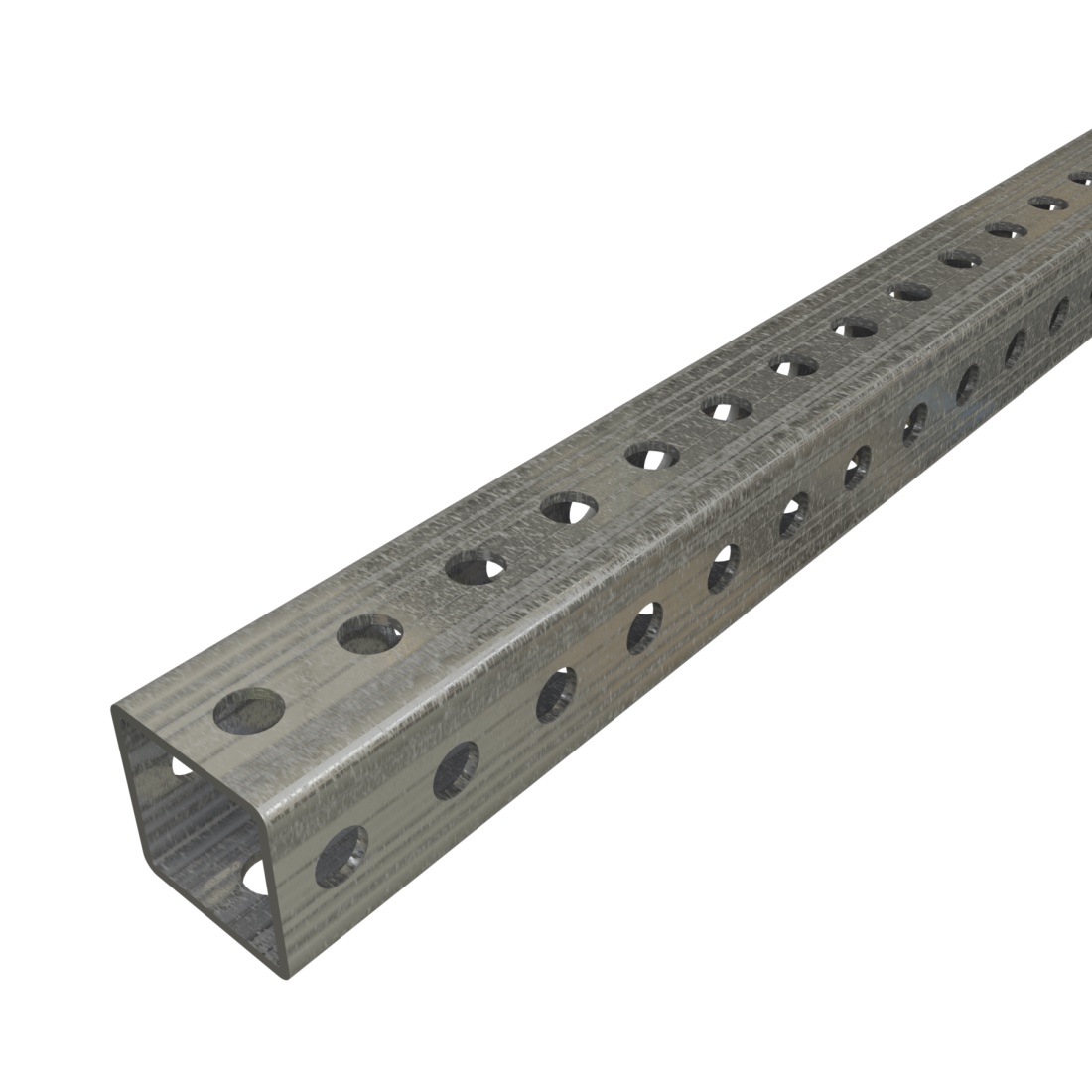
Square tube posts (often called perforated square steel tube, PSST, or by the brand name Telespar) are hollow, welded steel tubes with holes punched on every face. Missouri DOT's specification is typical: 12 gauge steel, ASTM A1011 Grade 50, hot-dip galvanized, with 7/16 inch holes on 1 inch centers on all four sides, and sizes made to telescope, so a 2 inch post slides into a 2 1/4 inch anchor without lining up any particular face.
That telescoping fit is the reason square tube dominates breakaway work. The anchor is a short length of the next size up, driven into the ground. The post drops into it and is bolted through. After a knockdown, you unbolt the bent post, pull the stub, and drop a new post into the same anchor: no digging and no concrete.
PennDOT lists the other advantages: signs on all four sides, greater loading capacity and greater torsional strength, for about 5 to 10 percent more than channel bar.
U-channel vs square tube: side by side
| Feature | U-channel post | Perforated square tube post |
|---|---|---|
| Shape | Open steel channel with flared flanges | Closed, welded square tube |
| How it is sized | Weight: 2, 3 or 4 lb/ft | Outside size and gauge, such as 2 in, 12 or 14 gauge |
| Holes | 3/8 in on 1 in centers, one face | 7/16 in on 1 in centers, all four faces |
| Signs per post | One face (back to back possible) | Any of four faces, including at right angles |
| Relative cost | Lowest | About 5 to 10 percent more |
| Strength | Lower load and torsion capacity | Higher load capacity and torsional strength |
| Breakaway method | Bolted lap splice to a driven base post | Post telescopes into a driven anchor sleeve |
| Stub left above grade | 4 in maximum (Florida and Pennsylvania details) | About 1 in (Pennsylvania detail) |
| After a knockdown | Replace post, often the base post too | Replace the post, reuse the anchor |
| Best for | Single signs on low-speed local roads | Street name assemblies, multi-sign posts, high-knockdown corners |
Sources: PennDOT LTAP Technical Sheet #212; Missouri DOT specification MGS-03-04H; Florida DOT Design Standard Index 600A. Your state DOT or city standard drawings govern on public roads.
What "breakaway" means and when the MUTCD requires it
The MUTCD 11th Edition, Section 2A.16, sets the rule in one sentence: post-mounted sign and object marker supports shall be crashworthy if within the clear zone. Crashworthy means breakaway, yielding, or shielded by a longitudinal barrier or crash cushion. The clear zone is the strip beside the travel lane that a driver who leaves the road needs to stop or recover; PennDOT puts it at 7 to 10 feet on typical low-speed, low-volume local roads.
- Breakaway supports separate from their base when struck, so the post is knocked ahead of or over the vehicle.
- Yielding supports bend and let the vehicle run over them.
"Crashworthy" also has a technical meaning: the post system has been crash tested to a national standard (NCHRP Report 350 or AASHTO's Manual for Assessing Safety Hardware, MASH) and accepted by FHWA. Many states will only accept post systems on their approved products list. Before you install on a public road, check that the exact post, anchor and hardware combination is on your agency's list, and follow its standard drawing. On private property, such as a parking lot or HOA street, crashworthy posts are still the safer choice wherever cars can leave the pavement.
One more MUTCD rule matters if you add a solar flashing sign: Section 2A.18 says solar panels and other equipment mounted on a sign support must not compromise its crashworthy performance or hide the sign's shape.
How high does the sign go? MUTCD mounting heights
Post length starts with mounting height. These are the minimums in Section 2A.15, measured to the bottom of the sign:
Conventional roadsFreeways and expressways
Source: MUTCD 11th Edition, Section 2A.15. A secondary sign below another sign may be 1 foot lower on conventional roads; signs 30 feet or more from the traveled way may be mounted at 5 feet.
In practice, almost every street name, stop, parking and crosswalk sign in a town, subdivision or parking lot sits at 7 feet or more, because people park, walk or bike nearby. The MUTCD sets no general maximum, but warns against mounting signs so high that drivers miss them.
Working out post length
Add three numbers: the mounting height, the height of the sign (or the stack of signs), and whatever goes below grade or into an anchor.
Example: a 30 inch stop sign in a residential area
- Mounting height: 7 ft to the bottom of the sign.
- Sign: a 30 x 30 inch R1-1 stop sign adds 2.5 ft, so the top of the sign sits 9.5 ft above grade.
- Square tube on a breakaway anchor: the anchor is in the ground with about 1 inch showing, and the post carries the sign above it. A 12 ft post leaves about 2.5 ft to spare for the depth the post sits into the anchor and any trimming.
- U-channel driven directly: Florida's standard calls for at least 4.0 ft of embedment for 3 lb/ft posts, so the post needs to be about 13.5 ft (9.5 ft above grade plus 4 ft below).
Add a street name sign on top or a plaque below, and add its height too. If the total gets close to the post length, step up a size rather than skimp on embedment.
How to install a breakaway square tube post
- Call 811 first. Have underground utilities marked before driving anything into the ground.
- Drive the anchor. Use a drive cap so the top is not mushroomed, and drive it plumb. PennDOT's detail drives anchors at least 3 feet and leaves about 1 inch of a square tube anchor above grade (4 inches maximum for channel posts). Follow your own agency's drawing for depth.
- Insert the post. The post slides into the anchor. Match sizes: a 1 3/4 inch post into a 2 inch anchor, or a 2 inch post into a 2 1/4 inch anchor.
- Bolt it through. Use the corner bolts or through bolts specified for the system; the bolts are part of what makes it break away correctly.
- Mount the sign. Bolt the sign through the post holes at the right height, facing traffic, and check it is level.
- Inspect it. PennDOT recommends checking posts, hardware and bases periodically so nothing has worked loose.
Breakaway systems only work as tested. Do not set a breakaway anchor in a concrete collar unless the system's drawing shows one, do not add extra posts within the same 7 foot path without checking the system's limits, and do not leave a stub taller than the detail allows. Any of these can turn a crashworthy post into a fixed hazard.
The sign post we stock
We sell a 12 ft breakaway sign post (SKU SPTS-12) as a complete kit: a 14 gauge perforated square steel post in 1 3/4 or 2 inch, a 30 inch anchor in 2 or 2 1/4 inch to match, and the corner bolts and hardware. It is $209.98 plus $39.99 shipping as of October 2026. We do not currently stock U-channel posts.
| Spec | 12 ft breakaway sign post (SPTS-12) |
|---|---|
| Post | Perforated square steel, 14 gauge |
| Post size | 1 3/4 in or 2 in |
| Post length | 12 ft |
| Anchor | 30 in long, 2 in or 2 1/4 in |
| Hardware | Corner bolts and hardware included |
| Price | $209.98 plus $39.99 shipping |
From the product page, checked 14 October 2026. The anchor is 30 inches long; if your agency's drawing calls for a deeper anchor, check with us before you order.
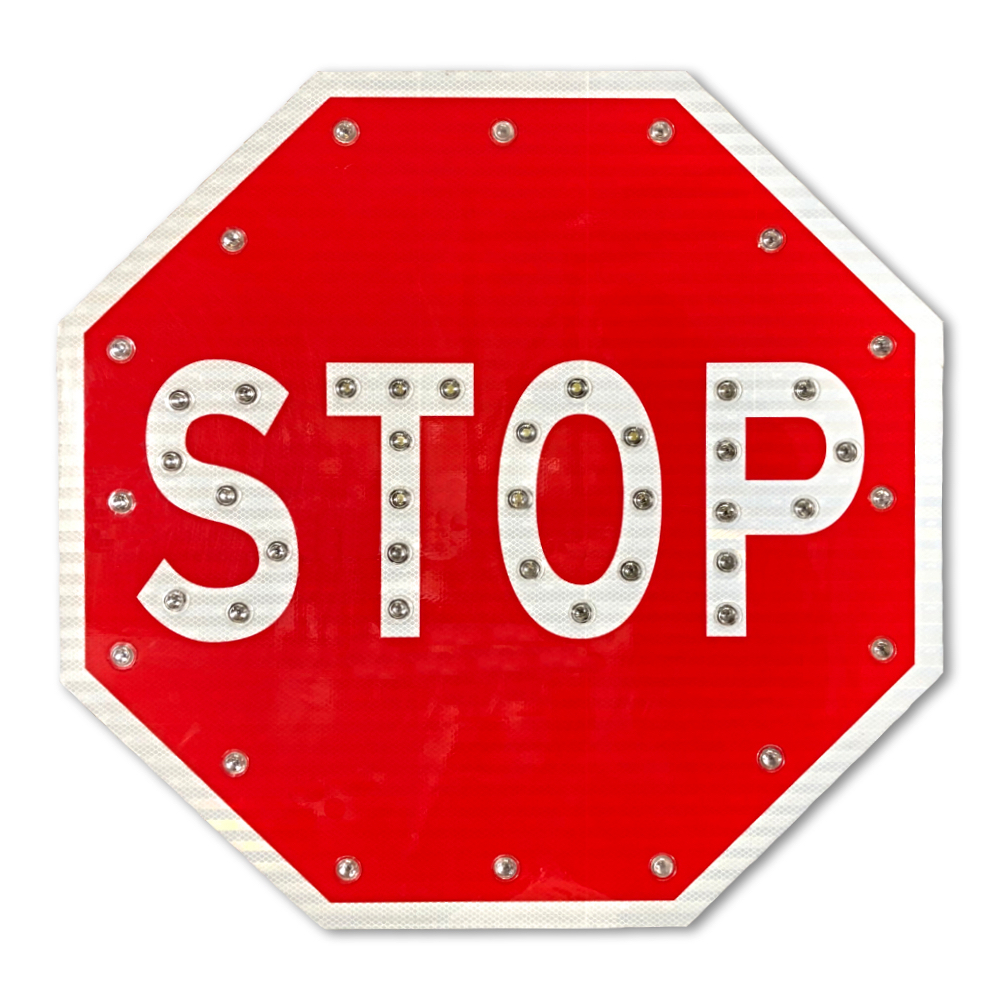
Pair the post with what goes on it. Our traffic signs include the full MUTCD sign range and solar flashing signs such as the 30 inch solar flashing stop sign ($999.99 as of October 2026). Sign shops can start from our aluminum sign blanks, and our sign shop page collects everything for fabricators in one place.
Planning signs for a lot or a crossing? Our guides to parking lot signs and crosswalk signs cover which signs you need, and our Type 3 barricade guide covers temporary closures.
Ordering posts for a job? Tell us how many signs, what sizes and where they are going, and we will help you match post size, anchor and hardware. Contact us or call 888-925-1966.
Frequently asked questions
What is the difference between a U-channel and a square tube sign post?
A U-channel post is an open steel channel with flared flanges, sold by weight per foot and punched with holes down one face. A square tube post is a closed, welded square steel tube punched on all four sides. U-channel is cheaper; square tube costs about 5 to 10 percent more but is stronger, takes signs on any face and telescopes into a matching anchor for fast breakaway repairs.
What are breakaway sign posts?
A breakaway sign post is a crash-tested post system that separates from its base when a vehicle hits it, so the post is pushed ahead of or over the vehicle instead of stopping it like a fixed pole. It usually has a short anchor in the ground, the sign post, and the hardware that joins them. The MUTCD requires crashworthy supports for post-mounted signs within the clear zone.
How deep should a sign post be in the ground?
It depends on the post and your agency's standard drawing. Florida's standard calls for at least 4.0 feet of embedment for 3 lb/ft U-channel posts and 4.5 feet for 4 lb/ft posts. For breakaway systems, the anchor goes in the ground instead; Pennsylvania's detail drives anchors at least 3 feet, leaving about 1 inch of a square tube anchor above grade.
How tall should a sign post be?
Tall enough to put the bottom of the sign at the MUTCD minimum: 5 feet in rural areas and 7 feet in business, commercial or residential areas and above sidewalks. Add the height of the sign and the depth below grade or into the anchor. A 30 inch stop sign at 7 feet tops out at 9.5 feet above grade, which fits on a 12 foot post in a breakaway anchor.
What is a street sign post called?
Most street sign posts are called sign posts or sign supports. The common steel types are U-channel posts and perforated square tube posts, which some people call by the brand name Telespar. Larger signs use wood posts or steel beams, and some cities mount signs on decorative round poles.
How are street signs attached to sign posts?
With bolts through the holes in the post. U-channel posts have holes on 1 inch centers down the web and square tube posts have holes on 1 inch centers on all four faces, so the sign can be set at the right height. Street name signs often use brackets or caps that fit the top of the post.
Is it legal to put up your own road signs?
On a public road, only the agency that owns the road can install traffic control signs. On private property, such as a parking lot or HOA street, the owner can post signs, but signs on roads open to public travel should follow the MUTCD's shapes, colors, sizes and mounting rules so drivers understand them.
Which is stronger, U-channel or square tube?
Square tube. PennDOT notes it has greater loading capacity and torsional strength than channel bar, and it can carry signs on all four faces. For a heavier sign on U-channel, step up the weight: Florida's standard uses 3 lb/ft posts for clear heights up to 10 feet and 4 lb/ft above that.
Sources
- FHWA, MUTCD 11th Edition, Chapter 2A (Sections 2A.15 Mounting Height, 2A.16 Lateral Offset, 2A.18 Posts and Mountings)
- PennDOT LTAP Technical Information Sheet #212, Breakaway Sign Posts
- Missouri DOT specification MGS-03-04H, Square Steel Perforated Posts
- Florida DOT Design Standards, Index 600A, sign post details
- LED Lighting Solutions product specifications, October 2026