My Cart: 0 item(s)
_2.png "Shadows ReadyTheme")
Type 3 Barricades: Dimensions, MUTCD Specs, and When to Use Type 1, 2 or 3
Key Takeaways
- A Type 3 barricade has three horizontal rails striped in orange and white retroreflective sheeting. It is the barricade the MUTCD calls for when you close or partially close a road.
- MUTCD 11th Edition minimums: Type 3 rails at least 48 inches long, each rail 8 to 12 inches wide, the barricade at least 5 feet tall, with 6-inch stripes sloping down at 45 degrees toward the side traffic must pass.
- Type 1 has one rail and Type 2 has two, both at least 24 inches long and 36 inches tall. They mark hazards where traffic keeps moving through the work zone. On freeways and other high-speed roads, use Type 2 or Type 3.
- The ROAD CLOSED (R11-2) sign belongs at or near the center of the road, on or above a Type 3 barricade. It should cover no more than 50 percent of the top two rails or 33 percent of all three.
- Our Type III barricades come in 4, 6, 8, 10 and 12 ft widths at $479.99 for a pack of five, about $96 each, as of September 2026.
A Type 3 barricade (also written Type III) is a portable or fixed frame carrying three horizontal rails with orange and white retroreflective stripes. Under the federal Manual on Uniform Traffic Control Devices (MUTCD), it is the device for closing or partially closing a road: across a street at a detour, at a closed ramp, or partway across a lane with a local traffic sign. It is at least 4 feet wide and 5 feet tall. Types 1 and 2 are smaller, one- and two-rail barricades for places where traffic still moves through the work area. This guide gives the MUTCD 11th Edition dimensions for all three types, shows where the Road Closed sign and warning lights go, and works through what a real street closure takes.
What is a Type 3 barricade?
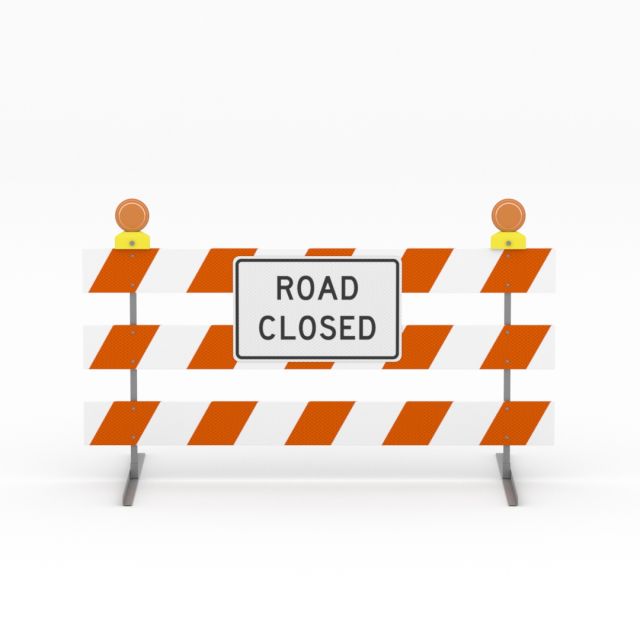
The MUTCD defines a barricade as a portable or fixed device with one to three rails, used to close, restrict or mark all or part of the right-of-way. Section 6K.07 sorts them into Type 1, Type 2 and Type 3 by the number of rails. The Type 3 is the largest and the most visible, and it is the only one the manual recommends for closing a road.
Three things make a barricade a Type 3:
- Three striped rails. Every rail facing traffic carries alternating orange and white retroreflective stripes.
- Size. Rails at least 48 inches long and the whole assembly at least 5 feet high, so it stands above a car hood and can carry a sign.
- Purpose. MUTCD guidance says Type 3 barricades should be used to close or partially close a road. They can run completely across a roadway or from curb to curb.
Our Type III barricade has a galvanized steel frame, a 5 ft height, three rails with white and orange engineer grade prismatic sheeting on both sides, and a choice of 4, 6, 8, 10 or 12 ft widths. It sells in packs of five.
Type 3 barricade dimensions and MUTCD specs
These are the MUTCD 11th Edition requirements, from Section 6K.07 and Figure 6K-1. Where the figure shows a minimum, that is the smallest compliant size; longer rails and taller frames are allowed.
| Spec | Type 3 requirement | Source |
|---|---|---|
| Number of rails | 3 | Figure 6K-1 |
| Rail length | 48 in (4 ft) minimum | 6K.07, Standard 05 |
| Rail width (height of each board) | 8 to 12 in | 6K.07, Standard 05 |
| Overall height | 5 ft minimum | Figure 6K-1 |
| Stripe color | Alternating orange and white, retroreflective | 6K.07, Standard 03 |
| Stripe width | 6 in | 6K.07, Standard 03 |
| Stripe angle | 45 degrees, sloping down toward the side road users pass | 6K.07, Standard 03 |
| High-speed roads | At least 270 sq in of retroreflective area facing traffic | 6K.07, Standard 05 |
| Warning lights | Optional | Figure 6K-1 |
Source: MUTCD 11th Edition (December 2023), Part 6, Section 6K.07 and Figure 6K-1.
Stripe direction matters and is often set up wrong. Where barricades run all the way across a road, the stripes should slope down toward the direction drivers must turn. If drivers can turn either way, the stripes slope down in both directions from the center. If no turn is intended, they slope toward the center. On windy, high-speed sites the MUTCD recommends ballast, and sandbags on the lower frame or stays are the approved way to add it. Never stack weight on the rails.
Type 1 vs Type 2 vs Type 3 barricades
_640x640.jpg)
All three types use the same stripe pattern. What changes is the number of rails, the minimum size and where each one belongs.
| Spec | Type 1 | Type 2 | Type 3 |
|---|---|---|---|
| Striped rails | 1 | 2 | 3 |
| Minimum rail length | 24 in | 24 in | 48 in |
| Minimum height | 36 in | 36 in | 5 ft |
| Stripe width | 4 in allowed on rails under 36 in | 4 in allowed on rails under 36 in | 6 in |
| Typical use | Conventional roads and urban streets, traffic moving through | Traffic moving through, including high-speed roads | Closing or partially closing a road |
| Our product | Type I, 24 in, folding | Type II, 24 in, folding | Type III, 4 to 12 ft |
| Price, pack of 5 | $167.99 | $197.99 | $479.99 |
Dimensions: MUTCD 11th Edition, Section 6K.07 and Figure 6K-1. Prices from ledlighting-solutions.com as of September 2026; all three are galvanized steel with white and orange engineer grade prismatic sheeting on both sides.
The 270 square inch rule explains why Type 1 stays off high-speed roads. A 24-inch Type 1 with one 8-inch rail shows 24 × 8 = 192 square inches of reflective face, short of the 270 the MUTCD requires on freeways and expressways. A 24-inch Type 2 with two 8-inch rails shows 384. That is why Section 6K.07 says Type 2 or Type 3 should be used on high-speed roadways.
The other dividing line is whether traffic keeps moving. Types 1 and 2 are for work zones where road users still pass through, often in a series to guide them past the work. When the road itself is closed, the MUTCD points to Type 3.
Cost per barricade
Our barricades sell in packs of five, so the price per barricade is the pack price divided by five:
Mounting a ROAD CLOSED sign on a Type 3 barricade
The Type 3 barricade is the MUTCD's preferred support for the ROAD CLOSED sign. The rules that apply:
- Which sign. Use ROAD CLOSED (R11-2) when the road is closed to everyone except contractors' equipment and authorized vehicles (Section 6G.04). STREET CLOSED (R11-2a) may be substituted.
- Where. At or near the center of the roadway, on or above the Type 3 barricade that closes it.
- Size. Table 6G-1 lists the R11-2 at 48 × 30 inches.
- How much rail it can cover. Section 6F.02 says a sign on a Type 3 barricade should cover no more than 50 percent of the top two rails or 33 percent of the total area of all three rails.
- Height. The bottom of a sign on a barricade must be at least 1 foot above the traveled way.
- When not to use it. ROAD CLOSED shall not be used where traffic is still maintained through the work zone on fewer lanes, or where the actual closure is some distance past the sign.
The 33 percent rule is stricter than it sounds. A 48 × 30 inch R11-2 has 1,440 square inches of face. Here is how much of each barricade width a sign may cover:
| Barricade width | 33% of rail area, 8 in rails | 33% of rail area, 12 in rails | 48 × 30 R11-2 fits on the rails? |
|---|---|---|---|
| 4 ft (48 in) | 380 sq in | 570 sq in | No, mount above |
| 6 ft (72 in) | 570 sq in | 855 sq in | No, mount above |
| 8 ft (96 in) | 760 sq in | 1,140 sq in | No, mount above |
| 10 ft (120 in) | 950 sq in | 1,426 sq in | No, mount above |
| 12 ft (144 in) | 1,140 sq in | 1,711 sq in | Only with 12 in rails |
Math: rail area = barricade width × rail width × 3 rails; allowance = 33 percent of that. Check the 50 percent limit on the top two rails as well. Section 6F.02 allows signs on or above barricades.
In practice, the full-size ROAD CLOSED sign usually goes above the top rail on a sign bracket or mast, not bolted across the rails. That keeps the stripes visible and satisfies both limits. Our online catalog does not list a 48 × 30 inch R11-2 panel, so call us before you order if your permit calls for one.
The advance warning signs that go with it
A closure needs warning upstream, and Section 6G.04 says the R11-2 should be accompanied by warning and detour signs. The W20-3 ROAD CLOSED AHEAD diamond is the standard advance sign. Table 6H-1 lists it at 36 × 36 inches on conventional roads, 48 × 48 on expressways and 30 × 30 as the minimum. Ours comes in 24, 30 and 36 inch sizes, so order the 30 or 36 inch; the 24 inch panel is below the work zone minimum. With engineer grade sheeting the 30 inch costs $79.62 and the 36 inch $115.48, as of September 2026. For a portable option, the ROAD CLOSED AHEAD roll-up sign in diamond grade sheeting is $47.99 at 36 inches and $97.99 at 48 inches.
Where local traffic can still reach homes or businesses up to the closure, the manual uses the Local Traffic Only signs (R11-3 series and R11-4) instead, and the barricades usually do not extend all the way across the road.
Warning lights on barricades
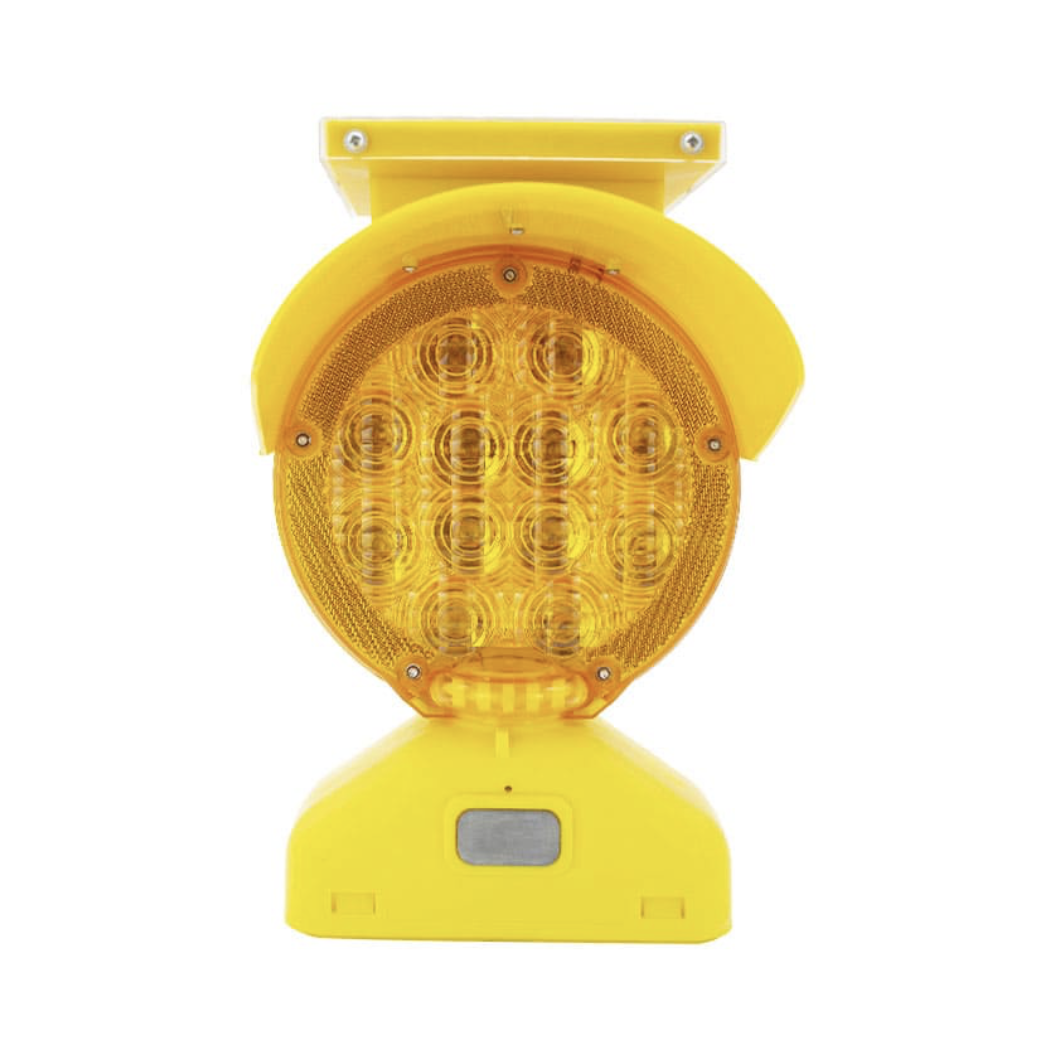
Lights are optional on a Type 3 barricade, but most night closures use them, and several MUTCD typical applications show flashing warning lights on the Type 3 barricades at a closure. Section 6L.07 sets the rules:
- Warning lights are yellow (amber), portable, powered and lens-directed.
- The bottom of the lens must be at least 30 inches above the ground.
- A light on a barricade standing alone or in a small cluster to mark a hazard shall flash.
- Lights on a line of channelizing devices guiding traffic shall be steady-burn, because a row of flashers does not show drivers the path. The one exception is a sequential flashing system on a merging taper.
- Type A and Type C lights must be visible on a clear night from 3,000 feet. Type B lights must be visible on a sunny day from 1,000 feet.
| Light type | What it does | Our option | Price |
|---|---|---|---|
| Type A, low-intensity flashing | Night warning on barricades and other devices | Battery LED barricade beacon, amber, flash or steady, rated MUTCD Type A/C, four D cells | $16.99 |
| Type B, high-intensity flashing | Day and night warning, often on advance signs | Solar LED barricade beacon, amber, rated MUTCD Type B | $54.99 |
| Type C, steady-burn | Night delineation along a line of devices | The battery beacon above in steady mode | $16.99 |
| Solar, general purpose | Dusk-to-dawn flash or steady light for barricades and bollards | Solar flashing LED barricade beacon, choose amber for work zones | $23.99 |
MUTCD types and ratings as stated on each product page; prices as of September 2026. MUTCD 11th Edition, Section 6L.07.
Worked example: closing a 36-foot street overnight
Say a utility crew needs to close a 36-foot-wide city street, curb to curb, for three nights. Here is how the MUTCD rules turn into a shopping list:
- Barricades across the street. Three 12 ft Type III barricades span 36 feet exactly. With 8 ft barricades you need five (40 feet), which is one pack. One pack of five 12 ft barricades covers this closure with two spares for the far end or a side street.
- ROAD CLOSED sign. One R11-2 at or near the center, mounted above the top rail.
- Warning lights. The barricades stand as a group marking a closure, so the lights flash: two amber Type A lights per barricade, as in the product photo above, is six lights at $16.99, or $101.94.
- Advance warning. A 36 inch W20-3 ROAD CLOSED AHEAD sign on each approach at $115.48 each, plus the detour signing your traffic control plan calls for.
- Stripes. If traffic can turn either way at the closure, set the stripes to slope down from the center in both directions.
Hardware for the barricades, lights and two advance signs comes to $479.99 + $101.94 + $230.96 = $812.89 before the R11-2 panel, sign supports and detour signs. Use it to check a quote or plan a budget; the traffic control plan approved by the agency with jurisdiction decides the final device list.
For the layout of the whole zone (advance warning area, transition, work space and termination), see our temporary traffic control guide. If the closure diverts traffic onto another route, an arrow board or message board upstream gives drivers more notice, and a solar light tower lights the work space itself.
Barricade mistakes that fail inspection
- Using Type 1 or Type 2 barricades to close a road. The MUTCD says Type 3 barricades should be used to close or partially close a road.
- Stripes sloping the wrong way. They should point drivers toward the side they must pass or turn.
- A sign covering the rails. Keep it within 50 percent of the top two rails and 33 percent of all three, or mount it above.
- Red or flashing lights in a channelizing line. Work zone warning lights are yellow, and lights on a series of devices should be steady-burn.
- Blocking the sidewalk. Barricade supports should not project more than 4 inches into a pedestrian route between 27 and 80 inches above the surface.
- No one responsible at the end of the day. Where equipment needs access through a closure, the MUTCD says a named person should close the Type 3 barricades at the end of each work day.
Our work zone safety guide covers the crash data behind these rules, and MUTCD 11th Edition changes explains what changed in Part 6.
Planning a closure? Tell us the road width, how long the closure runs and whether you work at night, and we will help you choose the barricade widths, lights and signs. Browse all work zone barricades, contact us, or call 888-925-1966.
Frequently asked questions
What is a Type 3 barricade?
A Type 3 barricade is a portable or fixed frame with three horizontal rails striped in alternating orange and white retroreflective sheeting. The MUTCD recommends it for closing or partially closing a road, and it is the usual support for a ROAD CLOSED sign.
What are the dimensions of a Type 3 barricade?
Under the MUTCD 11th Edition, each rail must be at least 48 inches long and 8 to 12 inches wide, and the barricade at least 5 feet tall. Stripes are 6 inches wide at 45 degrees. Common widths are 4, 6, 8, 10 and 12 feet.
What is the difference between Type 1, 2 and 3 barricades?
The number of rails and where they are used. Type 1 has one rail and Type 2 has two, both at least 24 inches long and 36 inches tall, for work zones where traffic keeps moving. Type 3 has three rails at least 48 inches long on a frame at least 5 feet tall, for closing a road.
What is a Type 4 barricade?
The MUTCD does not define a Type 4 barricade. It lists Type 1, Type 2 and Type 3 barricades, plus the Direction Indicator Barricade, which carries a one-direction arrow sign above a striped rail and is used in tapers and transitions.
How much does a Type III barricade cost?
Our Type III barricades cost $479.99 for a pack of five, about $96 each, in 4, 6, 8, 10 or 12 ft widths, as of September 2026. Type I barricades are $167.99 and Type II barricades $197.99 per pack of five.
Can you put a Road Closed sign on a Type 3 barricade?
Yes. The MUTCD says the ROAD CLOSED sign should be installed at or near the center of the roadway on or above a Type 3 barricade. The sign should cover no more than 50 percent of the top two rails or 33 percent of all three, so a full-size 48 by 30 inch sign usually mounts above the top rail.
Do Type 3 barricades need warning lights?
No, lights are optional, but they are common at night closures. MUTCD warning lights are yellow, mounted with the bottom of the lens at least 30 inches high. A light on a barricade used alone or in a group to mark a hazard flashes; lights on a line of devices guiding traffic burn steady.
When should you use a Type 2 barricade instead of a Type 3?
When traffic still passes through the work zone and you only need to mark a hazard or guide drivers past it. Type 2 barricades are smaller and cheaper, and the MUTCD accepts them on high-speed roads. Once the road is closed, use Type 3.
Sources
- FHWA, MUTCD 11th Edition, Part 6 (Sections 6F.02, 6G.04, 6G.05, 6K.07, 6K.08 and 6L.07; Figure 6K-1; Tables 6G-1 and 6H-1)
- FHWA, MUTCD 11th Edition, full manual (December 2023)
- LED Lighting Solutions product pages for the Type I, II and III barricades, barricade beacons, W20-3 sign and roll-up signs, checked 28 September 2026