_2.png "Shadows ReadyTheme")
How Many Light Towers Do You Need? Night Work Lighting Levels, Spacing and a Worked Layout
Key Takeaways
- To count light towers, multiply the work area in square feet by the foot-candles the task needs, divide by 0.5 to allow for light that misses the work, then divide by one tower's lumens and round up.
- OSHA sets the legal minimum on construction sites: 3 foot-candles for general areas such as excavation, access ways and storage, 5 for general construction area lighting, 10 for shops and plants.
- For night work on highways, the MUTCD 11th Edition gives three working levels: an average of 5 foot-candles for general activities, 10 around equipment, and 20 for precision work.
- Shape matters as much as area. A long, narrow work zone needs towers spaced along its length, even when one tower has enough lumens on paper.
- Flagger stations must be lit at night, and every setup should be checked by driving through it from each direction to find glare.
The quick answer: as a planning estimate, plan on one 60,000-lumen light tower for every 3,000 square feet of work around equipment, and one for every 6,000 square feet of general work. A 600-foot lane closure with a paving crew works out to five 60,000-lumen towers along the work, plus one small tower at each flagger station. The rest of this guide shows where those numbers come from, so you can run the same math for your own site.
The timing matters. Clocks fell back on November 1, so crews that finished in daylight in October now finish in the dark. Here is how to work out how much light the job needs, how many towers that takes, and where to put them.
How much light does night work need?
Two documents set the numbers for most U.S. jobs. OSHA's construction standard, 29 CFR 1926.56, applies to every construction site and sets minimums "while any work is in progress." The Manual on Uniform Traffic Control Devices (MUTCD), which governs work zones on public roads, adds guidance specific to night work in Sections 6M.08 and 6N.18 of the 11th Edition.
| Task or area | Foot-candles | Lux (approx.) | Source |
|---|---|---|---|
| Excavation, concrete placement, access ways, active storage, loading platforms, refueling and field maintenance areas | 3 minimum | 32 | OSHA 1926.56, Table D-3 |
| General construction area lighting; indoor corridors, hallways and exitways; tunnels and shafts | 5 minimum | 54 | OSHA 1926.56, Table D-3 |
| Construction plant and shops, such as batch plants and equipment rooms | 10 minimum | 108 | OSHA 1926.56, Table D-3 |
| General activities in a highway work zone at night | 5 average | 54 | MUTCD 11th Ed., 6N.18 |
| Activities around equipment, such as paving, milling and rolling | 10 average | 108 | MUTCD 11th Ed., 6N.18 |
| Tasks needing high precision and extreme care | 20 average | 215 | MUTCD 11th Ed., 6M.08 and 6N.18 |
One foot-candle is one lumen per square foot, or about 10.76 lux. OSHA's figures are enforceable minimums; the MUTCD figures are described as levels that "can be adequate" for each kind of task. Your state DOT or project specification may set its own levels, and those govern when they are stricter.
Two MUTCD rules apply to every night setup on a road. Flagger stations "shall be illuminated" at night except in emergencies. And floodlighting should be installed "in a manner that minimizes glare" to approaching drivers, flaggers and workers. More on both below.
How to count the towers, step by step

- Measure the work area. Length times width of the space where people and equipment actually work, in square feet. Measure separate areas, such as a paving zone and a staging yard, separately.
- Pick the light level for each area from the table above. Use the higher number when a task sits between two levels.
- Work out the lumens needed: area times foot-candles, divided by 0.5.
- Divide by one tower's rated lumens and round up.
- Check the shape. Divide each tower's coverage by the width of the work to see how much length one tower covers, then space the towers to match.
- Add the extras: one light at each flagger station, plus lighting for equipment crossings, walkways and the staging area.
- Drive through it at night from every approach after setup, look for glare and dark spots, and adjust.
Why divide by 0.5? Not every lumen from a floodlight lands on the work. Some spills past the edges, some is lost to aiming and distance. Assuming about half reaches the work surface is a common planning figure for aimed floodlights on a mast, and it is the same assumption we use across our light tower buyer's guide and our solar vs. diesel comparison. It is an estimate, not a photometric study, so confirm the result with a light meter on the first night.
How much area one tower covers
Flip the formula and you get the area one tower can light: lumens times 0.5, divided by the foot-candles. The light level you need changes the answer more than anything else. Here is a 60,000-lumen tower, such as a Medi400 or Super, at each level:
The same tower that lights a 100-by-100-foot storage yard to OSHA's 3 foot-candles lights only about a 40-by-40-foot patch to 20 foot-candles. For every tower size:
| Tower output | At 3 fc | At 5 fc | At 10 fc | At 20 fc |
|---|---|---|---|---|
| 30,000 lm (Mini, Medi200) | 5,000 sq ft | 3,000 sq ft | 1,500 sq ft | 750 sq ft |
| 60,000 lm (Medi400, Super) | 10,000 sq ft | 6,000 sq ft | 3,000 sq ft | 1,500 sq ft |
| 90,000 lm (Mega400, Mega600 hybrids) | 15,000 sq ft | 9,000 sq ft | 4,500 sq ft | 2,250 sq ft |
Planning estimates: coverage = rated lumens × 0.5 ÷ foot-candles. Real coverage depends on mast height, aiming, head angle and surroundings.
Tower counts for common night jobs
Here is the method applied to common night jobs. Each row shows the math so you can swap in your own dimensions.
| Job | Area and level | Lumens needed | Tower count |
|---|---|---|---|
| Utility trench along a street | 300 × 20 ft = 6,000 sq ft at 5 fc | 60,000 | Two Mini towers about 150 ft apart (one 60,000 lm tower has the lumens but cannot spread them 300 ft) |
| Material laydown yard | 150 × 100 ft = 15,000 sq ft at 3 fc | 90,000 | One Mega hybrid, or two Medi400 or Super towers on opposite sides |
| Site entrance and gate | 60 × 40 ft = 2,400 sq ft at 5 fc | 24,000 | One Mini or Medi200 |
| Equipment fueling and service pad | 80 × 60 ft = 4,800 sq ft at 10 fc | 96,000 | Two Medi400 or Super towers |
| Bridge deck finishing | 200 × 40 ft = 8,000 sq ft at 20 fc | 320,000 | Six Medi400 or Super towers, or four Mega hybrids |
Example: 150 × 100 = 15,000 sq ft; 15,000 × 3 ÷ 0.5 = 90,000 lumens. The fueling pad uses 10 fc because the MUTCD level for work around equipment is higher than OSHA's 3 fc minimum for refueling areas; use whichever your project specification requires.
The trench row is the one people get wrong. On lumens alone, one 60,000-lumen tower covers 6,000 square feet at 5 foot-candles. But a 300-foot trench is a strip, not a square. Each 30,000-lumen Mini covers 3,000 square feet at that level, which on a 20-foot-wide strip is 150 feet of length. Two Minis, one at each half, light the whole run evenly. One big tower in the middle would leave both ends dim.
Spacing and placement
For any long work zone, the spacing rule falls out of the same math:
A 60,000-lumen tower at 10 foot-candles covers 3,000 square feet. On a 24-foot-wide work area, that is 125 feet of length per tower, so space them about 120 feet apart. At 5 foot-candles the same tower covers 250 feet of length, so it can sit about 240 feet apart.
The MUTCD's guidance for night work adds four practical rules about placement:
- Light the work, not the road ahead. Floodlighting should minimize glare to approaching drivers, flaggers and workers. Aim heads down into the work area and away from oncoming traffic. Raising the mast to full height lets you aim at a steeper angle, which keeps the bright part of the beam off drivers' eyes.
- Make workers recognizable. The lighting "should be sufficient so as to give road users the capability to identify a worker as a person." Pair it with high-visibility apparel and lit equipment.
- Kill the shadows. The MUTCD warns about shadows that conceal workers in the work area. Lighting from two sides, or towers staggered along both edges of a wide zone, leaves fewer dark pockets behind rollers and trucks than one row of towers on one side.
- Check it from the driver's seat. Drive through the setup from each approach after it goes up, at night, and again periodically. Re-aim any head you can see glaring at you.
Worked layout: a night lane closure with a paving crew

A crew is milling and repaving one lane of a two-lane road overnight, with flaggers alternating traffic through the open lane. The activity area for the night is 600 feet long and 24 feet wide: the closed 12-foot lane plus 12 feet of shoulder for the paver, rollers and trucks.
- Area: 600 × 24 = 14,400 square feet.
- Level: paving and rolling is work around equipment, so 10 foot-candles (MUTCD 6N.18).
- Lumens needed: 14,400 × 10 ÷ 0.5 = 288,000 lumens.
- Towers: 288,000 ÷ 60,000 = 4.8, so five Super or Medi400 towers (300,000 lumens). Each covers 3,000 ÷ 24 = 125 feet of length, so space them about 120 feet apart along the shoulder. With 90,000-lumen hybrids, each covers about 187 feet, so four towers (360,000 lumens) about 150 feet apart. Three hybrids would come up short at 270,000.
- Flagger stations: the MUTCD requires them to be lit at night. Put one Mini at each end, beside the flagger rather than behind them, with the heads aimed down at the station and away from approaching drivers.
- Staging: if trucks queue in a separate staging area, size it as its own area at OSHA's 3 foot-candles.
Result: five 60,000-lumen towers along the work plus two Minis at the flagger stations, seven towers in all, or four hybrids plus two Minis. As the paver moves, leapfrog the rear tower to the front so the lit zone travels with the crew.
Planning estimate for illustration. Check your state DOT's night work specification, which may set its own light levels and placement rules, and confirm with a light meter.
Will solar towers last through a November night?
Longer nights are the other half of the time change. The run-time math is in our buyer's guide; the short version for a 10-hour night shift:
- A Medi400 or Super runs four 100 W heads, a 400 W load. Ten hours is 4 kWh.
- Four 200 Ah batteries hold about 9.6 kWh, assuming 12 V batteries, or roughly 4.8 to 7.7 kWh usable at the 50 to 80 percent discharge typical for gel batteries. One shift fits.
- The catch is recharging on short, low-sun days. The Super carries three 455 W panels on the same lamps and batteries as the Medi400, which has two. For long winter shifts, choose the Super, dim to two heads where the work allows, or choose a Mega hybrid, whose backup diesel generator runs when solar power is not enough.
Calculated from published lamp, battery and panel specifications. Ask us for the rated run time of a specific model at your location.
Inside the building: temporary work lights

Once a building is closed in, towers give way to hanging work lights. OSHA's 5 foot-candles applies to indoor corridors, hallways and exitways, and the same formula gives a starting count. A 50-by-80-foot floor is 4,000 square feet; at 5 foot-candles that is 4,000 × 5 ÷ 0.5 = 40,000 lumens, or three of our 19,500-lumen 150W temporary work lights. Two would fall just short at 39,000.
OSHA's wiring rules in 1926.405 also apply to temporary lighting: lamps for general illumination must be protected from accidental contact or breakage, and temporary lights must not hang by their electric cords unless the cords and lights are designed for it. Our 100W work light (13,000 lumens, $94.99) and 150W model ($108.99) are IP65 rated and run on 100 to 277 V AC. See all work lights.
Our light towers, by job
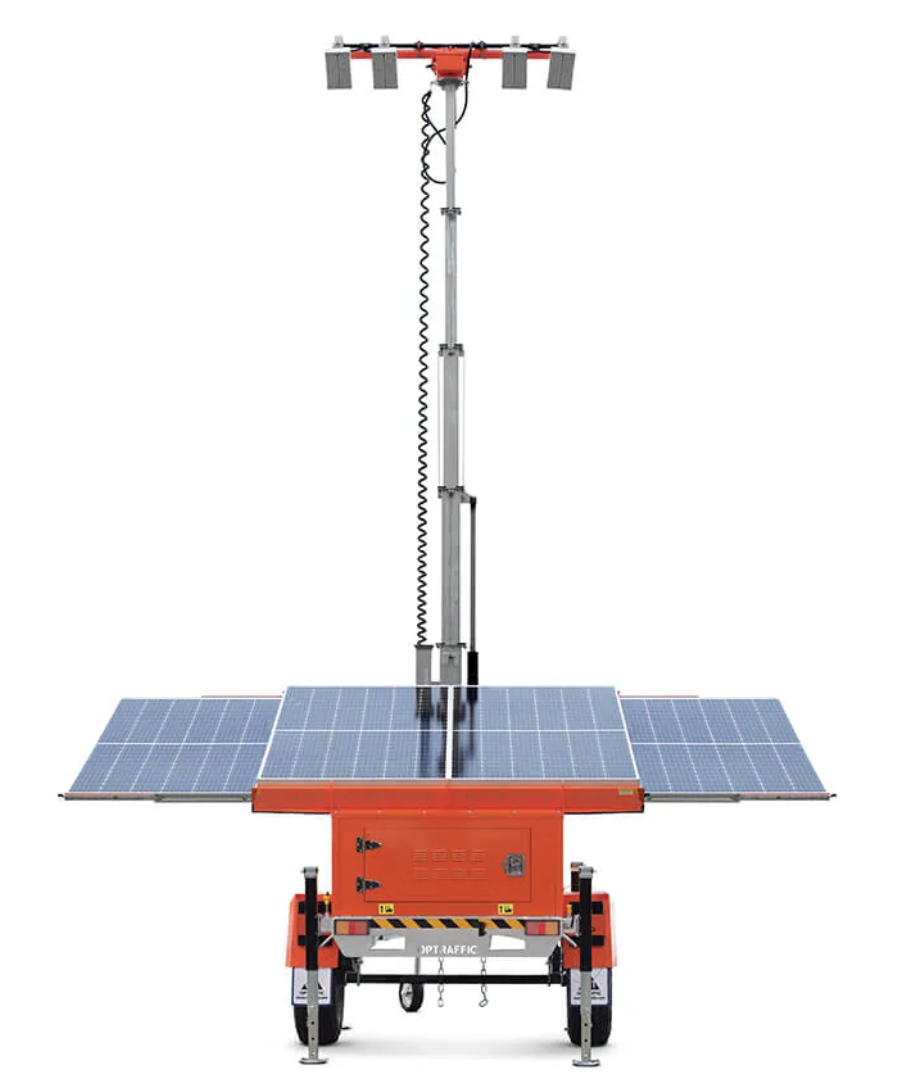
| Model | Lumens | Power | Fits best | Price |
|---|---|---|---|---|
| Mini | 30,000 | 1 × 455 W panel, 1 × 200 Ah | Flagger stations, gates, spacing along narrow strips | $4,899.99 |
| Medi200 | 30,000 | 1 × 455 W panel, 2 × 200 Ah | Same jobs as the Mini, with twice the battery | $10,599.99 |
| Medi400 | 60,000 | 2 × 455 W panels, 4 × 200 Ah | Work zones, fueling pads, yards | $12,599.00 |
| Super | 60,000 | 3 × 455 W panels, 4 × 200 Ah | Same jobs as the Medi400 through winter | $12,699.99 |
| Mega400 (hybrid) | 90,000 | 4 × 455 W panels, 4 × 200 Ah, backup diesel generator | Large yards and bridge decks with fewer towers | $14,899.99 |
| Mega600 (hybrid) | 90,000 | 4 × 455 W panels, 6 × 200 Ah, backup diesel generator | Sites that must stay lit around the clock | $15,499.99 |
Specifications and prices from ledlighting-solutions.com product pages, November 2026. All six are trailer-mounted with a telescoping mast and manual winch and are built for one-person setup. The Mini, Medi200, Medi400 and Super are fully solar; the Mega400 and Mega600 add a backup diesel generator.
A solar tower puts out less light than a large diesel tower, so a solar layout usually uses more, smaller towers. That suits linear work zones, where light spread along the job beats one bright source. For the full comparison, see solar vs. diesel light towers. If the yard needs watching after the shift rather than lighting, the Mini Pro CCTV Tower ($9,999.99) carries three 4K cameras on a 21-foot mast.
Round out the night setup with arrow boards, Type 3 barricades for closures and the rest of our work zone safety equipment. Our temporary traffic control guide covers where each device goes.
Frequently asked questions
How many light towers do I need for a construction site?
Multiply the work area in square feet by the foot-candles the task needs, divide by 0.5, then divide by one tower's lumens and round up. For example, 14,400 square feet of paving at 10 foot-candles needs about 288,000 lumens, or five 60,000-lumen towers. Then check the shape: long, narrow areas need towers spaced along their length.
What are the OSHA construction site lighting requirements?
OSHA 29 CFR 1926.56 requires at least 5 foot-candles for general construction area lighting and 3 foot-candles for areas such as excavation, concrete placement, access ways, active storage, loading platforms and refueling. Indoor corridors and exitways and tunnels need 5, shops and plants need 10, and first aid stations and offices need 30, while any work is in progress.
What are the OSHA rules for temporary lighting?
Besides the light levels in 1926.56, OSHA 1926.405 requires that lamps for general illumination be protected from accidental contact or breakage, that metal-case sockets be grounded, and that temporary lights not hang by their electric cords unless the cords and lights are designed for it. Portable lighting in wet or conductive locations must run at 12 volts or less, or 120 volts with a ground-fault circuit interrupter.
How bright should lighting be for night road work?
The MUTCD 11th Edition says an average of 5 foot-candles can be adequate for general activities, 10 foot-candles for activities around equipment, and 20 foot-candles for tasks needing high precision and extreme care. State DOT specifications may set their own levels for their projects.
What are construction site lighting requirements in lux?
One foot-candle is about 10.76 lux. OSHA's 3, 5, 10 and 30 foot-candle minimums are about 32, 54, 108 and 323 lux. The MUTCD's 20 foot-candle level for precision night work is about 215 lux.
How far apart should light towers be placed?
Divide one tower's coverage by the width of the work area. A 60,000-lumen tower covers about 3,000 square feet at 10 foot-candles, so on a 24-foot-wide work zone it covers about 125 feet of length; space towers about 120 feet apart. At 5 foot-candles the same tower covers about 250 feet of that zone.
How many lumens does a light tower put out?
Our solar light towers are rated at 30,000 lumens with two 100 W LED heads, 60,000 lumens with four, and 90,000 lumens with six. Large LED diesel towers are rated higher per trailer, which is why solar layouts usually use more, smaller towers.
Do flagger stations need lighting at night?
Yes. The MUTCD 11th Edition requires flagger stations to be illuminated at night except in emergencies. Light the station from beside the flagger and aim the light down and away from approaching drivers so the flagger is visible without glare.
- OSHA, 29 CFR 1926.56, Illumination, Table D-3
- OSHA, 29 CFR 1926.405(a)(2)(ii), temporary wiring and lighting
- FHWA, MUTCD 11th Edition, Part 6: Section 6D.06 Flagger Stations, Section 6M.08 Lighting for Night Work, Section 6N.18 Work during Nighttime Hours
- LED Lighting Solutions product specifications and prices, November 2026